



Plato’s allegory of the cave is arguably the most famous allegory in the history of philosophy. It inspired everything from George Orwell’s 1984 to The Matrix, and it illustrates the journey of the soul from ignorance toward truth.
Yet for as popular as the allegory of the cave is, most people still don’t heed its warnings. Even worse, they might think they understand it, while continuing to make the same mistakes the allegory warns against.
So how do you know if you really get it? How do you know if you’ve actually escaped the cave, or if you’re still trapped inside it, mistaking lies for the truth?
Today, we look at one of the most relevant examples of Plato’s cave in our modern culture. But unlike the dystopia of 1984, this isn’t a cave people are trapped in against their will — rather, it’s one most gladly choose to remain inside, willfully foregoing the truth and beauty that awaits them just beyond the shadows…
Plato Read-Along… LAST CALL TO JOIN!
Our slow read of the Republic is about to begin on our sister publication, the Ascend Book Club!

We start next week. See bottom of this email for details (+ a discount)…
Shadows on the Wall
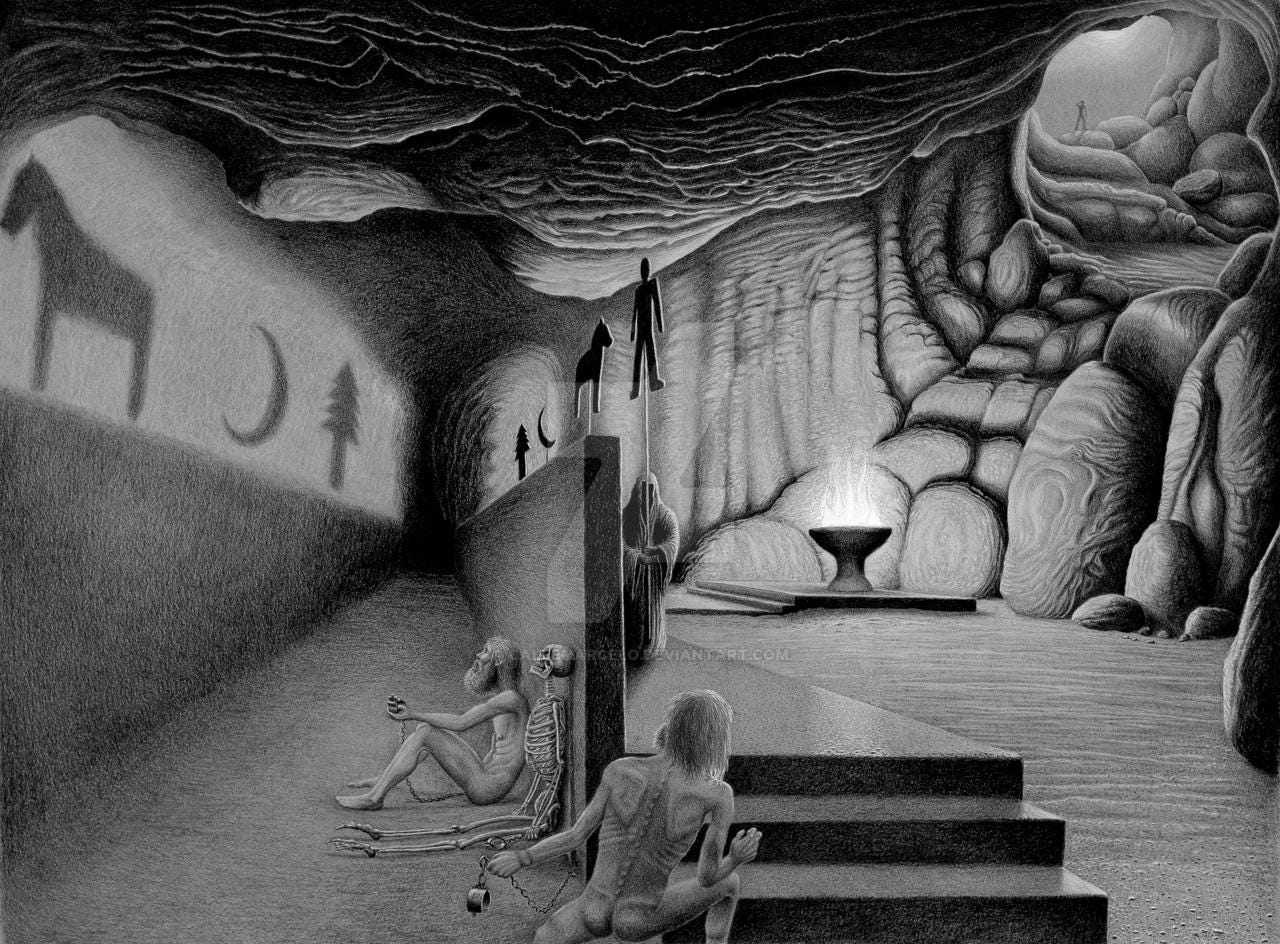
But first, let’s quickly recap the actual allegory itself. In Book VII of Plato’s Republic, the character of Socrates asks you to imagine prisoners who have spent their entire lives shackled inside a cave. They are able to look only at the wall in front of them, and behind them burns a fire. Between that fire and the prisoners, people pass back and forth, carrying puppets and other objects while speaking.
The fire casts the shadows of these objects onto the wall, and the voices of those who carry them echo throughout the cave. Having never seen the people or objects behind them, and not having known any other world, the prisoners believe that these shadows and voices are reality itself.
Socrates suggests that if a prisoner were forcibly removed from this cave, he would be painfully blinded by the sunlight outside. Reasonably, he’d want nothing more than to go back inside the cave because it’s comfortable — the only world he’s ever known. But if the prisoner were introduced to the light of day slowly, he’d eventually adjust to it without shock, and come to appreciate the unveiled reality of the outside world for what it is. Indeed, he’d soon grow dissatisfied with the shadowed life he had known before, seeing it now for what it really is.
The 21st Century Illusion
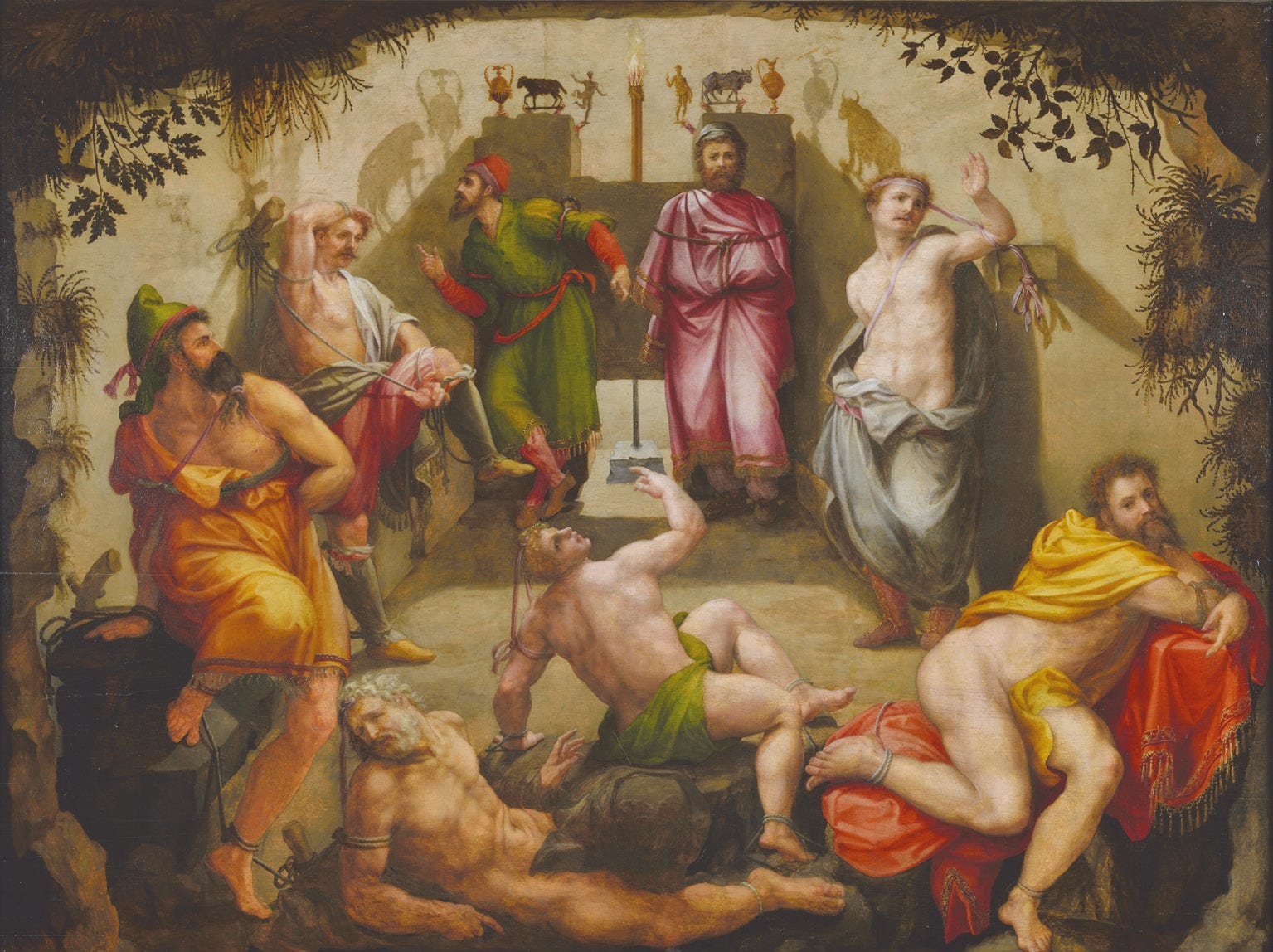
But what does Plato’s cave look like for us today? Historically, the allegory has been used to describe dystopian worlds in which shadows of reality are impressed upon the public against their will: think Fahrenheit 451, 1984, etc. In our modern world, however, the danger is quite the opposite: that the public, preferring the comforts of the cave to reality, chooses to impress shadows of reality upon themselves.
Social media is the prime and most immediate example. Rather than showing you a chronological timeline of posts from the people you follow, social media algorithms are mathematically designed to show you more of the content you are already interested in seeing. At first glance, this doesn’t seem all that bad — if you’re renovating your kitchen, coming across videos of others who are doing the same can provide some useful insight.
The real danger, however, is subtle. If you’re seeking parenting advice, the algorithm doesn’t actually expose you to diverse ideas about parenting. Instead, it presents you almost exclusively with the strands of advice that confirm and justify your preconceived notions. The more people go down these paths, the more their vision of reality becomes progressively narrower. They begin to think their way is the only way, that their ideas are more widespread than they really are. Or, in other words, they begin to think the shadows on the cave wall are what constitute reality.
At least, that’s the argument critics make. But how much of what they say is really fair? Are modern-day algorithms really that bad, or is the allegory of the cave misapplied here?
The Comfort of the Cave
It’s natural, of course, for human beings to seek like-minded friends with whom to share discussions, hobbies, and interests. From book clubs to local pubs, enthusiasts of everything from Anna Karenina to Arsenal Football Club have always gathered together to be surrounded by their own kind.
But there’s a critical difference between a world you build for yourself in choosing a handful of interests out of many, and a world you build for yourself in which all you ever see are your own interests. Consider, too, the implications of what happens when the scope of your worldview consists almost exclusively not only of your favorite pastimes, but also of ideas about core values, human worth, politics, and societal ideologies.
In Plato’s cave, the prisoners are so engrossed by the shadowy images before them that they fail to look both at themselves and at their fellow prisoners shackled beside them. In the same way, algorithmic social media risks robbing you of introspection and of relationships with those closest to you. At the same time, it also makes it so that the world “out there” feels increasingly foreign — indeed, even painfully blinding — the more time you spend online.
As Plato’s allegory reveals, the cave becomes increasingly comfortable the more time you spend inside it. The light of truth becomes more harsh on the eyes, and you become more reluctant to face all that comes with the freedom of the outdoors: different ideas, beliefs, points of view, etc. The good news, however, is that you can leave the cave. You’re not actually shackled to the wall. Mind-forged manacles are all that hold you in place, and they can be readily unlocked by the key of conscience.
The world outside the cave, Socrates warns, is not an easy one. It is, however, the true one. Are you prepared to see it for what it really is?
Read Plato With Us — LAST CALL TO JOIN
We are about to begin our slow, attentive read-along of the Republic on our sister publication, the Ascend Book Club. We kick off next week.
If you’re ready to have some of your deepest assumptions about justice, freedom, politics, education, and the good life overturned, there’s far more to Plato’s Republic than the allegory of the cave. A close, careful read of this will change your life.

To celebrate the start of the read-along, Ascend is running a 24-hour discount.
20% off full book club membership:
We've been working on this for over a year: a week-by-week curriculum, gathering 20+ scholars and 30+ episodes to guide you through it. We start on October 6 and end on August 31, 2027 (with a break for Lent). To see the full reading schedule, click here.
All paid members of Ascend will gather once per month for the live discussions, hosted by Dcn. Garlick and guest scholars. Along the way, there’ll be plenty of discussion inside the Ascend chat room, so please join the dialogue!
We are so excited to get started. Here are just some of the scholars joining us between now and Christmas:

First up, some key questions:
Why should we read Plato?
How are we supposed to read his dialogues?
Why is the drama important?
What is the Socratic method?
Why is it said that all of Western philosophy is but a footnote to Plato?
Yesterday, we posted this podcast on Ascend to address these questions and more before we get started…
Join our group for this epic read-along by becoming a subscriber of Ascend here:
In addition to the weekly podcast, Ascend subscribers get:
Live book club discussions with Dcn. Garlick & guest scholars (monthly)
In-depth reading guides and essays to lead you through the great books
Access to the incredible community of readers
The full archive of members-only content (guides, essays, and podcasts)
Note: nothing is changing here on The Culturist. Our own book club continues to function as usual. Don’t forget, our next session on Dostoevsky’s “The Idiot” is on October 7, at noon Eastern Time.
What a great allegory! Social media is the cave.
Reminds me somewhat of Exodus. The comfort of slavery vs the freedom in the desert / wilderness.