


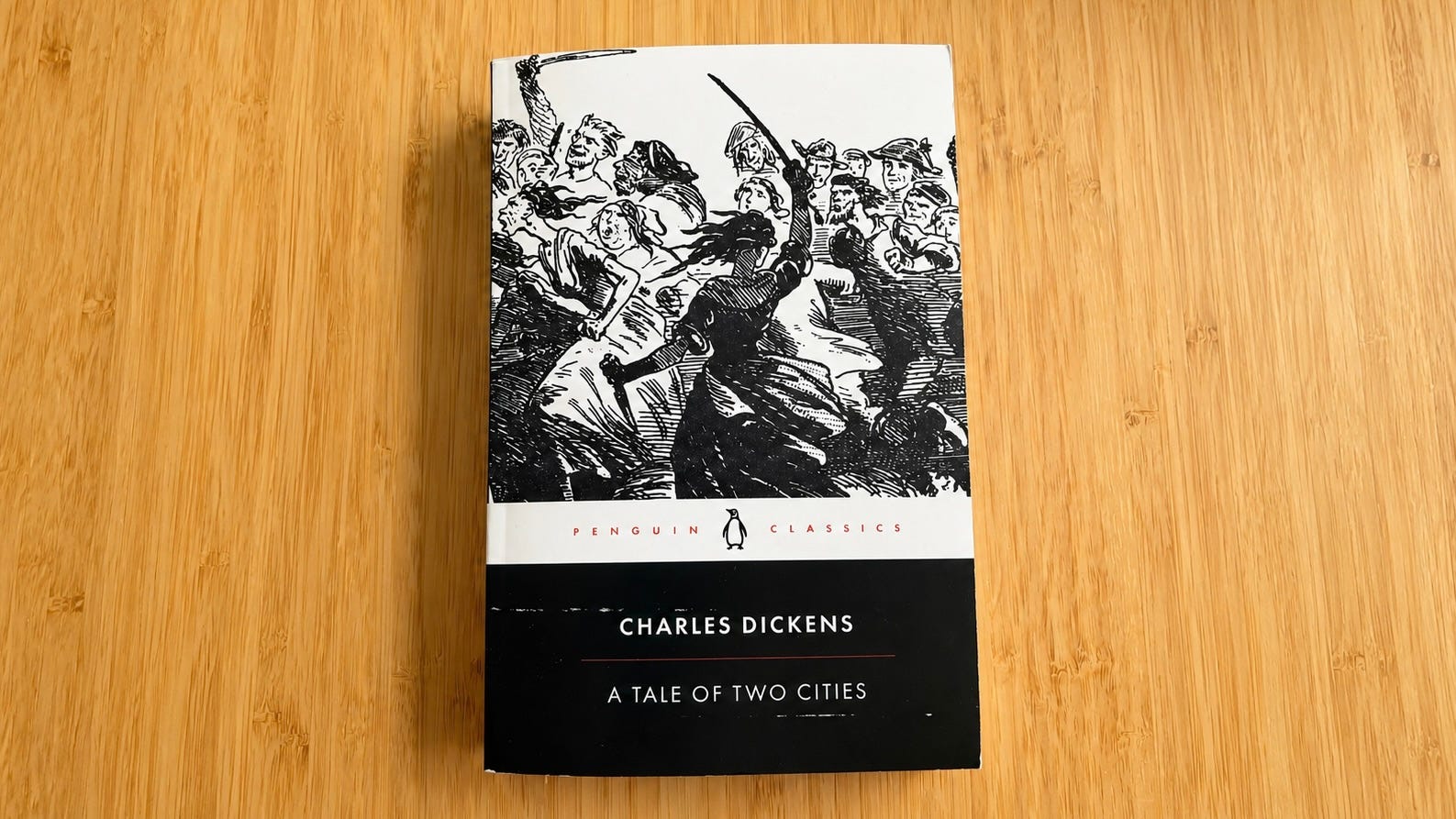
Hello, book club!
It’s another beautiful week… We have our second discussion on A Tale of Two Cities. If you missed the first one, we highly recommend watching the recording here.
We meet on November 18 at noon ET. We’ll be discussing Book 2 chp. 19–24 + Book 3. The discussion will be livestreamed via Substack at this link.
For those joining our discussion group directly (available to all paid members), the Zoom link is at the bottom of this email…
So, here are some key ideas for us to ponder ahead of the next discussion…
You can join our pilgrimage through the Great Books by taking out a membership here:
As a full member of our book club, you’ll get:
Live book club discussions (biweekly) and recordings
Weekly discussion threads like this one to guide the reading
Access to our incredible community chat
Our entire library of resources, essays, and articles
If you’re wondering how the book club works, check out this page:

A Nation Buried Alive…
Recall the main themes of the book thus far: the “best of times, worst of times” age, a man recalled to life, and the gathering of a figurative storm in pre-revolutionary France. In short, Dickens has been building a steady tension that is about to erupt.
If the first half of the book’s focus was on whether or not a man can be “recalled to life” after years of suffering, this book raises the scope from the individual to the societal:
What does it mean for a nation to be buried alive for generations? Can said nation ever be resurrected/redeemed, and if so, what does such a redemption entail?
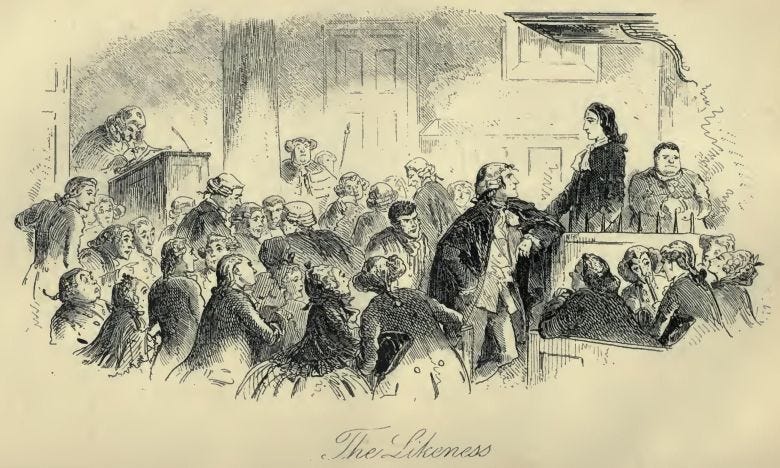
The city of Paris in particular draws our focus to these questions. Dickens — in the genre of romanticized historical fiction — used the Evremonde brothers (the Marquis and his brother, Darnay’s father) to emphasize how the vicious aristocracy of the old regime led to oppression and disenfranchisement among the people. The Manettes and the Defarges are the two main families we follow who are victims of this oppression. Both desire justice, but seek drastically different means:
Dr. Manette, imprisoned for 18 years by the old regime, maintains a sense of civility, propriety, and forgiveness as mediated through the loving caress of his daughter Lucie. The Defarges, however, seek unapologetic eye-for-an-eye bloodshed.
The great irony is that Dr. Manette was the greater victim, and yet his forgiving nature recalls him to life. The Defarges, however, become increasingly brutal as the Revolution’s bloody outcries demand further bloodshed. As the novel progresses, the Defarges begin to mirror the viciousness of the very old regime they despise.
Thus, the Defarges’ vengeance proves too extreme, the Manettes’ forgiveness gracious, but perhaps insufficient — as their humility is not enough to stop the cycle of bloodshed raging through France.
How, then, can this vicious cycle be thwarted? The solution, if one is to be found, lies in the lowliest of this novel’s characters...
Sydney Carton, remember, is a brilliant, talented man who wasted his life on idleness and alcoholism. He’s not a victim of the French regime like the Manettes, nor is he a perpetrator in its violence like the Defarges, and yet he increasingly finds himself moved toward the center of this novel’s conflict — growing further emboldened through the eyes of his beloved Lucie, which inspire a long-lost vitality in his soul.
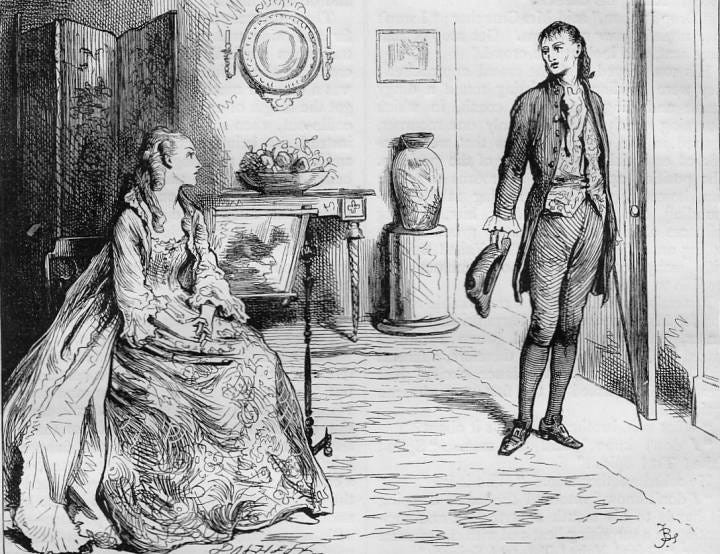
Indeed, soon the Revolution will bring us to the darkest hour of this book, and all eyes will turn upon the one man who perhaps most discerns the light of life within a maelstrom of revolutionary violence…
Below are some key questions to consider:
First, ponder Dickens’ portrayal of the Revolution itself. Is he entirely sympathetic to the revolutionaries, or does he critique their violent means? Consider also the nature of the Evremondes and Charles Darnay, who represent the old regime in France. Is their portrayal complex and nuanced, or simplified? Why would Dickens portray them as such?
Next, compare the Defarges’ brand of vigilante justice with the Manettes’ world of moral restraint. Is either account perfect, or flawed? Does each side possess something the other is lacking? What does this dichotomy suggest about the nature of justice in relation to civilizational vices?
The book’s opening theme was being “recalled to life.” How does that theme redevelop and mature by the novel’s conclusion? Who or what is finally “resurrected”?
Ponder the nature of Sydney Carton’s role in this half of the novel. Why does a figure who has nothing to gain or lose through the French Revolution suddenly become a central figure?
The famous opening paradoxes returned us to the tension of the age — the best and worst of times. In light of this novel’s entire arc, were these truly the best of times, the worst of times, or both? Why?
Please share your thoughts below or in the subscriber chat, along with any questions you have — and we’ll incorporate them into Wednesday’s discussion!
I sure hope so...
I've read all of Dickens novels except the posthumous ones. He's given me so much joy and comfort. I can remember where I was sitting and what I was doing when I curled up to read these amazing novels of his. I was an English major in college but we didn't read Dickens because he was considered too pedestrian but he's not pedestrian at all; just like in art history we studied artists but we didn't study Norman Rockwell. I love Dickens for many reasons including that his characters have so much Humanity, so much love and so much compassion.