

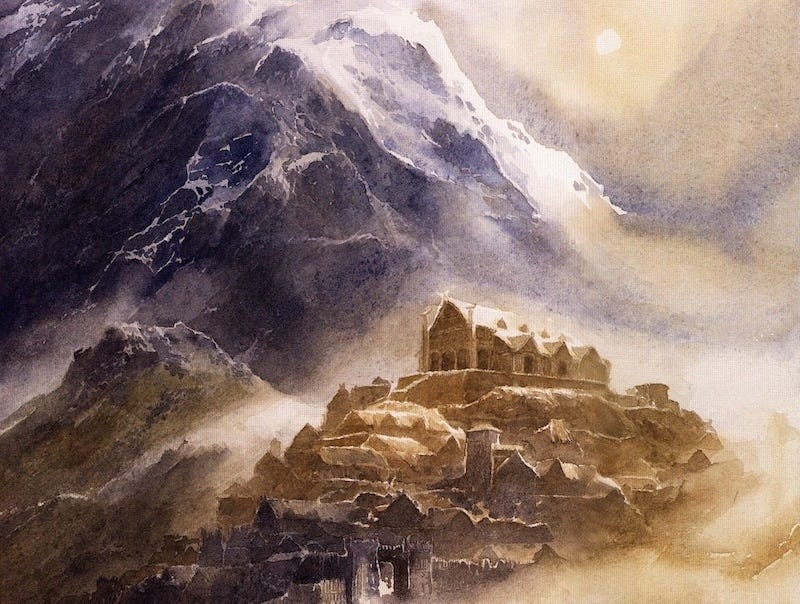
We often think of antiquity and the medieval age as ages of “enchantment.”
Those were times of pervasive wonder, when people perceived the world as intermingling with strange and supernatural forces. In their world, human participation was of deep significance, and their actions imbued with a sense of meaning and adventure.
By contrast, human activity in the modern world only has meaning if it can be rationally argued for (if it passes a kind of cost-benefit analysis), and the physical world can be fully understood in rational terms. In this “disenchanted” age, it’s common to hear calls for “re-enchantment,” for us to somehow put magic and mystery back into everyday life — but how?
Fantasy writers C.S. Lewis and J.R.R. Tolkien are often seen as revolutionaries of this re-enchantment through literature. But when Lewis wrote The Lion, the Witch and the Wardrobe, he dedicated it to a young girl named Lucy Barfield. Lucy was the daughter of Owen Barfield, a philosopher and writer who was perhaps Lewis’s single greatest influence.
Before any of Lewis’s or Tolkien’s fantasy novels were penned, Barfield had produced an astounding idea that breathed new life into the literary world.
Barfield argued that the enchantment of past societies was actually a different stage of human consciousness — one that he could demonstrate, and in time, would be reclaimed once more.
Because although modern humans have evolved away from this ancient mindset, we are also arching back toward a new age of enchantment…
Thank you for reading! If you’d like to support our work, please consider taking out a paid subscription — it helps us enormously. Plus, you’ll get:
New, full-length articles 2x per week
The entire archive of content (180+ articles, essays, and podcasts)
Membership to our biweekly book club (and community of readers)
We have just voted to read Plato’s Republic in our book club for January. The first discussion is on January 14, at noon ET — don’t miss it!
Winds and Spirits
Barfield is best known for developing his idea of the evolution of consciousness. Across a number of published works, such as Poetic Diction and Saving the Appearances, he demonstrated how ancient peoples had an entirely different relationship with the world.
Take his example of the following passage in John’s Gospel (per the King James translation), in which we find three similar yet distinct words: “Spirit,” “spirit,” and “wind.”
Jesus answered, “Verily, verily, I say unto thee, Except a man be born of water and of the Spirit, he cannot enter into the kingdom of God. That which is born of the flesh is flesh; and that which is born of the Spirit is spirit… The wind bloweth where it listeth, and thou hearest the sound thereof, but canst not tell whence it cometh, and whither it goeth: so is every one that is born of the Spirit.”
– John 3:5-8
It’s eye-opening to learn that these three words were translated by King James’s scribes from only one Greek word: “πνεύμα” (pneuma)! Pneuma means all three modern interpretations at once, as well as “breath”. The ancients’ experience of pneuma was simultaneously the wind that can be felt by the senses, and the spirit that cannot.
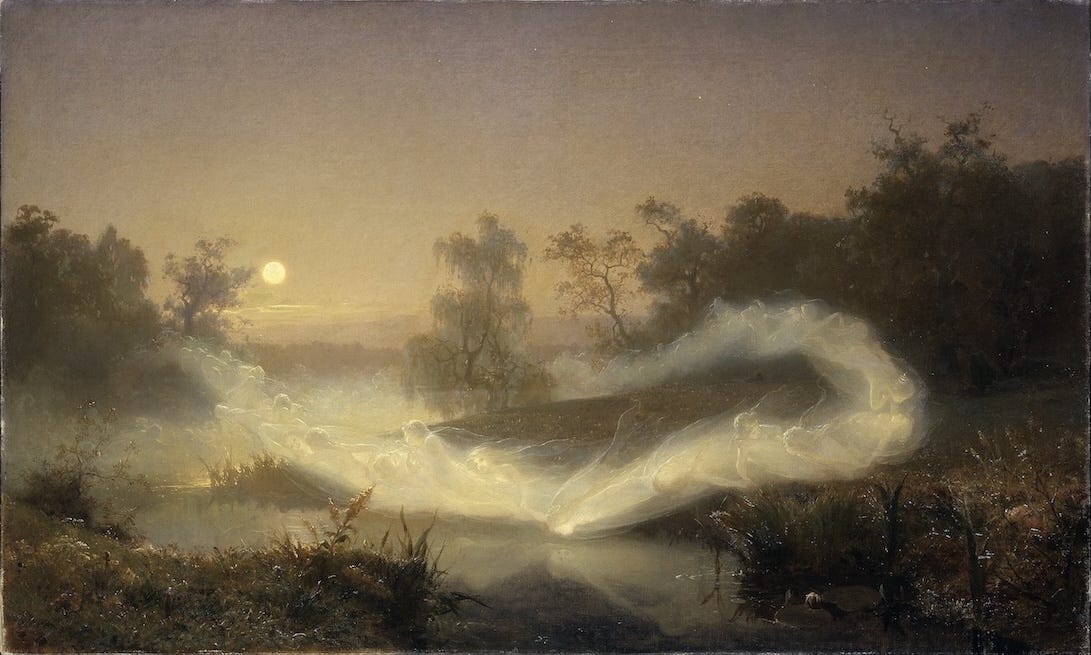
According to Barfield, the New Testament was written closer to a time when ancient man identified what was within his own mind as indistinguishable from his surroundings — his thoughts about things were not differentiated from the things themselves. He did not passively observe nature, but was actively involved in its very structure.
In Barfield’s nomenclature, this is called “Original Participation”. A tree or a storm wasn’t just an external thing, but something with its own inner life that connected directly, without barriers, to the person experiencing it. The human spirit was never disentangled from the wind, and this produced an enchanted and unified relationship with the natural world.
The Disenchantment of History
Barfield read the next 2,000 years of history as a gradual evolution away from this mode of consciousness. Humans now perceive that we are entirely separate from nature, which we understand as a set of “dead” objects with which we interact. Instead of something that meaning is inherently a part of, nature is something we project meaning onto.
Things like pneuma were once felt and immediately recognized through a pre-conscious process that produces our perceptions of things. Meaning was drawn from nature as we breathe the air. Now, external stimuli are received and then represented by our modern minds (say it slowly: “re-presented”) as either objective things (breath and wind) or subjective things (spirit and soul).
Ancient man never distinguished between these two categories, and the result was that his connection with nature was richer and his life was charged with meaning.

Without stepping too far into the details of this transition, Barfield asserts that human consciousness evolved into a state of heightened self-awareness. He points to monotheism and bans on idol worship (images treated as though they have an inner life) as revolutionary steps in this evolution, sharpening the distinction between humanity and the world/God.
So then, practically speaking, how can we begin to participate fully in the world again?
Fortunately, Barfield proposes a fascinating solution. Unfortunately, the way forward is not easy, nor is it simply a return to the way things were before…