

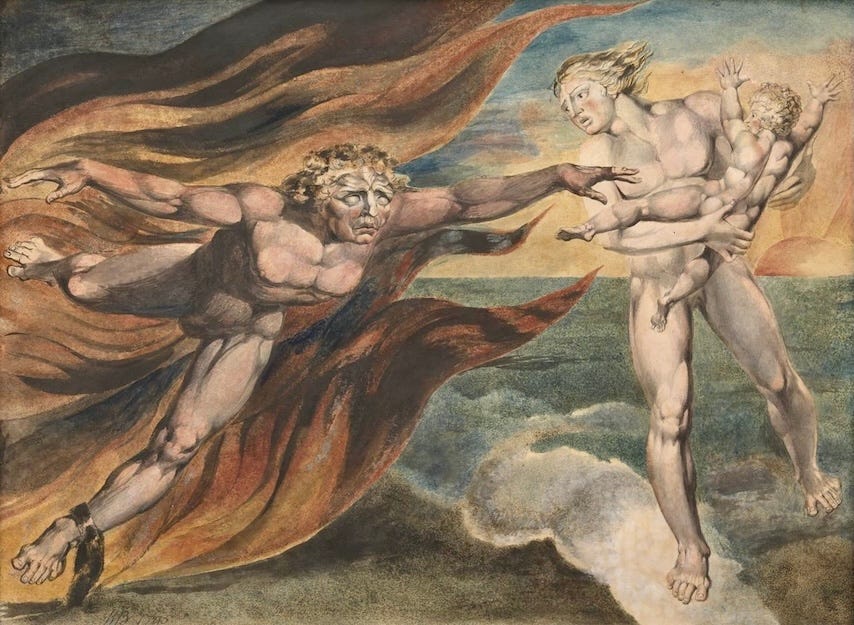
Imagine if people in hell could take a bus ride to heaven. You might think that sounds somewhat cruel, but what if the visitors could stay if they wanted to?
And what if almost all of them chose to return to hell afterwards?
In his lesser-known masterpiece, The Great Divorce, C.S. Lewis uses a busload of visitors from hell to peel back the layers of human choice. It’s not a tale about the actual afterlife, but rather, a parable about why people choose evil over good.
And yet, one of the greatest lessons of The Great Divorce is not demonstrated by a choice at all — but by the blades of grass in heaven.
Lewis takes a deceptively simple story and uses it to demonstrate a profound theological idea: that the choices we make shape the very reality (or unreality) of who we are…
Thank you so much for reading this year! If you’d like to support our work, please consider taking out a paid subscription — it helps us out enormously. Plus, you’ll get:
Full-length articles 2x per week
The entire archive of content (150+ articles, essays, and podcasts)
Membership to our biweekly book club (and community of readers)
We have just voted to read Beowulf, the foundational epic in the English language, in our book club. The first meeting is Wednesday, December 17, noon ET — join us!
A Bus Ride to Heaven
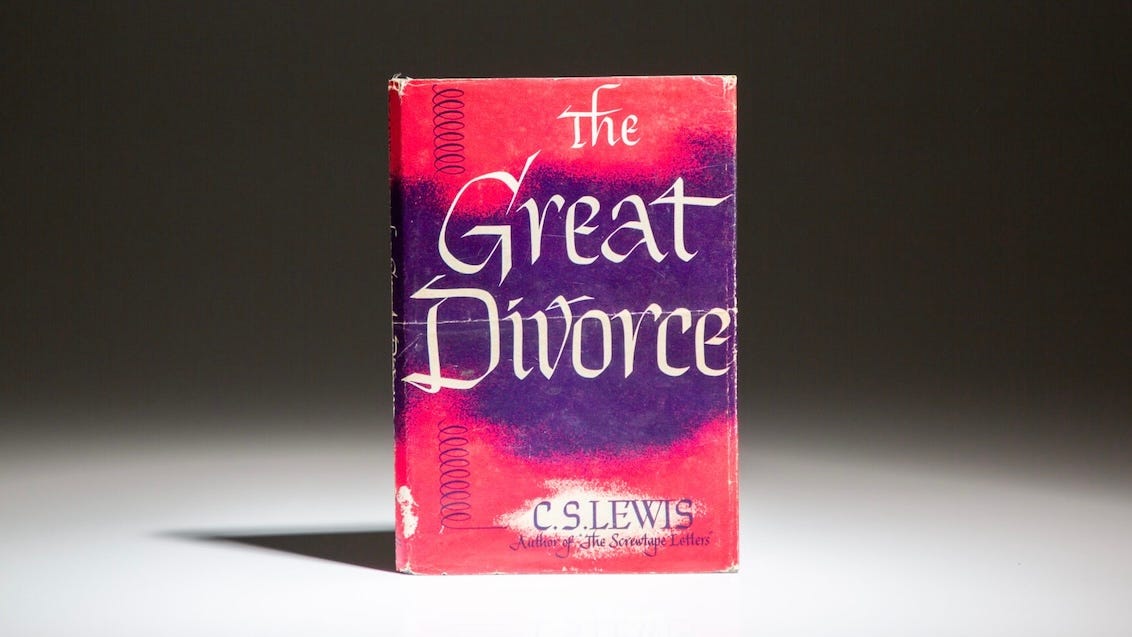
When the visitors from hell disembark the bus and enter into heaven, they notice something peculiar: they are transparent. Lewis describes them like a smudge on a window, or a living shadow. In contrast, the heaven around them is brilliant in color and lucidity, and very much solid.
The shades attempt to walk among this celestial garden, but soon find that it hurts them to do so. They cannot so much as bend the grass or disturb the dew drops, as they have no weight or substance; instead, the grass bends them, like a thousand diamond spikes digging into their feet. They cannot pick up apples or bathe in the inviting river, but a falling leaf or swaying branch could easily crush them.
Lewis presents a deeply strange contrast, but what is he trying to imply about good and evil?
The Nature of Evil
You may think of good and evil as equal opposites, or two distinct forces in an endless spiritual war, as many people do. Lewis, however, asserted that good and evil are far from equals — in fact, evil is not real.
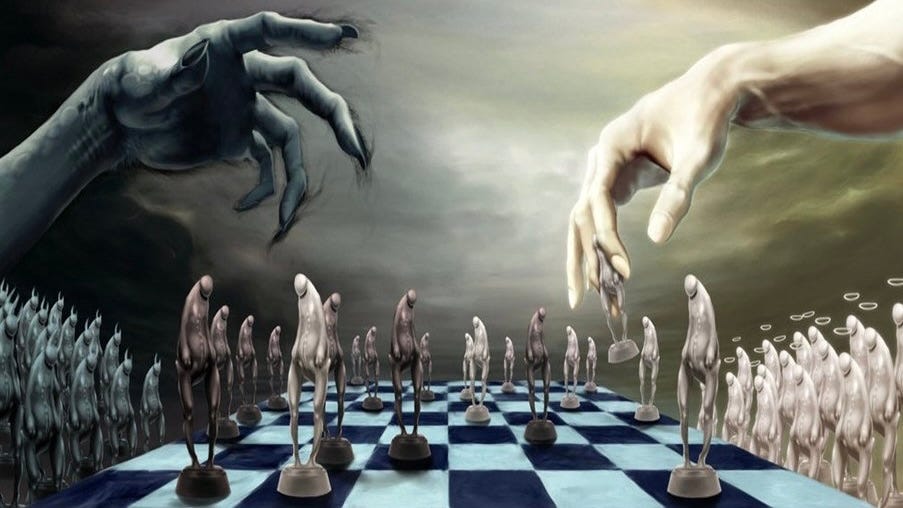
You might push back here by pointing out that evil must be real in some manner, because it is intelligible — you can know it. It has a name. But Lewis encourages us to think of it this way instead: evil is real in the same sense that a hole in the ground is real. It is an absence.
In the 13th century, Thomas Aquinas taught that “evil is the privation of the good,” drawing from the Neoplatonic tradition. In other words, evil is an absence; like darkness to light or cold to heat. Lewis demonstrates this by having the citizens of hell appear less real than even a single blade of heavenly grass.
Just as all the darkness of the cosmos could not snuff out a single candle flame, so too would all of hell struggle to move a single blade of grass in heaven. Evil is a privation, an unreality.
But if the visitors from hell aren’t real, you might ask, how do they exist at all?
What Is Good?
A hole in the ground is only a hole because the ground exists. Without the ground, a hole simply could not exist — it cannot exist on its own.
Evil exists in much the same way: nothing can be purely evil, because if it was, it would not exist. Put simply, the good is real, and evil is unreal. To the degree that something is evil, it is also unreal, for it suffers a kind of privation.
Nothing then, according to Lewis, can be purely evil — not even Satan himself. In Christian theology, Satan is a creature of God, and all that God has made is good. Creation is inherently good and God does not make evil, but through free will, a being can embrace evil and become something less than what God had intended. The true purpose of free will, then, is to choose the good and participate in what is real.
Lewis demonstrates this by allowing his visitors to stay in heaven should they choose, and by staying, they slowly become more solid. In other words, even as a damned soul in hell, they exist; and there is still some good that can be cultivated.
In Christian doctrine, souls cannot leave hell to visit heaven, and they certainly cannot stay. But much like Dante in his Divine Comedy, Lewis is not presenting a story to articulate the details of heaven and hell — it’s to show why humans choose evil over the good, and a large part of understanding that choice is knowing the difference between the two.
Reality or Unreality?
The simple lesson of The Great Divorce is to see moral choices for what they really are. They are not, as many suppose, about adhering to a list of arbitrary, cosmic rules. Instead, they are about shaping the very reality (or unreality) of who you are.
Every time you choose pride, resentment, or lust, you are choosing to become less real. You are thinning yourself out.
Every time you choose humility, gratitude, or love, you are choosing to become more real, or more fully the person you were meant to be.
Why? Because these are the things, says Lewis, that align with the ultimate reality…
If you’re interested in reading more articles like this one, check out our new sister publication, The Ascent.
There, we are diving deeper into theology, mysticism, and ancient texts. You’ll get one free article every Tuesday, and longer essays every Friday for paid readers.
The Ascent is currently running a 48-hour discount — 25% off the full publication.
As a bit of a Tolkien scholar, I always love seeing where his thoughts align with Lewis. Reading this (and I absolutely love “The Great Divorce,” by the way), I was reminded of Tolkien’s orcs, how they were once fair elves, but evil twisted them into something lesser. The same goes for the One Ring - the longer one has it, the lesser one feels. Bilbo feels thin, like “butter scraped over too much bread” (Fellowship). So interesting… great article!!
I especially like this insight: "Evil is real in the same sense that a hole in the ground is real. It is an absence. In the 13th century, Thomas Aquinas taught that 'evil is the privation of the good'.” It is the Divine design, thanks to the gift of free will – life is pleasant when we choose wisely and harsh when we choose foolishly.