



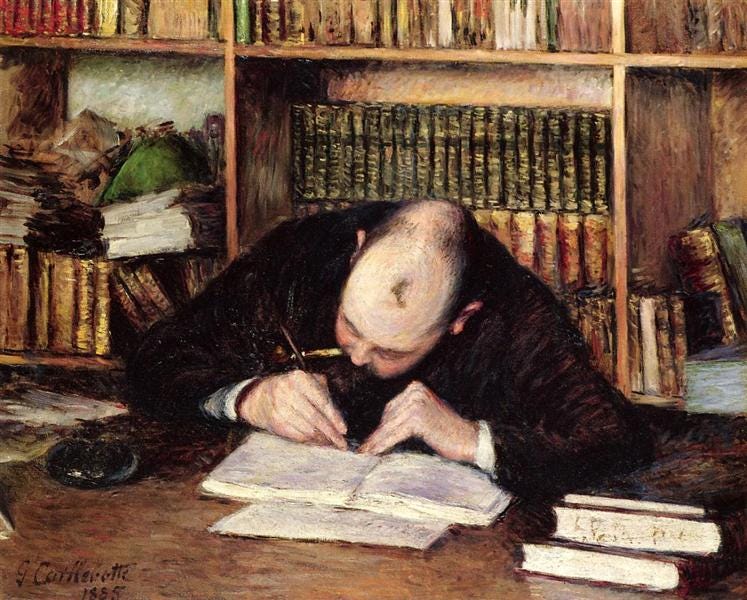
Che cosa faccio? Scrivo.
-Rodolfo, La Bohème
When I was young, I often dreamt of becoming an author. It is a romanticized career if there ever were one: still to this day, the image of the pipe-smoking Oxford don alone with his pen, writing stories to enthrall the world, remains one of the classic images of the “author” that prevails in the public consciousness.
But while to be an author is one thing, to be a writer is quite another. In fact, thanks to platforms like Substack, it is a more realistic and accessible career than ever before. Because even if you can’t make money selling your poetry and novels, you can certainly earn a living sharing your insight and knowledge.
Thanks to a few lucky breaks and unexpected twists of fate, I now find myself in the category of the latter. Although I never introduce myself as a “writer”, objectively speaking I am one: thanks to the incredible readers of publications like this one, I’m able to earn a living from the written word.
Recently, I was asked how I became a writer, and my answer to that question serves as the inspiration for today’s article. To be clear, I don’t profess by any means to be the next Dante or Dostoevsky (although I would like to pen an epic poem one day). However, I do believe there are certain principles to follow in order to improve your writing, no matter how advanced you are or what kind of literature you want to write.
Those four principles are what we explore today. They are what have helped me most in my own journey to become a full-time writer, and it is my hope they can help you as well…
Reminder: this is a teaser of our paid subscriber essays.
If you’d like to support our work, please consider a subscription. You’ll get:
New, full-length articles 2x per week
The entire archive of content (200+ articles, essays, and podcasts)
We’re currently reading Homer’s Odyssey in the book club. The next discussion is on Wednesday, July 1, at noon ET — join us!
1. Take It All In
A few weeks ago I wrote about how to learn a language, and many of the lessons from that article can be applied to becoming a writer as well. Chief among them, however, is input: get as much exposure to the written word as you possibly can.
Begin by reading as much as possible, and in different genres. Needless to say (hopefully), reading tweets on X doesn’t count. You should instead be reading things written with craft in mind, whether a poem or a persuasive article.
Of course, the classics are often the best place to begin, precisely because the passage of time has confirmed the merit of their message and the art of their prose. This is especially true of classics written in your native language, as translations often fail to capture the full beauty of foreign writing. For English speakers, the non plus ultra will forever remain Shakespeare, who, despite being the most famous playwright in the English language, is still underrated (you read that correctly) in regards to his vivid poetic imagery, clever wordplay, and masterful turns of phrase.1

By reading a wide range of authors and genres, you’ll be able to pull from different forms and incorporate them into your own writing. Dialog, journalism, prose, and poetry all have some role to play, and you must read them all in order to become familiar with their unique strengths and intricacies.
2. Study the Science, Get the Reps
Literary input provides the raw material for your personal style in writing. Like most raw materials, however, that input must be refined and crafted into a final product.
The second step, then, to improve as a writer is to study the science of writing. Take a look at common rhetorical formulas and begin implementing them in your work. You’ll naturally come across these when you read famous speeches or popular passages of literature, but to study them intentionally will drastically speed up your progress.
The Elements of Eloquence by Mark Forsyth is one book which outlines the most popular rhetorical forms and how to implement them. It covers everything from alliteration to polyptoton, hendiadys, epistrophe, and more. Once you learn why these rhetorical flourishes give phrases like “Bond, James Bond” or “Shall I compare thee to a summer’s day?” their power, you’ll be able to implement similarly effective turns of phrase into your own writing.
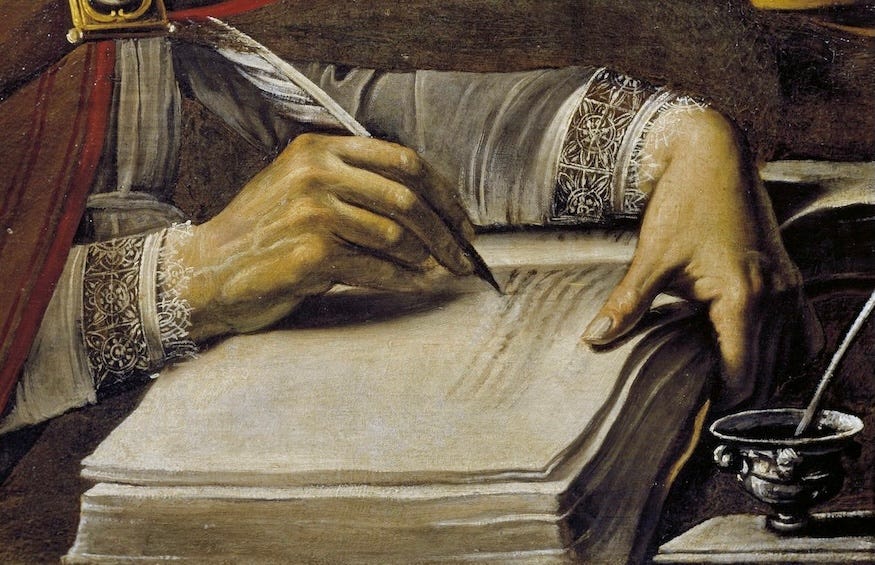
If you want to make some money while you hone your craft, consider becoming a marketing copywriter. The art of (good) copywriting is much harder than it seems, since it requires that you pack important information into simultaneously short, digestible, and memorable phrases.
Admittedly, many now outsource their marketing copy to AI, which means there are fewer opportunities for you to start with this. But copywriting used to be the trial-by-fire for writers for good reason, and it played a major role in my own journey. Before AI threads took over Twitter, for example, I was able to amass millions of views from well-written hooks. Now, however, people are distrustful of posts that read like AI, even though they would have been celebrated as “great copy” just two years ago.
We will look at what it means to write as a human in the AI era later in this article, but first we need to look at the one thing that changed my writing more than any other.
Because for all the time I had spent reading and writing, it wasn’t until I mastered the art of clarity that my writing truly began to take off…