



This is a guest essay from our friends at Cosmos Institute, who write regularly on philosophy, AI, and what it means to live well in the technological future.
Mary Shelley learned to read by tracing the letters of her mother’s name on a gravestone. Behind London’s St. Pancras Old Church, the young girl would run her fingers over the markings: “Mary Wollstonecraft,” the writer, philosopher, and women’s suffrage campaigner who died giving birth to her. Raised by her father William Godwin, Shelley’s childhood was marked by radical ideas at the dinner table, the tensions of a complicated family life, and a taste for the eerie that she harbored from her earliest years.
In 1816, at just eighteen, she accompanied the poet Percy Shelley to a Lake Geneva villa where Lord Byron, the celebrity poet who had just fled England in disgrace, had gathered a small circle of friends. Volcanic ash from Mount Tambora had blocked out the sun, so they resolved to stay indoors to write ghost stories. Carrying with her a fascination with experiments showing dead creatures twitching in response to electric charge, Mary wondered what it might be like to be switched on rather than born.
Her story, Frankenstein, took this idea to its logical conclusion. If the scientific showmanship of the day could produce a being through technical wizardry, then the fruits of this creation would exist as a child without childhood. For someone who never met her own mother, a book about life without formation seemed like a fitting project.
Frankenstein; or, The Reluctant Parent
Frankenstein is often read as a tale of hubris, a story about man’s reach exceeding his grasp. That interpretation is true enough. But Frankenstein is less about the audacity of creating life than about the catastrophe of abandoning it. Shelley imagines a creator, Victor Frankenstein, who refuses to become a parent as much as she imagines a man who wants to play God.
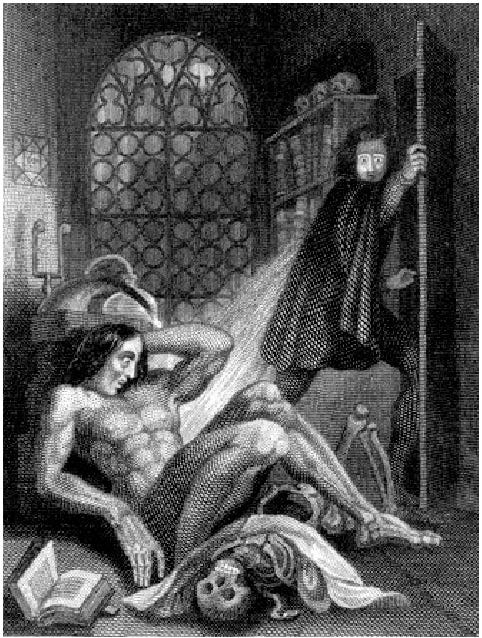
Victor Frankenstein scavenges body parts from graveyards, stitches them into a single form, and uses lightning to force life into dead flesh. The creature stirs. Its “dull yellow eye” opens, watery and unnatural, barely distinguishable from the pale socket that holds it. In that instant, the beauty Victor imagined gives way to something grotesque and terrifying. He flees his laboratory, abandoning what he has brought into the world.
The creature awakens raw and unformed, as all beings do. But he receives no care, no guidance, and no language from his creator. He must learn everything alone. He flees into the countryside and eventually finds refuge near a cottage. Unable to reveal himself, he begins to watch the family who lives there from the shadows.
His education comes entirely from observation. He hears the family read Milton, figures out how to speak, and begins to understand human language and sentiment. Yet it is an education wholly detached from participation. He is exposed to Paradise Lost, one of the most morally complex works in English literature, without any framework for understanding it. He identifies with Satan, the rejected creation who rebels against his maker, because his own experience gives him no other lens through which to read. He studies humans like a natural historian observing specimens, never entering the experiment proper.
When he finally reveals himself to the family, the creature discovers that seeing humanity from the outside is not the same as being seen as human. He is chased away. Rejected and alone, he turns to violence, murdering those closest to Victor: his younger brother, his best friend, his bride. The creature has learned moral language but cannot turn it into moral being. He becomes, instead, an articulate monster.
This is a failure of formation. The creature never receives what Adam Smith understood to be essential for moral development: the chance to participate in the lives of others, to be seen and corrected, to practice sympathy through actual relationships rather than distant observation.
For Smith, moral sense begins in the particular — in “feeling with” the person in front of us. Sympathizing with those closest to us becomes a practice ground for judgment, and from this foundation we gradually extend our moral concern outward.
But this process requires participation. The flow of contextual information we receive from face-to-face interaction teaches us to read genuine emotion and respond appropriately. We learn through rupture and repair: we hurt someone, see the damage, and learn to mend it. Character develops through being implicated in the lives of others, through the consequences of our actions on people we care about. Moral life begins in the nursery and only later aspires to the public square.
The creature has none of this. He gathers impressions without ever being implicated in them. He accumulates knowledge of sympathy’s language but none of its practice. Intelligence without formation produces monstrosity.
The creature’s predicament is the predicament of childhood itself. He must act in the world before he possesses the internal authority to determine how. Every child occupies this condition. The crime is refusing to stand beside them.
The Sovereign Child
Victor abandoned his creature outright. A subtler version of the same failure now operates under the sign of love. A fantasy persists in contemporary parenting, one that holds children are naturally autonomous agents who simply need space to discover themselves. In this view, the task of a parent is to honor a will already present in a young person, to clear obstacles so they might tune their own moral compass without interference. Education becomes a matter of freedom rather than cultivation. Put a child before the widest possible range of ideas, the thinking goes, and they will naturally figure out the kind of person they want to become.
The central wager is that character springs fully formed once obstacles are removed. But removing external authority does not create internal authority. It only leaves children subject to whatever force fills the void.
What is childhood? It is a normative predicament in which a person must act on reasons of their own but lacks the settled authority to determine what those reasons should be. Unlike adults, who possess a settled perspective they can refine through guidance, children must borrow authority from their elders while their own constitution forms.
Young people differ from adults in kind. Adults refine an existing will; children are still forming one. This plasticity creates the space in which character can form, but it also means instability. The child’s will can be shaped by any persistent force.
This makes the essential role of a parent clear: to act as a surrogate conscience until internal unity can take shape, to model good judgment and gently correct missteps before they harden into habits. This authority is not tyranny. It is provisional, exercised on behalf of a will that does not yet exist but must be brought into being. To love a child is to stand beside them as they learn to stand on their own.
Children denied adult guidance become subject to other forms of compulsion. Peers, impulses, and algorithms rush in to fill the vacuum, and unlike the authority of a loving parent, these forces are indifferent to whether the child develops the capacity for self-direction.
Consider the parent who, believing in unmediated exploration, lets a child navigate YouTube alone to follow their interests wherever they lead. The platform appears to offer limitless freedom, a vast library of content catering to every possible curiosity. But YouTube does not serve content at random. It recommends videos to retain attention as long as possible. That which looks like freedom of exploration optimizes for engagement rather than development.
The fantasy of the sovereign child assumes that unmediated exposure cultivates genuine interest. But interest requires competence, and competence requires patient formation. Children who sample endlessly without developing mastery drift from one stimulation to the next, never discovering what sustained engagement feels like.
For adults with a stable center of judgment, algorithmic recommendation provides a test of will that some pass and others do not. For children still forming the deliberative perspective that constitutes a will, the gravity of these systems is far harder to escape. They lack the settled perspective needed to recognize when engagement has become compulsion.
Like the creature absorbing Paradise Lost without a framework for understanding it, children encounter sophisticated moral and social content through systems that cannot see them or be changed by them. They witness stories of injustice, power, rebellion, and belonging. But without moral apprenticeship, they identify with whatever best captures and retains their attention. The creature learned to see himself as Satan when he peered into the family’s house. Today, our children develop similar misidentifications daily because their sense of self is shaped by simulation rather than by reflective experience. There is a world of difference between a child learning with caring adults who help them navigate algorithmic environments and a child left alone before a screen.
Victor knew he was fleeing. He felt the horror and ran. The modern version of his failure is harder to recognize because it looks like provision. And it operates at industrial scale. Every parent who hands a child a screen and walks away is making Victor’s choice in miniature. We create without raising.
Thank you for reading!
This essay was recently published by our friends at Cosmos Institute, who write regularly on philosophy, AI, and what it means to live well in the technological future.
Subscribe for one free essay every Friday, plus access to salons, reading groups, and grant opportunities…

It’s alive! But is it human?
Excellent work, thank you.
Surrogate conscience… A term I never heard of before, but love!
This is how I feel about having God in my life. Having Him as my surrogate conscience knowing I always need to depend on Him and His guidance.; not let my interests solely guide me.