
How to Awaken Your Imagination
Lessons from The Chronicles of Narnia
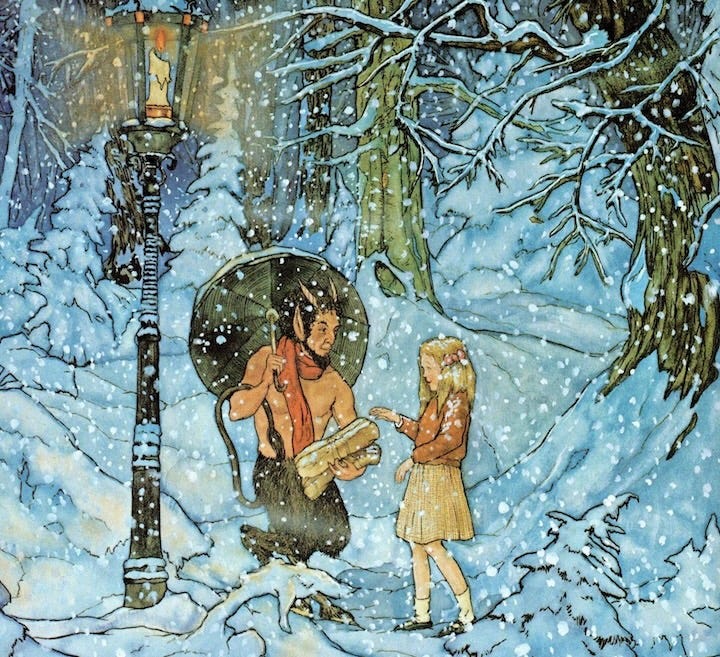
If your childhood was anything like mine, you often found yourself lost in Narnia: the stories that took you beyond the four walls of your bedroom, through the wardrobe in the attic, and into an exhilarating world of magic, prophecy, and mythic beasts.
But like many of the things that sing to us in childhood, revisiting Narnia as adults can unlock entirely new levels of meaning.
It’s well known to most that Lewis’s Chronicles are religious stories, written by a devout Anglican who imbued them with Christian allegories and ethics. However, they were not written for any straightforward moralizing or evangelizing purpose.
Rather, Lewis understood that fantasy tales are to be experienced at a much deeper level than didactic allegory. By composing Narnia, he was attempting to awaken a mindset shift in all of us; one that transformed his own life in his early thirties.
Narnia is instructive because it reveals why adults need mythic stories — and their own imaginations — even more than children do…
Thank you for reading this year! If you’d like to support our work, please consider taking out a paid subscription — it helps us out enormously. You’ll get:
Full-length articles 2x per week
The entire archive of content (180+ articles, essays, and podcasts)
Membership to our biweekly book club (and community of readers)
The book club is currently reading Beowulf, the foundational epic poem in the English language. The next meeting is TODAY, December 31, noon ET!
Allegory in Narnia
The allegorical elements of Narnia are glaringly obvious at times. Edmund, a stand-in for sin, eats the Turkish Delight before betraying his siblings to the White Witch, seduced by pride. We see the poisonous influence of the serpent in Genesis.
Aslan the Lion then comes, as revealed through prophecy, to save Edmund (and all of Narnia) through sacrifice. Note that, in the Book of Revelation, Christ is described as “the Lion of the tribe of Judah.”
When Aslan gives himself up to the White Witch, he isn’t just killed. He’s taunted by a mob, spat on, and kicked on the way to the Stone Table (much like Christ at Golgotha). He’s later resurrected by a “Deeper Magic,” which can reverse the death of one who willingly took the place of someone guilty.
Biblical parallels permeate the entire series, which even concludes like the New Testament does. In The Last Battle, the “real” Narnia emerges out of the old one’s apocalypse, commanded by Aslan, and the corrupted world is replaced by eternal joy. Death, we learn, is not an ending but another doorway. Aslan now wields judgment, letting some through and condemning others to be “swallowed up in his shadow.”
Beyond Allegory
Notice, however, that there are few simple, one-to-one allegories. Edmund can be read as Adam, Judas, or sin itself. And unlike Judas Iscariot, who committed suicide shortly after betraying Christ, Edmund ultimately repents and finds forgiveness.
This is because Lewis knew that allegory is an unsuitable medium to properly ignite the imagination. He rejected the label “allegory,” preferring to call his Narnia a “supposal” instead:
Suppose there were a land like Narnia and that the Son of God, as He became a Man in our world, became a Lion there, what would happen?
So, if not for mere religious allegory, for what purpose was Narnia really written?
The answer lies toward the end of the series, when the Pevensie children grow up. Susan refuses to accept that Narnia was ever real, and gets lost in the material world: “interested in nothing nowadays except nylons and lipstick and invitations.”
The story ends with the children’s tragic death in a train wreck, and reunion with Aslan in Narnia. But Susan wasn’t with her siblings at the time. She carries on in life, “too keen on being grown-up,” and we’re left to wonder if she’ll make it into Aslan’s “heaven.”
The key point, perhaps of the entire series, is Susan’s desire to grow up. Lewis saw that the grind of modernity (and adulthood) makes us lose a sense of mystery in ordinary things, and with it a sense of meaning. But mythic stories, experienced through the receptive lens of a child (or a childlike adult), open us up to the idea of reality beyond the material world, and new meaning within it.
Become Children Again
Fantasy books are often misjudged as a sort of escape from reality. In fact, they tear down the “veil of familiarity” through which you see the world, allowing you to step back and see it more clearly. And in doing so, you might find out that you are part of a grand narrative.
This is exactly what happens to the Pevensie children. They discover that their place in the world is one of royal significance, crowned as monarchs and entrusted to preside over a Golden Age of peace in Narnia. It’s an awakening to a reality a million miles from the one they’re used to, yet it feels even more real.
Similarly, when Lewis embraced Christianity in his early thirties after much deliberation, he saw it as a reawakening of his childlike imagination. The pagan myths that he had encountered by then had stirred his inner, childlike openness to the supernatural, and renewed the wonder with which he now read the Christian story.
The stories we inhabit shape us, but to let them do that, we need to encounter them as a child would. “Childlike” is an imprecise term, but to Lewis it meant something like openness to truths beyond those that can be measured — to delight in the impossible instead of being offended by it. Lewis wrote:
Young things ought to want to grow. But to carry on into middle life or even into early manhood this concern about being adult is a mark of really arrested development. When I was ten, I read fairy tales in secret and would have been ashamed if I had been found doing so. Now that I am fifty I read them openly. When I became a man I put away childish things, including the fear of childishness and the desire to be very grown up.
Indeed, there’s a related passage in Matthew’s Gospel that might well be read as the quintessence of the entire Chronicles:
And he said: “Truly I tell you, unless you change and become like little children, you will never enter the kingdom of heaven.”
–Matthew 18:3
More Real Than Real
Reading (or better yet, writing) fantasy is one of our best tools for preserving our inner child. Unlike fiction grounded in the real world, fantasies like Narnia can give you something of a three-dimensional experience. This matters because the most important truths are arrived at through experience, not observation.
Lewis wrote that a well-composed fantasy can “generalise while remaining concrete, to present in palpable form not concepts or even experiences but whole classes of experience, and to throw off irrelevancies.” Myths “can give us experiences we have never had and thus, instead of ‘commenting on life’, can add to it.”
The key is that fantasy stories are unhindered by the irrelevancies and constraints of primary reality, and can therefore punch straight at the heart of truth. They pull you out of the mundane and superficial and into something designed to highlight only that which is most fundamental. The mythic world is more real than “real” life.
As adults of pragmatism and routine, our perceptions are worn down by familiarity, and we lose the ability to notice the inherent wonder of ordinary things. But an invented or secondary world, which renders ordinary things extraordinary, can unshackle those perceptions.
In the invented world, grass needn’t be green — it might instead be blue. Then, when you return again to the primary world, you may see “real” grass anew, as if for the first time, because now you’ve seen it elsewhere in a different stage of the imagination. This is what keeps our eyes childish.
What’s more, a character like Aslan is made more captivating by the fantastical qualities of his being, and with the veil of familiarity lifted, you’re more open to the lessons he has to offer. Aslan himself explains this, when the children sail to the very edge of the Narnian world:
“This was the very reason why you were brought to Narnia, that by knowing me here for a little, you may know me better there.”
Thank you for reading and Happy New Year!!
And a sincere thank you for being part of this community. We could not be more grateful for all the support and kind messages received.
If you’d like to support our work here, please do consider taking out a paid subscription for a few dollars. We are almost entirely reader-supported, and your help will allow us to take this search for Truth, Goodness, and Beauty much further in 2026…
Also, if you’re interested in reading more articles like this one, check out our sister publication, The Ascent. There, we are diving deeper into theology, mysticism, and ancient texts: one free article every Tuesday, and longer essays every Friday for paid readers.
Recently, we wrote about how Lewis uses Narnia’s endless winter to tackle the problem of evil, and how it ties into the freezing pit of Hell in Dante’s Inferno.


Good read. Thank you.