


If you’re living through a great decline, how should you personally live and act in the midst of it?
This is the question at the heart of J.R.R. Tolkien’s 1954 masterwork, The Lord of the Rings. Middle-earth is marred by civilizational decline, the loss of hope among men, and a profound sense that the beauty of the past is doomed to decay. This slow fading was the author’s attempt to express something he had felt all his life, which he once described as a “heart-racking sense of the vanished past.”
As we read in his letters, Tolkien also interpreted real human history in this way: a steady fading of the beauty and magic of creation.
I do not expect ‘history’ to be anything but a ‘long defeat’ - though it contains (and in a legend may contain more clearly and movingly) some samples or glimpses of final victory.
Yet the Professor’s storytelling is the opposite of doom and gloom. In fact, it offers one of literature’s most compelling answers to enduring an inevitable downfall.
If living through an age of decline is indeed your own destiny, there is more than enough reason to face it forthrightly, even — and especially when — all hope has disappeared…
The Death of Boromir
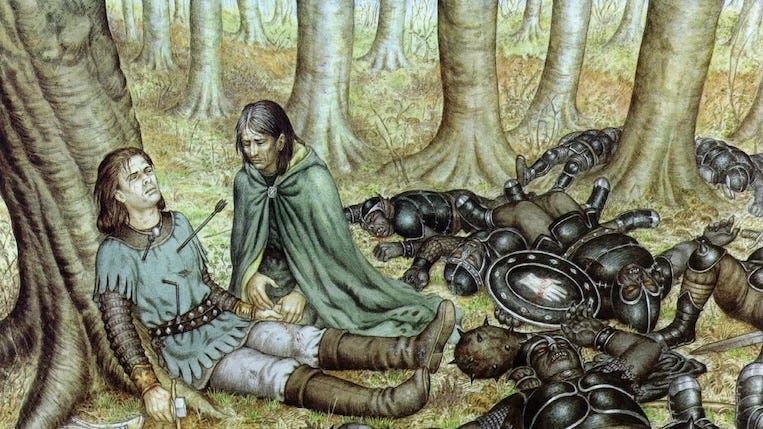
We begin to see the answer to the “long defeat” in the events following the death of Boromir. After Boromir gives his life to save the Hobbits from Saruman’s Orcs, the Fellowship lies in tatters. With time against them, Merry and Pippin being swept away by the enemy, and Frodo passing out of their control, Aragorn and company make a decision that seems strange.
They pause to mourn Boromir’s passing with a proper ritual.
To many readers, this feels entirely reckless. Their “best” course of action is surely to prioritize what is most urgent: that the fate of their quest hangs in the balance. We recognize that, in any “normal” context, it would be wrong to let Boromir’s body lie out in the open. But the nature of their mission surely doesn’t allow for the luxury of a funeral — right?
But the fact that abandoning Boromir’s body is wrong in normal times is precisely why it is wrong even now. At the heart of The Lord of the Rings is the idea that moral decisions lie beyond their immediate context. Some things just are wrong and others right, and once context becomes an arbiter of that distinction, you’ve lost your grip on what it means to be good.
At its core, this worldview is deontological: ethical decisions should be made according to a set of universal principles, not the consequences of each decision. This is famously elaborated in the ethical theories of Kant, who believed that morality is grounded in our rational duties to one another, and all humans are inherently worthy of this dignity. Boromir is worthy of a funeral rite, and so it is the Company’s duty to provide it.
But something else then happens. Aragorn makes yet another decision to halt progress on the greater mission in favor of that which speaks directly to his heart:
“I would have guided Frodo to Mordor and gone with him to the end; but if I seek him now in the wilderness, I must abandon the captives to torment and death. My heart speaks clearly at last: the fate of the Bearer is in my hands no longer.”
He will pursue Merry and Pippin, rather than sacrifice them for the “more important” quest. This decision is underpinned by something else crucial to the story’s ethical framework: Tolkien’s heroes recognize they are not in control of everything…
The Anti-Great Man Theory
Aragorn cannot force the Ring to be unmade through his own will to power, and he’s aware that the universe — and the fate of the Ring — is guided by forces beyond his own and of his enemies. His decisions are all made in that humility.
This stands in opposition to what we might call the “Great Man Theory,” the idea that history is shaped by the will of a few exceptional figures: “The History of the world is but the Biography of great men.”
This theory was popularly held at the time Tolkien was writing, and Middle-earth is itself a story of exceptional heroics — but there’s a difference. Even Middle-earth’s kings recognize that they themselves play only a small part in the grand story.
When Frodo breaks away from the Company, it seems Aragorn is pushed out of the central quest altogether. He comes to terms with the fact that he cannot control Frodo’s fate, yet this only sharpens his focus on what he can control. Saving Merry and Pippin may not play a part in the arc of history, but it is in service of the good, and so worthy of his attention all the same.
Norse Courage
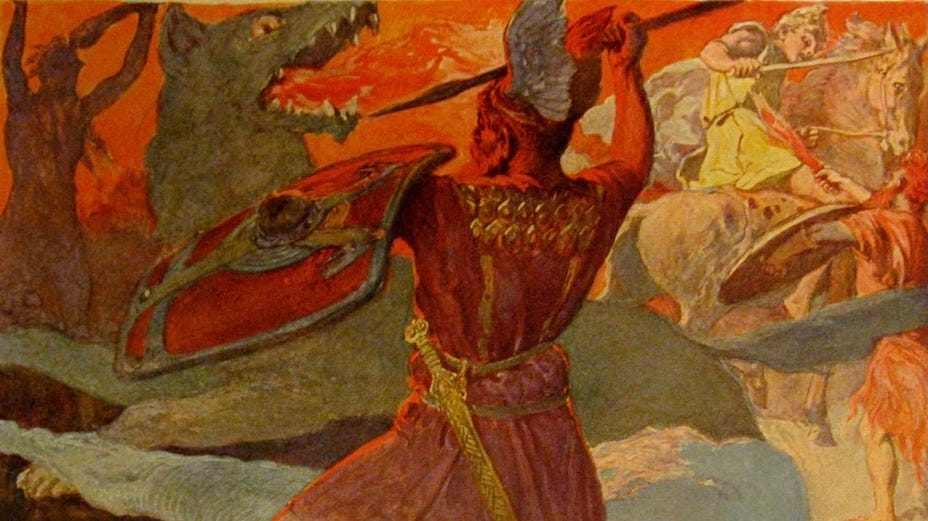
Throughout Tolkien’s epic, again and again we see a kind of “Norse courage,” a reckless bravery that stands firm to its principles in the face of all odds. To die with this form of courage is to win a certain immortality, and it’s something that Tolkien absorbed from Norse myth and Old English tales like Beowulf.
The Defense of Osgiliath, the Battle of the Black Gate, and a hobbit contending with the might of Sauron are hopeless, unwinnable endeavors. And yet, none of them is a cause for despair for the heroes living through them.
The commitment to one’s duty even when the battle is lost resonates with all of us, but it’s another thing to have the courage to actually live (and die) by a code so strict. It’s easy to support the idea in principle, but how can we readers find the courage to live this way in our own lives?
Fortunately, Tolkien does not fail to answer this question. The answer is hiding in one of the most insightful sentences of the entire trilogy, as well as in a new concept proposed by the author.
This concept is an Elvish one, and it’s even more powerful than Norse courage. It’s what you turn to when all hope really does run out...
A Great Reversal
Middle-earth is guided not just by the opposing wills of good and evil but by another, providential force beyond the material. In the earliest chapters of the series, we learn that Gandalf is keenly aware of this, when he warns against the pragmatic decision to slay Gollum:
“I have not much hope that Gollum can be cured before he dies, but there is a chance of it. And he is bound up with the fate of the Ring. My heart tells me that he has some part to play yet, for good or ill, before the end.”
The Lord of the Rings is a “eucatastrophic” story, to borrow Tolkien’s phrase. His characters are guided by a sense that a great reversal or turn in fortune — a “eucatastrophe” — is always just around the corner. This is indeed what happens when the Ring is destroyed at the story’s climax, but how can they trust that it’s really coming?
Hope or Trust?
Another Tolkienian concept is enormously instructive here: something that he calls “estel.” Estel is an Elvish word for “trust,” and it’s given as a childhood nickname to Aragorn by the Elves to hide his true identity from Sauron. This kind of trust is much more powerful than hope, as we read in Morgoth’s Ring (a compendium of Tolkien’s unpublished manuscripts):
“That is one thing that Men call ‘hope’,” said Finrod. “Amdir we call it, ‘looking up’. But there is another which is founded deeper. Estel we call it, that is ‘trust’. It is not defeated by the ways of the world, for it does not come from experience, but from our nature and first being. If we are indeed the Eruhin, the Children of the One, then He will not suffer Himself to be deprived of His own, not by any Enemy, not even by ourselves.”
Estel is not a vague belief that fortune, if you give it enough time, will eventually swing back in your favor. It is the idea that a universal goodness really does exist, and by its nature will never deprive itself of its own kind. Goodness is destined to ultimately prevail because it is backed by ultimate, objective truth. Estel is deeper than hope because it is underpinned by something that cannot be shaken “by the ways of the world.”
It is precisely because Tolkien’s heroes believe in objective good that they can trust that eucatastrophe is coming. To believe this is to live in accordance with destiny, and it’s what feeds you the courage to die for the good if necessary. Even when all reasonable hope runs out, there is always trust. Aragorn relays this himself, after Gandalf falls in Moria:
“We must do without hope,” he said. “At least we may yet be avenged. Let us gird ourselves and weep no more! Come! We have a long road, and much to do.”
If everything is turning against you in life, estel is there when hope fails — because there is a task that must be finished anyway.
Never Let the Fire Go Out
Finally, consider how Tolkien uses the concept of eternal fire. Gondor’s White Tree is a symbol of the realm, but when we encounter it in The Return of the King, it has been dead for 150 years.
Tolkien was borrowing a very old idea here. In Ancient Greece, towns had a hearth at the center called a prytaneion. Someone had to tend to the sacred fire each day, believing that if it died, so too the city would die. Failure to keep Gondor’s tree alive during the rule of the Stewards is a symbol of man’s dwindling ennoblement, and the loss of hope in a true king’s return.
But who cares if a fire goes out, or if a tree dies?
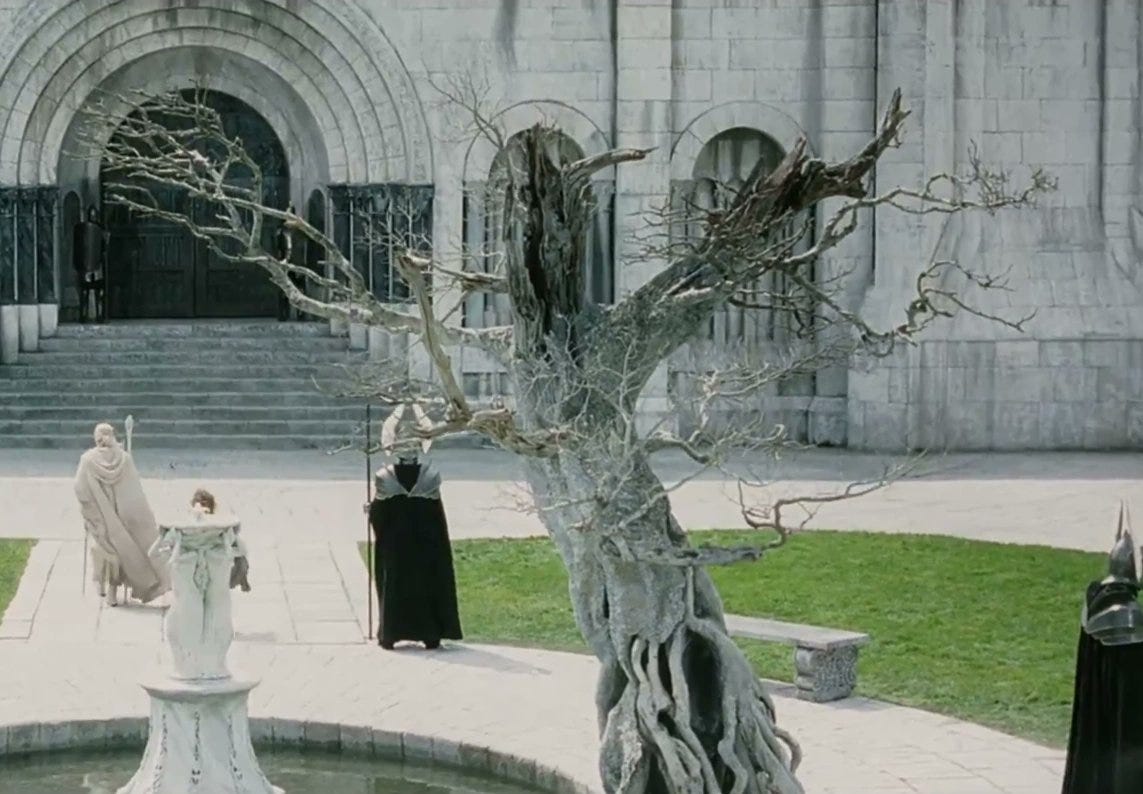
When hope is gone, you must live with trust instead. And to live with trust in the good is to recognize that the small (but good) things around you matter: tending to a symbolic flame, honoring a funeral ritual when it slows you down, or helping someone with no ability to repay you.
A good world is brought into being by small acts of courage and kindness, even when they seem superfluous in the wider context of your quest. Each and every little thing contributes to the grand story, for they keep the fire burning when all other lights have gone out.
Another great read. One thing I especially appreciated is how the “decline” in Tolkien isn’t cosmic but social. What’s breaking down are kingdoms, institutions, forms of life. Middle-earth isn’t falling apart because reality itself has lost its grounding, but because the social order has slipped out of alignment with it.
That distinction matters. History, in this sense, works at the level of power, memory, and collective arrangements. But the good doesn’t originate there. Aragorn’s freedom to act rightly isn’t granted by the health of Gondor or the odds of success. It comes from being oriented beyond history. Because he’s anchored in something higher than the social order, he isn’t ruled by its panic or its decline.
That’s why the moral logic of the story holds even as things fall apart. When social coherence weakens, the we are still capable of real goodness, because that capacity isn’t produced by society in the first place. Though most of the time, goodness flows through customs, rituals, and shared life, Tolkien shows it doesn’t depend on them absolutely. When history falters, the soul can still stand upright, and in doing so, keep the world from going entirely dark.
Denethor is good contrast to trust. He “knows” hope is lost from looking into the palantir, so he can only trust or despair, and chooses despair.