

When I was a teenager, I had a conversation with a cousin who was about a decade older than me. I remember asking him if he had any regrets in life.
“No, I don’t regret anything. I’ll never regret anything.”
His reply struck me as strange. To not regret anything — wouldn’t that mean you never made a mistake? Or that you were too ignorant to realize you made one? Or that you never put yourself in situations where you were forced to fail and to grow?
What I later realized was that his response, which sounded strong and self-assured in the moment, actually revealed a deep insecurity. And rightfully so: we all hate to have regrets. Often, it’s far easier to deny you have them than to wrestle with their painful implications. But in life, regrets are inevitable. Learning how to deal with them, therefore, is an indispensable skill.
One of the greatest works of world literature, Alessandro Manzoni’s The Betrothed, addresses this topic head on. It shares, among many other things, the story of a girl who is forced against her will to make a decision she can never turn back from. Her heartbreaking story, recounted by Manzoni with pity and compassion, shows just how much regret can destroy your life.
But at the same time, Manzoni also answers the timeless question, “how do you carry on in light of regret?” and reveals the key to overcoming the greatest tragedies of your life. The wisdom he offers isn’t theoretical, but rather shaped by the painful reality of his own life, in which his wife and seven of his nine children predeceased him.
Today, then, we look at what the greatest Italian novelist can teach you about overcoming the pain of regret — and especially, the regret of self-inflicted mistakes and bad decisions. The answer he provides is simple, not easy. But in the 200 years since the novel’s publication, millions have found consolation in its timeless wisdom…
Reminder: this is a teaser of our paid subscriber essays.
If you’d like to support our work, please consider a subscription. You’ll get:
New, full-length articles 2x per week
The entire archive of content (200+ articles, essays, and podcasts)
Born an Afterthought
In his deep consideration of the human heart, Manzoni ranks with Dostoyevsky and Tolstoy, but without the occasional creepiness of the former and the more than occasional preachiness of the latter.
-Dr. Anthony Esolen
The girl at the heart of Manzoni’s lesson on regret is named Gertrude. Although she’s not one of the main characters, Manzoni still dedicates multiple chapters to her, indicating how much weight he places on the lesson to be learned from her story.
Gertrude’s tragedy begins just northeast of Milan, where she was born into one of the wealthiest families in Monza. Her father, intent on passing down everything he owns to his son and heir, views Gertrude as a threat to his ambition. He thus conditions Gertrude from an early age to prepare for life in a convent — a practical solution which allows him to avoid the questions of a dowry and dividing inheritance altogether.
When she is around 12 years old, Gertrude spends some time observing life in the convent, but is forced to leave for a year before officially applying to join. The reason for this is simple: religious life is intense, and the nuns want to make sure she’s not joining on a whim (or being pressured to do so).
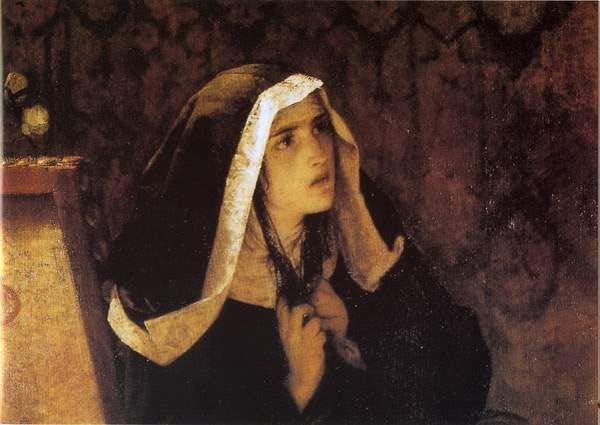
Yet upon her return home, Gertrude’s family deprive her of affection, only showing basic familial warmth when she appears to capitulate to their vision for her life. The young girl, desperate for love, yields to her father’s vision. Manzoni describes what she feels like on each occasion she does so:
Terrified by the step she had taken, ashamed of her ineptitude, annoyed at both herself and others, she made a grim count of the occasions left for her to say no, and promised herself, vaguely and feebly, that on one of those occasions she would be stronger and more adept.
Despite these thoughts, her fear of her father’s scowl had not subsided in the least…
-The Betrothed, Chapter 10
At one point, a priest visits Gertrude for a private conversation and asks if she is being coerced into becoming a nun. Yet it’s too little too late, for by this point Gertrude is a broken girl:
The true answer to that question leapt to Gertrude’s mind with a terrifying clarity. To give that answer, she would have to explain what had happened, say who had threatened her, tell the story. The unhappy girl shrank from this idea in fear. She hastened to find another answer and found only one, the one farthest from the truth, which would free her from that torment swiftly and surely.
“I am becoming a nun,” she said, hiding her agitation. “I am becoming a nun of my own free will.”
The Despair of Regret
But lest you think Gertrude is simply incapable of sticking up for herself, Manzoni adds the following context to better explain Gertrude’s thought process. He knows that in order for his lesson to resonate, you have to truly empathize with the predicament in which Gertrude finds herself:
In addition to her revulsion at the idea of revealing her weakness to that austere and righteous man, who seemed to harbor no suspicions of her, the poor girl knew that while he could prevent her from becoming a nun, his authority over her, and his protection, would end here.
Once he was gone, she would be alone with [her father], and no matter what she came to suffer in that house, the good priest would know nothing of it; or, if he did, with even the best intentions, he could do little more than feel pity for her, the peaceful, moderate pity generally accorded as a courtesy to anyone who has given a reason or excuse for the wrongs they suffer.
So it is that Gertrude proceeds to finally enter the convent at 13 years old, forever trapped in a world she never wanted to be a part of. But as the years past, she suffers and broods over the life she could have lived, eaten alive by regret:
Endless regret for her lost freedom, hatred of her present state, and an all-consuming yearning for desires that would never be requited: this is how she occupied her mind. She brooded over her bitter past, recollected all the circumstances that had brought her there, and a thousand times undid in her mind, to no avail, what she had done through her actions.
She accused herself of ineptitude, and others of tyranny and treachery. And she wasted away. She both idolized and lamented her beauty, deplored a youth that was destined to fade away in a slow agony, and envied, at times, any woman, of status, or any morals, who could freely enjoy these gifts in the world.
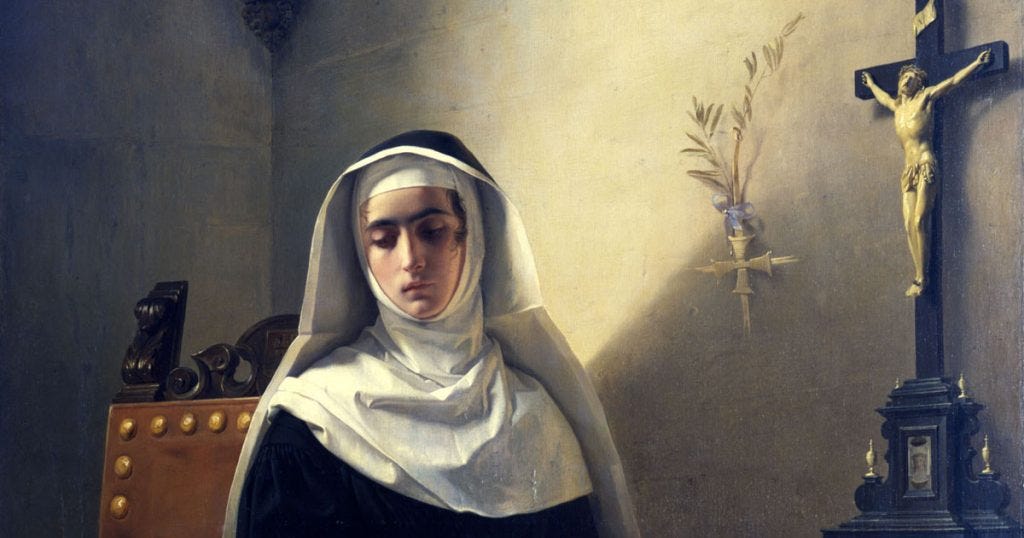
As a nun, Gertrude is cruel towards her sisters. She frequently takes out her frustrations on anyone who gets in her way, and never misses an opportunity to make fun of others. She is hostile even to those who are kind to her, for “in their piety and good cheer she saw a criticism of her restless and eccentric behavior.” Ultimately, she even goes as far to murder another nun, a deed which haunts her forever. In short, regret completely destroyed Gertrude’s life, making it impossible for to live with others, and herself.
Yet this is the moment when Manzoni springs his trap on the reader. For although he’s just spent chapters detailing how unjustly Gertrude was treated, he finally arrives at an astonishing conclusion: that things didn’t have to end this way for Gertrude.
Without minimizing the incredible injustice Gertrude suffered, or the overwhelming ruefulness which now drives her to despair, Manzoni reveals the key to moving forward and overcoming regret.
How do you carry on after a decision there’s no turning back from? Manzoni details it all in one of the most sublime passages in all of literature…