


I saw this phrase circulating online recently:
Humans are designed to create.
This is why you get depressed when all you do is consume.
This perfectly succinct point can be derived from many great writers on the creative imagination and our innate desire to “sub-create”: J.R.R. Tolkien, Owen Barfield, George MacDonald, etc.
G.K. Chesterton was another of those writers. He recognized that the ability to create ideas and worlds inside your own head is a domain with infinitely far-reaching potential, and, importantly, a fortress against nefarious outside forces. “The most essential educational product is Imagination,” he wrote.
Chesterton wrote about how to cultivate the imagination in various stages of life — this article discusses those stages, why the imagination matters, and why flexing it in adulthood is most critical of all.
But first, be careful to note that imagination is not escapism. For Chesterton, it is something far more powerful indeed. A healthy imagination works to renew an ancient consciousness with which you interpret the real world: “imaginative does not mean imaginary.”
In our time, safeguarding one’s imagination is an increasingly vital skill. It is your internal defense against the external forces that seek to hijack your mental faculties…
Reminder: this is a teaser of our paid subscriber essays.
If you’d like to support our work, please consider a subscription. You’ll get:
New, full-length articles 2x per week
The entire archive (200+ articles, essays, and podcasts)
Early Childhood: Ancient Wonder
A child of seven is excited by being told that Tommy opened a door and saw a dragon. But a child of three is excited by being told that Tommy opened a door.
Chesterton notes that very young children do not need elaborate fairy tales to ignite their imaginations. To them, “mere life is interesting enough.” An older child is interested in romantic tales, whereas an infant likes realistic ones, because they already perceive them as romantic.
Nursery stories, therefore, are straightforward and only exist in order to gently prompt the powerful imagination that all children have at birth. They only “echo an almost pre-natal leap of interest and amazement.”
This, Chesterton intuits, is our ancient instinct for astonishment or wonder. We have an innate predisposition to experience the world we inhabit with awe and joy. As life continues, a working imagination is what helps adults return to this forgotten state…
Late Childhood: Heroes & Dragons
About the age of five or six is when we begin to enjoy things like fairy stories as a way of stimulating the imaginative process. These operate at the next level up from nursery stories.
The key consideration with fairy stories is that they help train the moral imagination. Play and fantasy, which augment the world with great beasts and greater heroes, equip the child with a sense of adventure and heroism that will later prepare him for life’s real battles.
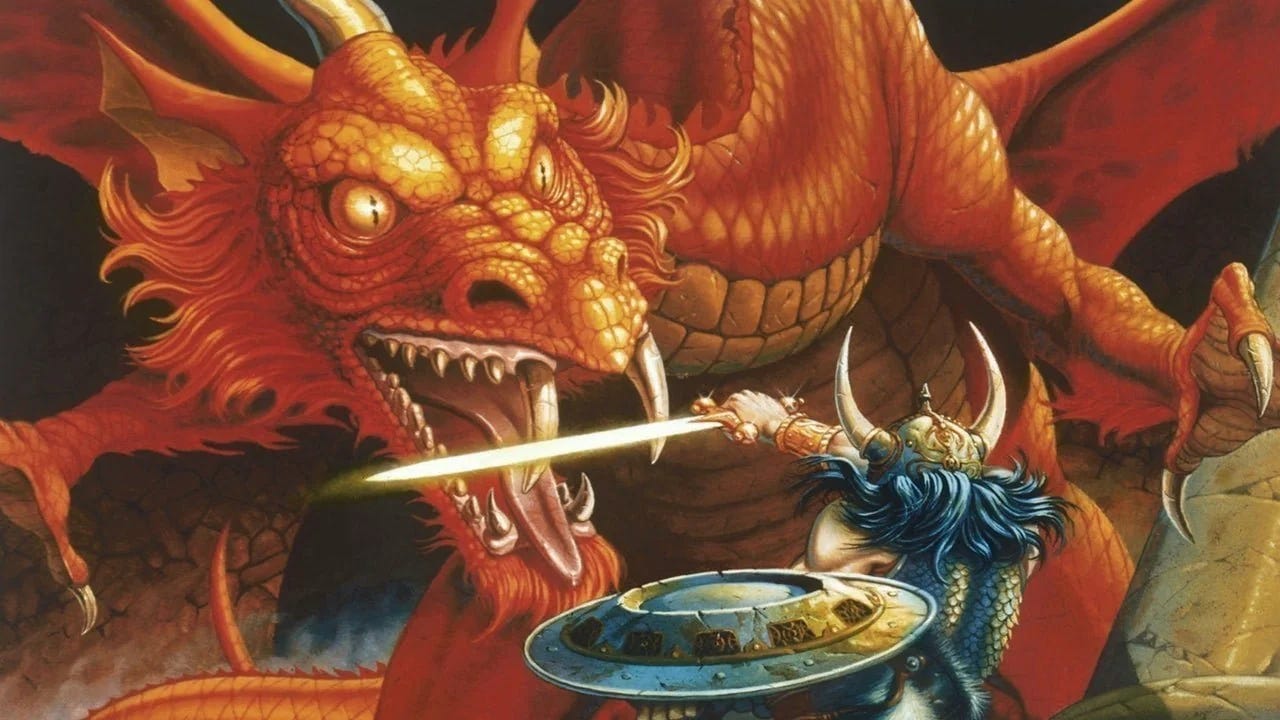
A rich imagination matters not because the child can escape into a secondary world, but because the secondary world alters his perception of the primary world, imbuing it with a sense of challenge and meaning.
The fairy tale provides you with a kind of vision required to confront evil, because it awakens an internal sense of justice and, crucially, agency. It helps you see the world as a great story in which you are called to play your own, heroic part (this perspective will be useful later on). Indeed, by now you are already fully aware of dragons and the need for heroic action, and any attempt to try to shelter you from this won’t work. Chesterton writes:
Fairy tales do not give the child his first idea of bogey. What fairy tales give the child is his first clear idea of the possible defeat of bogey. The baby has known the dragon intimately ever since he had an imagination. What the fairy tale provides for him is a St. George to kill the dragon.
So, reading fairy tales helps to form an internal moral language — a kind of consciousness that sees the world as something to be explored from inside your own mind. Life is a great story, and you can face it as either a hero or a coward.
Adolescence: Internal Dragons & Passivity
As you exit childhood for adolescence, you begin more and more to encounter internal dragons of doubt and temptation. You are hyper-self-conscious, at risk of becoming a passive creature only capable of responding to what others do and say.
A rich internal life is what protects you from passivity. Chesterton says that we are all called to be active creators and not consumers. An active imagination — stimulated by making things, writing things, playing instruments — makes you less vulnerable to manipulation by peers, the media, or trending ideologies. Why? Chesterton writes:
The man who can make up stories about the next-door neighbour will be less dependent on the next day’s newspaper.
Crucially, the imaginative mind is less dependent on external stimuli or validation. It delights in doing things for itself. Chesterton once wrote that cultural decline is marked by people paying for others to dance for them, rather than a whole room of individuals doing the dancing themselves, together.
Life was better when we all did the dancing ourselves, and so it is with thinking. The imaginative adolescent reclaims his agency at the stage of life where it is most at risk, and this shields him from the despair of living life passively.
We’ve talked so far in broad terms, but how does one actually protect and cultivate one’s imagination, particularly in the next stage of life: adulthood?
Well, recall that the infant enters the world with an imagination strong enough to see joy in the most mundane of objects — basic reality is already presented to him as romantic. In adulthood, the goal is to get back to this view.
To get there, says Chesterton, a radical re-framing of your perspective is necessary…