

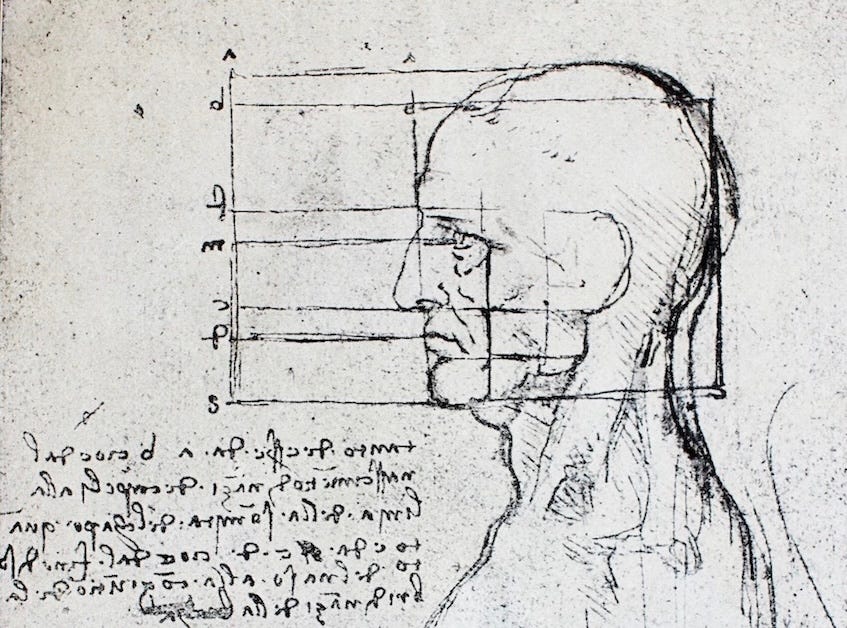
“Beauty is in the eye of the beholder” is a powerful saying. But is it true?
Across different eras, continents, and cultures, the answer comes back as a resounding “no”. While it’s true that personal preference plays a minor role in what you find attractive, those preferences generally operate within already set boundaries. And it is not us who set those boundaries, but nature itself.
Previously, we’ve written about how the Fibonacci sequence and the golden ratio inform your understanding of spatial and visual harmony. But there’s a far more common ratio that’s found in everything around you: the ratio of 2/3rds. This, arguably more than any other ratio, shapes what you see as beautiful in everyday life.
The rule of thirds makes you realize just how much mathematics, not personal preference, influences your perception of beauty.
Once you see it, you’ll never view the world the same again….
We are 100% reader-supported. This newsletter is free, but if you’re able to support, please consider a paid membership — it helps us enormously. You’ll get:
Full-length articles 2x per week
The entire archive (200+ articles, essays, and podcasts)
Where Beauty Begins
Like the golden ratio, the rule of thirds has its roots in nature, not abstract theory. But while the golden ratio is found in pinecones and the spiral of seashells, the rule of thirds is found in something far more familiar: the human face.
There are two main ways of viewing the human face. The first is to divide it into halves and quarters, while the other is to divide it into thirds. Take the image below, for example: while the white parameters feel rote and mechanical, the orange ones are rich with information, and genuinely describe the face they’ve been drawn over.
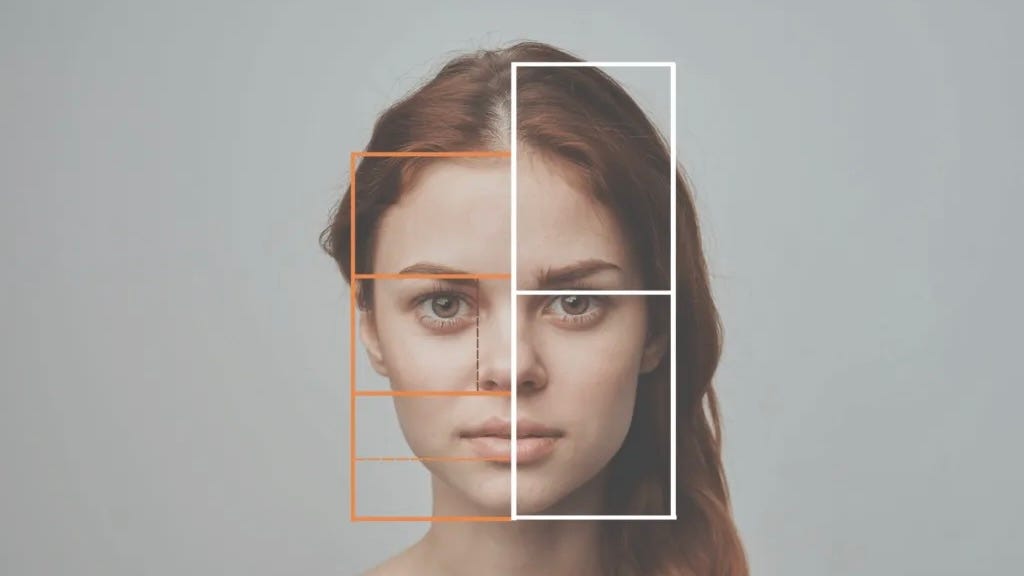
The average human face is organized into a recurring hierarchy of divisions in which a 2/3rds ratio repeats at different scales. The first and largest division is from the chin to the eyebrows (the bottom 2/3rds of the face), with the space between the eyebrows and hairline constituting the remaining third. Then, within each of these divisions, the same pattern repeats.
Take the bottom third of the face, for example. Within this segment, the distance between the bottom of the chin and the top of the lips constitutes roughly 2/3rds. The same goes for the middle segment of the face, where the distance between the bottom of the nose and the bottom eyelid is again, you guessed it, 2/3rds.
Humans are hardwired to read faces, and the latent information you encode because of this is enshrined deep down in your psyche. No wonder, then, that it informs our perception of beauty, and that we can’t help but reflect it back out into the world…
The Face Made Stone
It’s no coincidence that the word façade takes its name from the word face. Whether in Greco-Roman, art-nouveau, or colonial-style housing, the buildings we find most beautiful are those which reflect the rule of thirds in their proportions.
Take the Taj Mahal, for example. It’s a far cry from the baroque and gothic cathedrals of Western Europe, but yet it still follows the rule of thirds to a tee:

While it’s easy to see the main 2/3rds division in the photo above, astute eyes will catch the pattern recurring in less obvious places. Look at the main entrance in the close-up below, and what do you see? From the ground level to the top of the upper window, the 2/3rds pattern occurs once more:

The most beautiful commercial homes retain the rule of thirds in recurring, if not immediately obvious ways. Though the two builds below couldn’t be any more different in terms of their architectural style, they are united in their use of the 2/3rds ratio:

But of course, the rule of thirds isn’t limited simply to architecture. It is also deeply ingrained in what you wear…
Ordering the Human Form
Just like the face, the main features of the human body generally reflect the rule of thirds. The distance from your ankles to your natural waist makes up the bottom 2/3rds, while the distance from your waist to your shoulders composes the remaining third.
In the realm of dress, therefore, clothing which best mimics this pattern is often seen as more elegant and naturally beautiful. In the image below, for example, the outfit on the right visually divides the body into two halves, whereas the outfit on the left more closely follows the 2/3rds ratio:
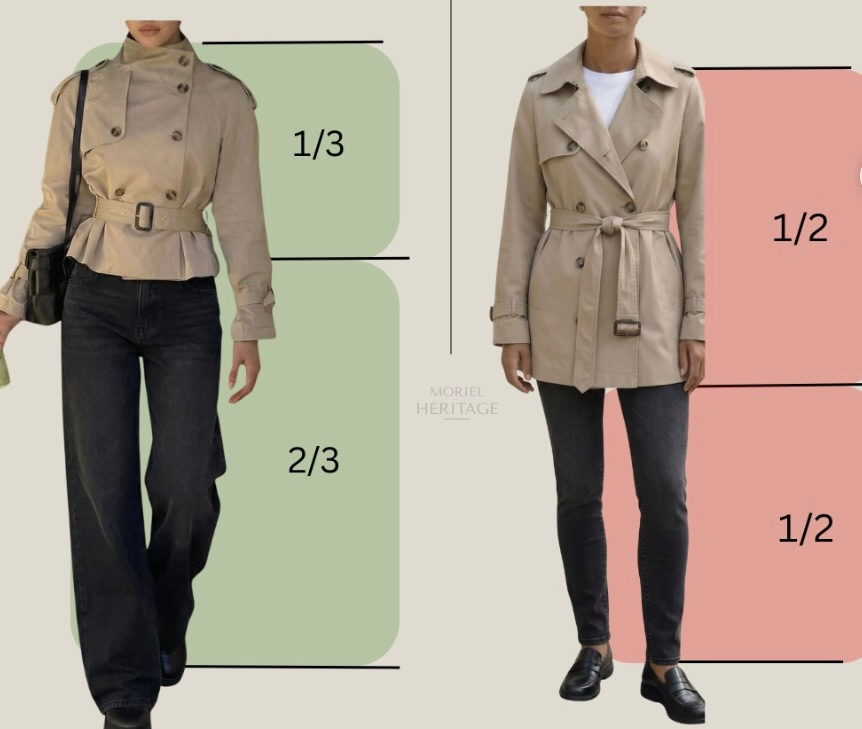
Now, some people might see this photo and immediately think that the outfit on the left looks better because the model is taller. But, in fact, this is the same model. When your body is visually divided into halves instead of thirds, you often look shorter than you really are.
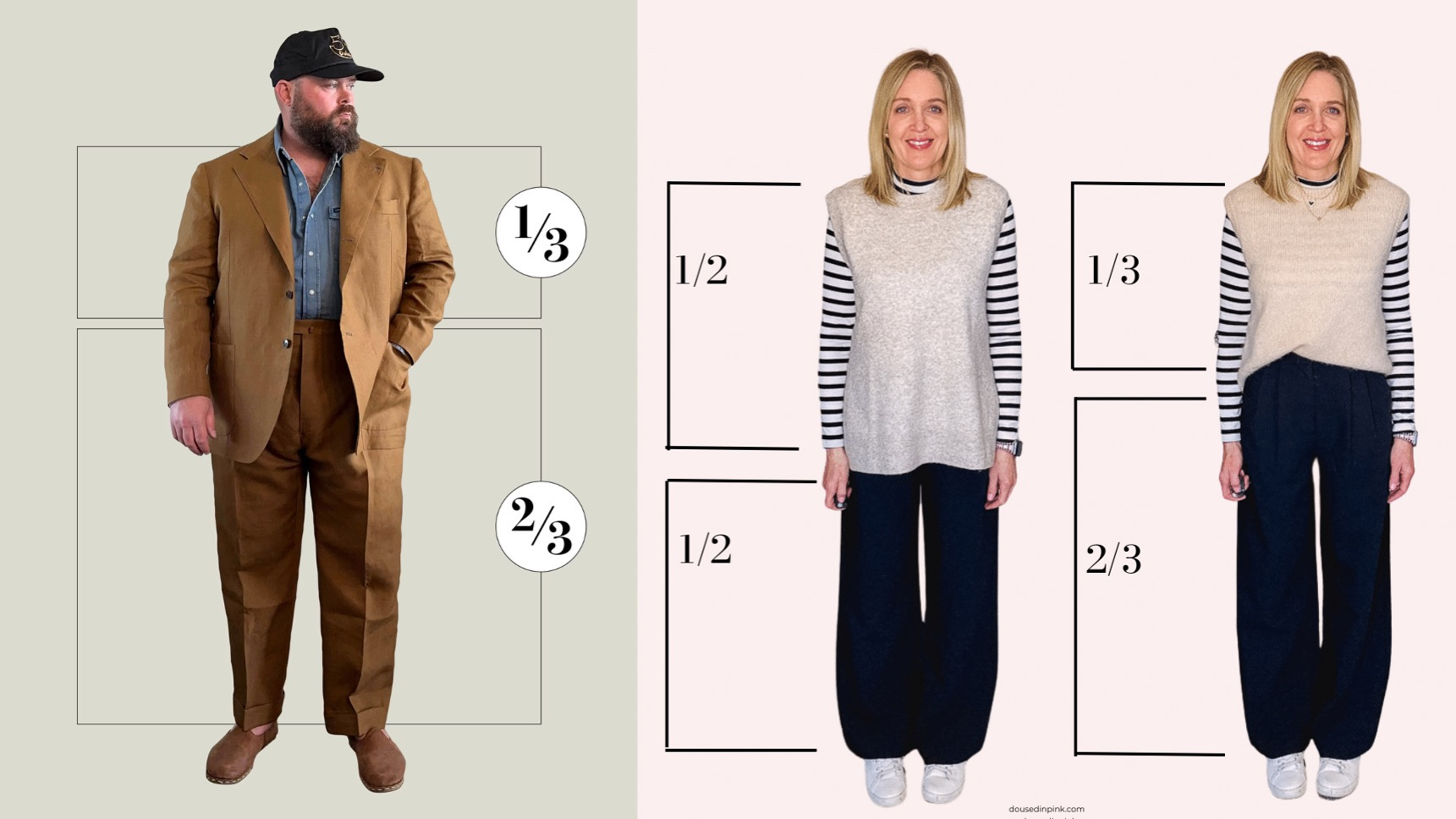
Generally speaking, both men and women look better when they dress to reflect the rule of thirds, and the easiest way to do so is to wear trousers that fall at your natural waist. Today, most trousers are made to rest on your hips (a side-effect of mass-market incentives), so finding a good pair of high-waisted trousers can be tough. But, as the photos below testify, the result warrants the effort:
There is much more that could be said about the rule of thirds showing up in everything from the length of a suit jacket, to the width of your lapels, the composition of a photo, etc. But for now, let this be a good intro into the myriad of ways in which the rule of thirds shapes our perception of everyday beauty.
Because beauty, as it turns out, is not subjective. It’s what looks most harmoniously human.
If twenty people agree that the rose is beautiful then it is very likely that the beauty is not just in the eye of that beholder but in the qualities of the rose.
Concerning beauty, let’s take the relativist’s position. They often interject with “eye of the beholder” nonsense, not as true leveling in both directions, which leveling would be, but as armor for the ugly. A raising of their status. A lowering of the high in return. They fail to understand the game they play is inappropriate, that relativity betrays them. For they believe the statements negate the portioners of this nectar, this ichor, that their adorations are deserving of the demos. But it’s the wrong game. If their tenets hold, as they truly believe, then the adoration for the few and revilement for the others is not awash. It is on firmer ground still. For the beauty, if in the eye alone, is in that case very real, undoubtedly real. And so too must the be the profane. No amount of appeals of any nature can sway what is then a matter of momentary taste. For if taste is the measure, then taste in the moment is perfect. Fixed. God like.