

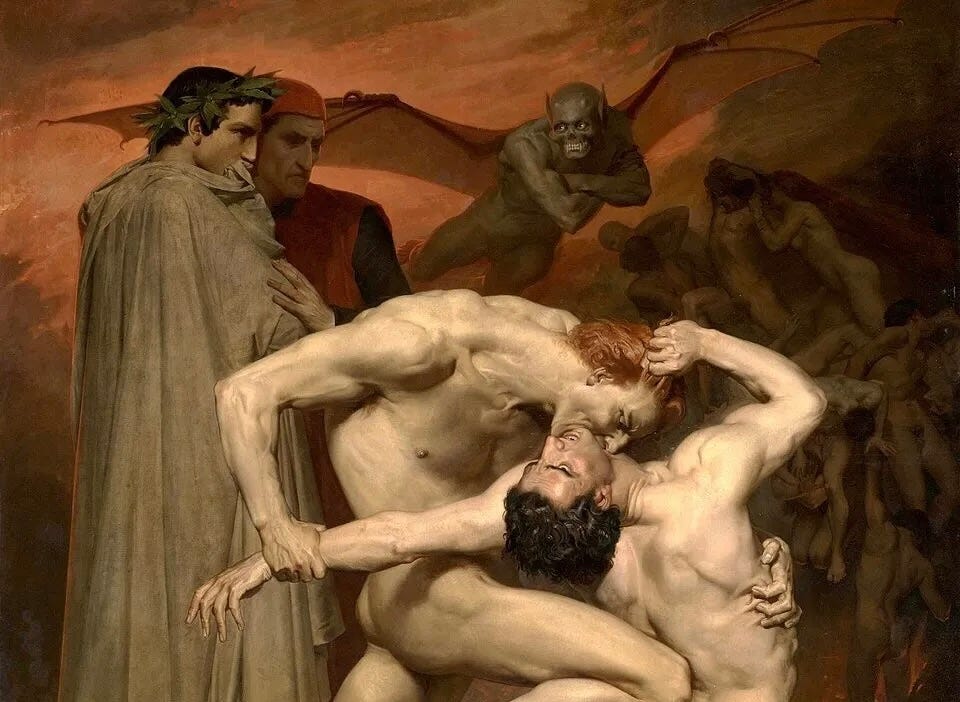
Is lying worse than murder?
In Dante's Inferno, violent sinners land in the 7th circle of hell. All kinds of fraudsters (flatterers, seducers, panderers) land in the 8th circle. Why?
Dante is a master of the soul, and what he offers is a tremendous insight into the spiritual harm of lying and its corruptive effect upon the intellect of man.
You will never see lying the same way again…
The Depths of Hell
Having journeyed through most of hell, Dante and his guide, the poet Virgil, arrive at the Eighth Circle. In Dante’s Inferno, hell is presented as nine concentric circles plummeting into the earth, with each consecutive circle representing a greater sin and thus a worse punishment. As such, those near the top of the Inferno suffer lighter punishments for less serious sins, while those in the depths of hell suffer the most for the most egregious crimes against God and neighbor.
Having already traversed the first seven circles, Dante has seen souls punished for sins such as lust, gluttony, wrath, acedia, and heresy. He observed that tyrants — those who brought untold suffering to mankind — were punished for violence against their neighbor by being boiled in a river of blood.
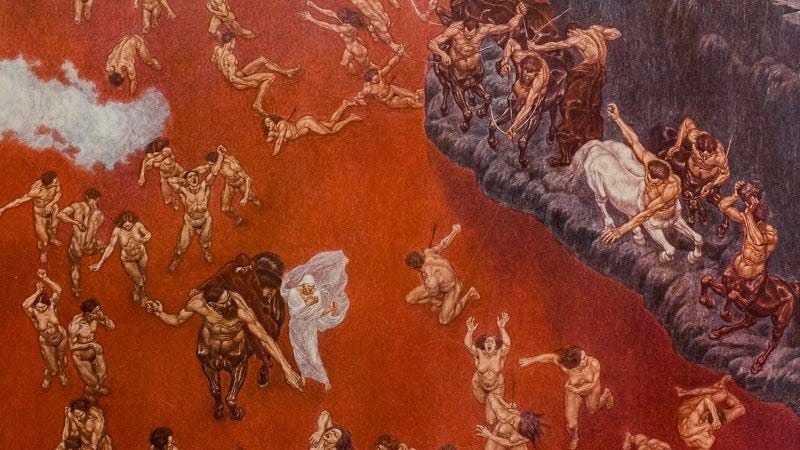
Having just witnessed such a brutal punishment for tyrants, Dante leaves those who engaged in violence and enters the Eighth Circle. Expecting to see a sin worse than the circle before, Dante sees those souls who engaged in pandering, seduction, and flattery.
How is flattery a worse sin than heresy or murder?
What Is Truth?
Virgil tells Dante the Pilgrim that the souls in the Eighth Circle are guilty of simple fraud, while those in the Ninth and final circle are guilty of complex fraud or treachery.
Dante the Poet does not present the Inferno as an actual mapping of hell but rather as a mapping of the depravity of sin. Dante is a master of the soul, and the Inferno rips the polite veneer off sin and reveals the ugliness of human desire. It is a story of vice and what leads souls into choosing evil.
What, then, is Dante the Poet trying to teach you about the nature of evil by placing a sin such as flattery, a species of fraud, in a lower section of hell than violence?
Two preliminary considerations to start to see his wisdom…
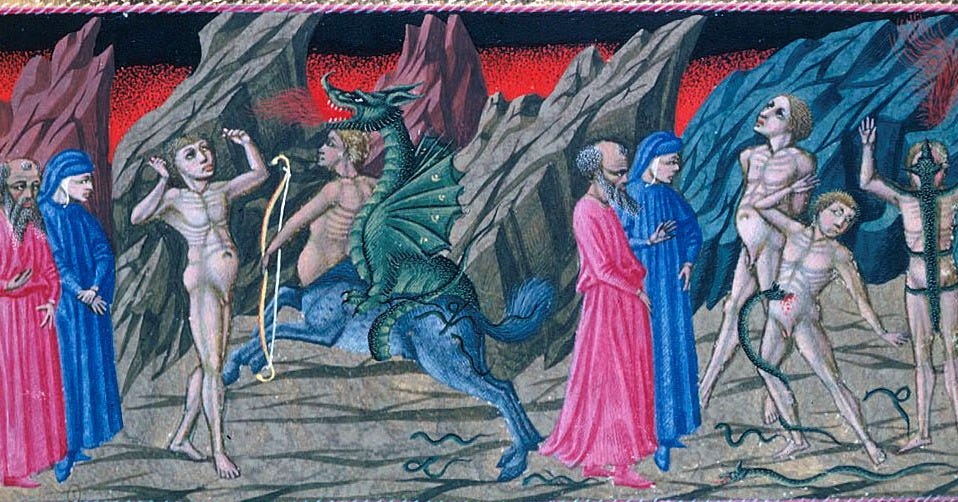
First, you must understand that truth is the conformity of the mind to reality. When you say something is true, you mean it represents authentic existence, an objective realism. Modern man often wants reality to conform to his mind, but truth is the conformity of the mind to reality — this definition of truth comes from Saint Augustine and was leaned upon by Saint Thomas Aquinas.
Christians teach that the world is intelligible. You can come to know truth in this life, as the cosmos is ordered and knowable. Saint Paul teaches in the opening of his letter to the Romans that you can come to understand the reality around you and determine what is good and what is evil — and you are responsible to live in accordance with those rational observations.
Second, the purpose (telos) of speech is to convey truth. If truth is the conformity of your mind to reality, then your speech has the purpose of sharing truth with another. Speech is not neutral. It is ordered toward reality, toward what is true. Your speech should always help you and your neighbor come to understand what is true. Iron sharpens iron, and speech is the way you pursue truth with those around you.
The corruption of the best is the worst. Or, in a more poetic fashion, the higher the angel, the greater the demon. It is in understanding the loftiness of truth and speech that you can start to understand the depravity of lying, a lesson that Dante carves into his Inferno.
Still, how is lying worse than murder?
What Is a Lie?
Lying is contrary to the very purpose of speech. Where speech has the purpose of wedding the mind to reality, lying divorces the mind from reality. When you lie to your neighbor, you impede his intellect from knowing what is true. It is incredibly deleterious to the soul, as the intellect, which loves truth, now satiates on a falsehood. It leads into greater error, as the soul operates off a fiction and not reality. Lying decouples the mind from reality and leads it into disorder and artificiality.
Yet, does this really answer the question presented by Dante?
Lying is evil, yes, but why does Dante think it is so evil that even the sin of flattery would be punished amongst the worst sections of hell?
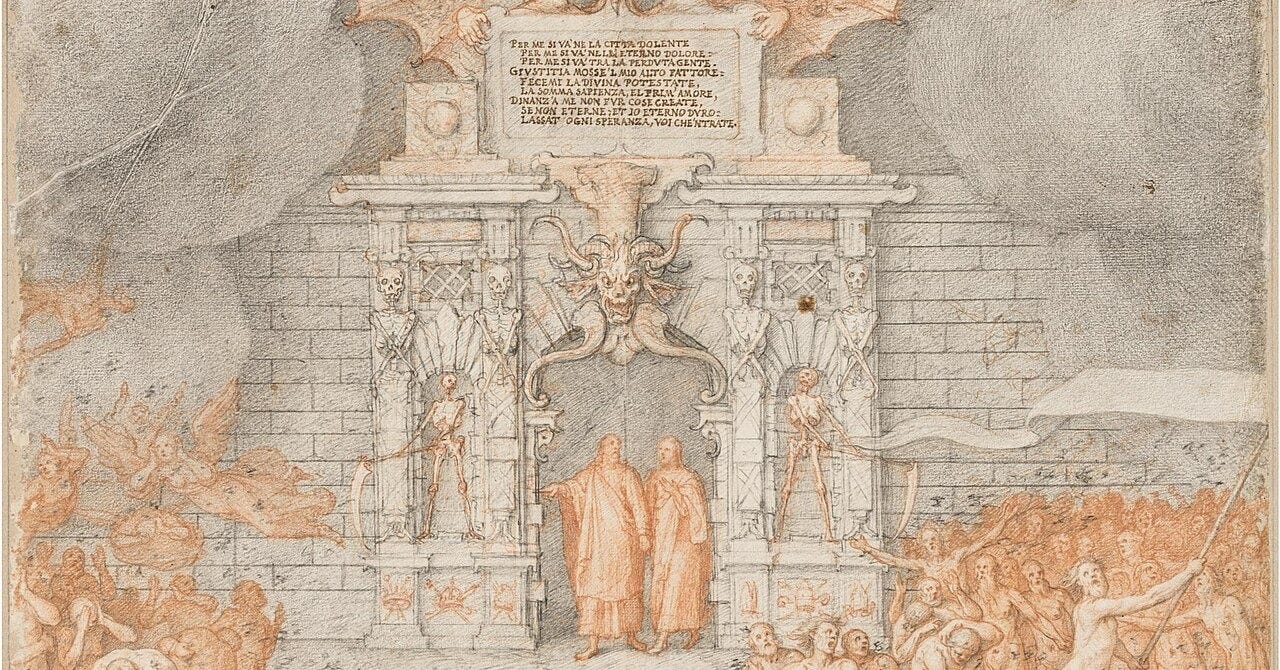
The Eternal Word
To understand why, recall that Jesus is understood by Christians as the Eternal Word. Saint John, in the opening of his Gospel, states:
All things were made by Him: and without Him was made nothing that was made.
John 1:3
In Genesis, we see God speaking creation into existence — it is the Word that gives structure to reality itself. God says, “Let there be light” and light becomes real. Similar to how a word gives form and meaning to sound, the Eternal Word gives structure to reality. When you speak, you attempt to convey the truth about reality. When God speaks, it conveys reality itself.
This is why Christians, like Dante, say that Christ is the truth. Not that he knows the truth, but rather he is the truth — because if truth is the conformity of the mind to reality, and Christ is the author of reality, then to come to know him is to know the truth of all things.
Thus, returning to Dante’s catechesis on lying, you can see that to speak a lie is contrary to the very nature of reality. Every lie you are told separates your intellect from the truth, which in turn separates you from God’s truth.
To Dante, it is evil to destroy the body, but it is much more evil to destroy the mind. Fraud, which includes malicious flattery, causes the intellect to satiate on falsehood, ushering in a host of disorders. And every act of fraud, every deception of the intellect causes a soul to be further from reality and its author.
Again, the corruption of the highest is the worst, and Dante knows that the corruption of man’s intellect — his highest faculty — creates in him the greatest evils.
Never lie.
Thank you for reading!
This is an essay that we recently published on our sister publication, The Ascent.
There, we are diving deeper into theology, mysticism, and ancient texts — please join us if that interests you! You’ll get one free article every Tuesday, and longer essays like this every Friday for paid readers…

Thank you for sharing our article! Dante is a master of the soul. He has many lessons for those willing to learn.
Dante as an architect of the soul, not a keeper of the penal ledger, that is the strongest move in your text. The idea of reading lying as sabotage of the contact between mind and reality lands perfectly. Suddenly, the flatterer seems more dangerous than the tyrant, because he attacks not the body, but the map inside the head.
That is precisely why I stumble over the smooth phrase “Never lie.” In Dante’s inner geometry of hell, that may be true. In a hospital, in an interrogation room, at a deathbed, it becomes more complicated. The white lie, the polite half-truth, self-deception. All lies, yes, but not all the same circle. Anyone who presses everything into one formula risks believing their own moral system is clearer than the real world.
A second blind spot. If lying is so grave, where do we place fiction? Dante himself invents a hell that never existed in order to move us closer to the truth. The boundary between poetry and deception does not run along the sentence “This did not really happen,” but along the claim to have reality on one’s side. Flatterers and propagandists imitate precisely that claim.
Perhaps that is the real point after all. Not “Never lie,” but “Do not confuse your theology with reality, or you will become a flatterer yourself.”