


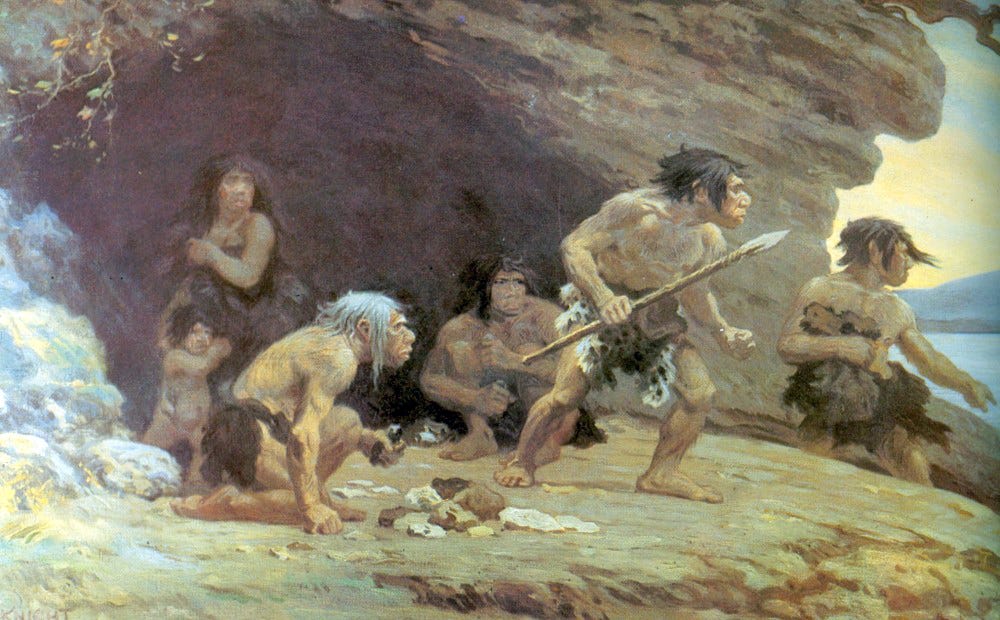
Every age likes to think of itself as more enlightened than the one before it. We look back on our ancestors with a sense of intellectual superiority, convinced that humanity is steadily advancing towards a better, wiser, more rational future.
But is this really the case?
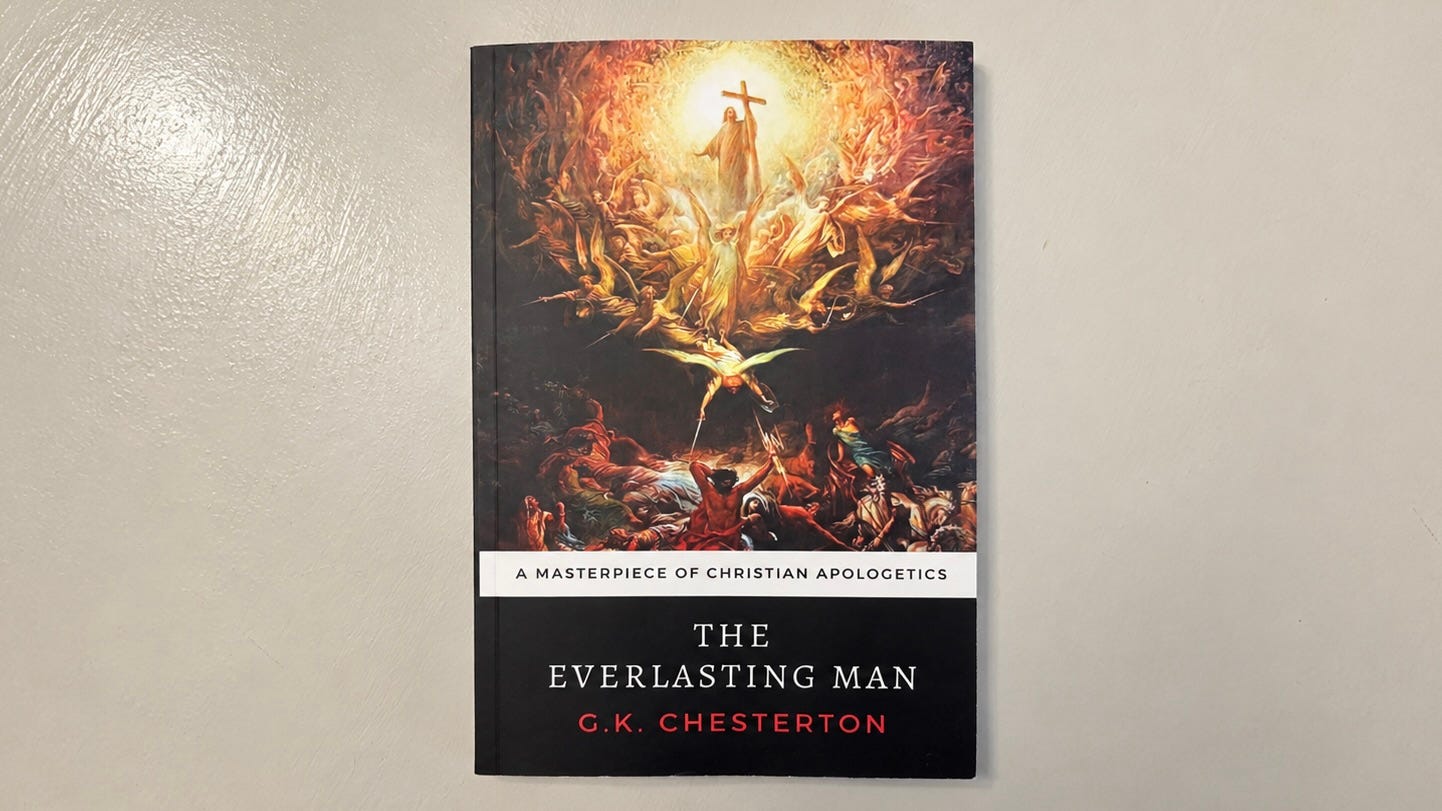
Tackling this very question will be the focus of our book club read for December, because we’ve just voted to read this masterpiece next:
The Everlasting Man by G.K. Chesterton.
In this classic work, Chesterton challenges some of the most deeply held assumptions of the modern world…
We will read it together over the next 4 weeks and discuss it in two parts:
December 2nd — Part 1, On the Creature Called Man
December 16th — Part 2, On the Man Called Christ
Note: we are expanding our book club activities, so members will now receive weekly reading guides (like this one) via email instead of just biweekly!
We want to make this a much richer read-along experience for those who want to dig deep into the texts with us. To begin, then, below are some key ideas to consider during Week 1…
Join our pilgrimage through the Great Books! You can get all our resources and participate in the discussions by taking out a membership here for a few dollars:
Chesterton wrote The Everlasting Man in 1925 as a response to H.G. Wells’ The Outline of History. Wells’ basic argument presupposes that man is a fundamentally rational creature, whose story is one of a seamless evolution from ape to man. Furthermore, Wells argues that man is becoming increasingly rational over time — religion, spirituality, and mythology were archaic practices of primitive man, but we are now progressing to a higher mode of being where mankind will become an entirely rational being.
In short, this is the modern “doctrine of progress”: man’s progression to a higher mode of being that will enable him to live long, well, and prosper.
It is precisely this “doctrine of progress” that Chesterton takes issue with. His main argument in Part 1 is not a positive argument for Christianity, but a negative argument against Wells’ philosophy. His attempt is to show that the modern beliefs about “progress” are built on bad philosophy, and that Christianity, by contrast, is the most rational choice (or the least irrational) for a reasonable man to make.
To be clear, Chesterton is not simply rejecting evolution as such, but challenging the assertion that evolution necessarily entails intellectual, moral, and spiritual progress. Even if man developed from apes, this tells us very little about whether modern man is wiser, more virtuous, or more fully human than his prehistoric ancestors.
To ground this argument, Chesterton introduces two core ideas:
1. Man Is a Stranger on Earth
The first idea is that man is a stranger on Earth. In Chesterton’s own words, man is “a very strange being; almost in the sense of being a stranger on Earth.”
Whereas animals fit snugly into nature, man does not. He wears clothes, builds fires, tells stories, buries his dead, and commits to the arts and activities with seemingly no practical use whatsoever.
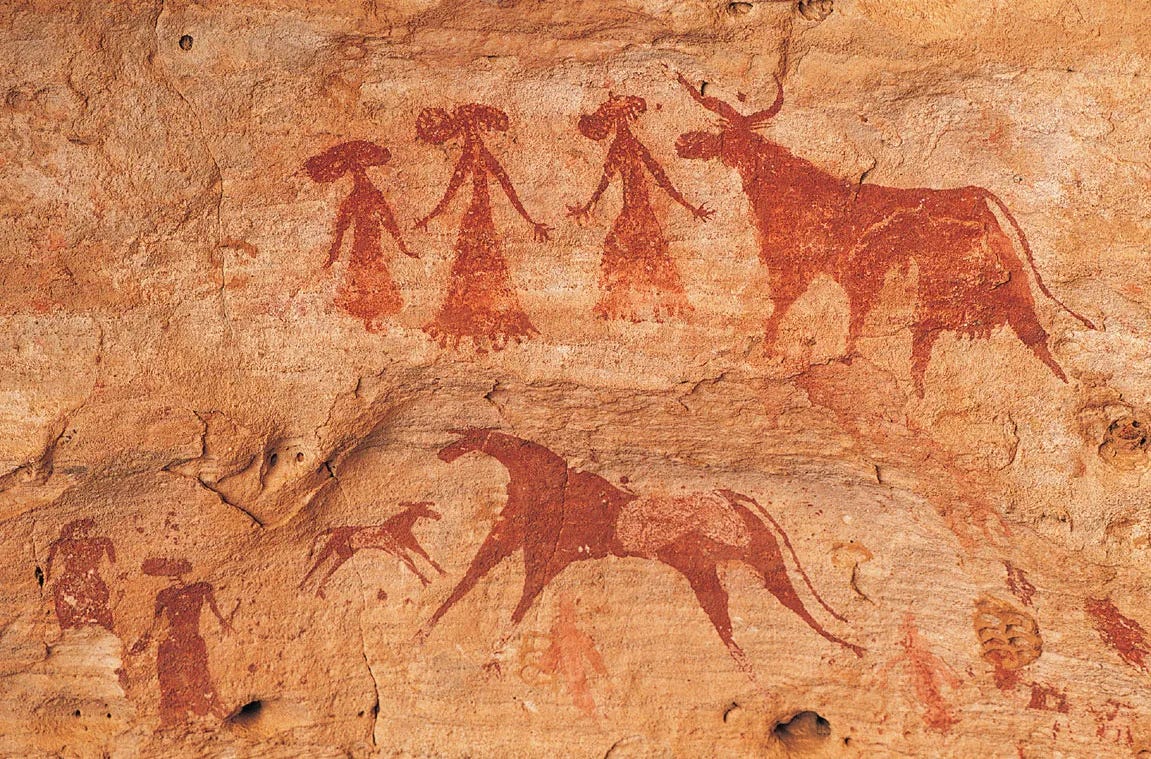
He places particular emphasis on art. The cave paintings of prehistoric man were obviously not practices to help man survive; rather, they were the first signs of mankind attempting to communicate ideas to one another. “Art is the signature of man,” Chesterton asserts.
Such a signature is distinct to man alone, and evolution may suggest that man descended from apes, but it does not explain why man created art.
And this brings up the second idea of Chesterton’s: debunking a popular myth widely accepted by the modern mind. Once this myth is exposed, it reveals that most of modern philosophy’s ideas, assumptions, and beliefs about human nature are far more faulty than meets the eye.
2. The Myth of the Caveman
This second idea involves debunking the “popular myth” of the caveman. Chesterton points out how — in the popular imagination — we picture a caveman as a bumbling, subhuman brute who gradually becomes more rational with time.
Chesterton’s question, however, is: where did we get this idea? What evidence do we have that cavemen were actually bumbling, ape-ish brutes?
He points out that we have virtually no evidence to support this view. All that science and history can reveal to us are artworks left on the walls, and a few bones and tools of prehistoric man — but bone structure gives no indication about the mind, body, or soul of prehistoric man. In fact, Chesterton notes a great irony that cave evidence suggests the opposite: the caveman was already an artist, dealing with symbols, signs, and allegory.
Fundamentally, these musings on the cavemen are not an argument for Christianity, but an argument meant to shatter our false, unearned confidence in the modern “doctrine of progress.” Chesterton points out how said doctrine is founded upon ignorance and poor philosophical assumptions, hiding behind the authority of science to smuggle in faulty conclusions.
The deeper question, then, should be approached with a posture of wonder and humility: what is the proper origin and story of mankind? This question will help guide the further arguments as we continue through The Everlasting Man…
Some other questions/ideas to ponder:
Chesterton claims man is a “stranger on the earth.” Does his argument from art convince you? Why exactly is the drawing of images significant to understanding man?
Chesterton insists that the difference between man and beast is not a matter of degree — that evolution alone cannot explain WHY man became conscious in the first place. Ponder this mystery of consciousness, and why it distinguishes man from beast.
Chesterton embraces science, but accuses the evolutionary storytellers of smuggling bad philosophy behind the authority of science. What, then, is science actually capable of teaching mankind? What are the limits of science as it pertains to philosophy?
Think about the fact that Chesterton’s initial argument is negative — emphasizing the irrationality of the modern doctrine of progress. Why might he have chosen this approach? What does it suggest about how he thinks truths about man are best known?
Share your thoughts below or in the subscriber chat, along with any questions you have. We’ll incorporate them into our discussion!
You can join our pilgrimage through the Great Books (and participate in the live discussions) by taking out a membership here:
As a full member of our book club, you’ll get:
Live book club discussions (biweekly) and recordings
Weekly discussion threads to guide your reading
Access to our incredible community chat
Our entire library of resources, essays, and articles
If you’re wondering how the book club works, check out this page:

The caveman part is my favorite part of the book.
We iimagine grunting brutes, and then you look at the horses at Lascaux and they're beautiful.
Somebody crawled deep into a dark cave with a little lamp to paint those beauts. That's not a guy who's only trying to survive……Art really is the signature of man….long ago too.
I quit the doom newsfeed this year and went back to old books like this one. Chesterton is the cure for the idea that newer necessarily means wiser.
Progress is a lie.