


Hello, book club!
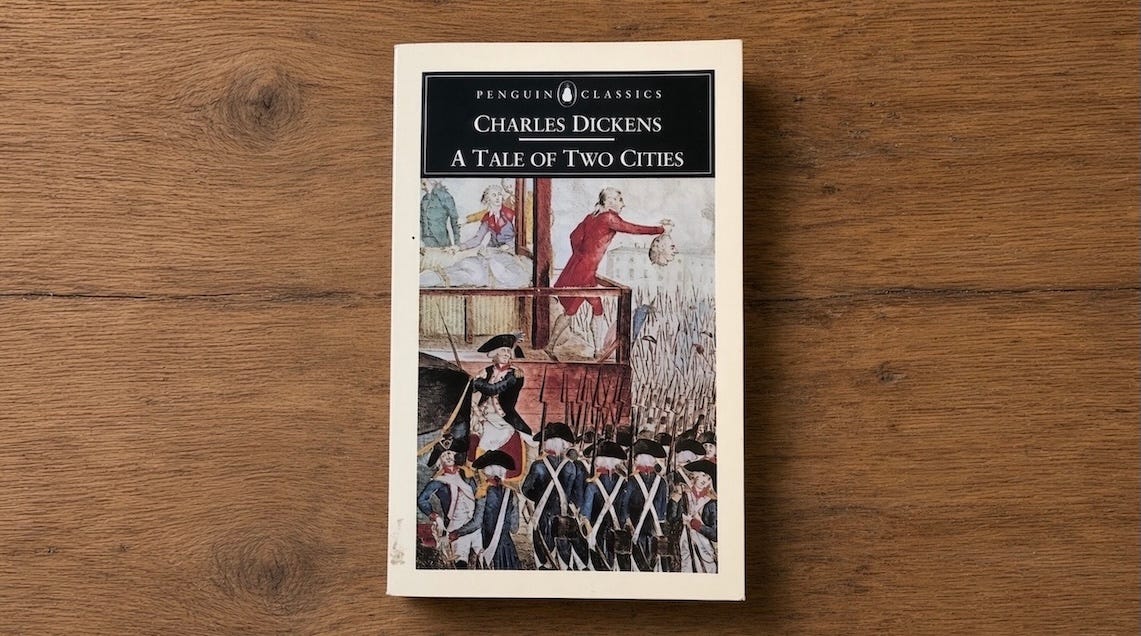
It’s the beginning of a beautiful week… we’re about to start our read-along of A Tale of Two Cities by Charles Dickens.
In my own humble opinion, this is Dickens’ greatest work. It is a deeply emotional, redemptive story that is easily one of the crowning works of the English language. It is less sprawling, less digressive, less “Dickensian” than his other works, though it is Dickens at his most concentrated and devastating.
We meet on Wednesday, November 4, at noon ET. The first discussion will cover the context of the work and what to look out for in Part 1 and the first half of Part 2.
Note: you don’t strictly need to have done any reading yet, but it will help if you have done some. Wednesday’s discussion will be a useful introduction for those just making a start.
We will discuss the novel in two parts:
Session 1 (Nov 4) – Book 1 + Book 2 chs. 1–18
Session 2 (Nov 18) – Book 2 chs. 19–24 + Book 3
The first discussion will be live streamed via Substack at this link.
For those joining our discussion group directly (available to all paid members), the Zoom link is at the bottom of this email…
To begin, then, here are some key ideas for us to consider ahead of the first discussion…
You can join our reading group by taking out a paid membership here:
As a member of our book club, you’ll get:
Live book club discussions (biweekly) and recordings
Access to our incredible community of readers
The entire library of essays, articles, and podcasts
The novel begins with its famous catalog of paradoxes:
It was the best of times, it was the worst of times, it was the age of wisdom, it was the age of foolishness, it was the epoch of belief, it was the epoch of incredulity, it was the season of Light, it was the season of Darkness, it was the spring of hope, it was the winter of despair, we had everything before us, we had nothing before us...
Dickens emphasizes the strange dichotomy of the era (the story begins in 1775), particularly in France and England. Depending on the lens through which you viewed society at the time, it was either an era of great pleasure or suffering.
The optimistic outlook of “good times” was due in part to unprecedented luxury enjoyed by the French aristocracy and English elites. It was also an era of progress — the Industrial Revolution and the Enlightenment were reshaping society — and man had dreams of a better tomorrow. And finally, revolutionary fervor under the ideal of “liberty for all” was sweeping through Europe.
And yet, these “good times” were counteracted by severe poverty for the lower classes, along with a felt sense of moral decadence, and ultimately state terror through the oncoming French Revolution. This milieu of extremes will mark the environment in which our narrative takes place.
The narrative itself begins with a message delivered to Jarvis Lorry, a banker’s clerk. The note reads:
Wait at Dover for Mam’selle.
Rather cryptically, Lorry’s reply is simply:
Recalled to life.
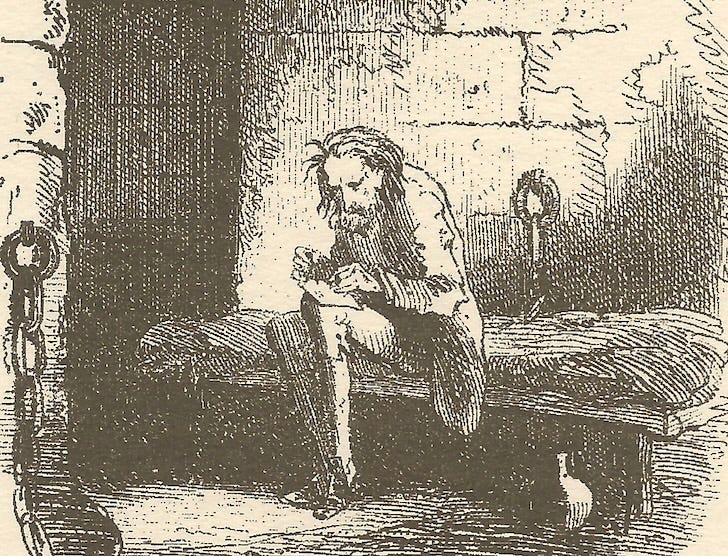
This message refers to Dr. Manette, a man imprisoned in the Bastille for 18 years who was presumed dead. Brief as this message is, it has a strange resurrectional tone underpinning it. Dr. Manette was figuratively “buried alive,” which introduces a running atmosphere throughout the novel: a felt sense of death, burial, and return to new life.
In other words, is redemption possible after years of suffering have sapped a man of his humanity?
This question is largely prompted when we meet Dr. Manette himself, who’s been reduced to a downtrodden husk of a man in prison. After 18 years, his memory has faded and he is only able to identify himself by his cell number, 105.
This question is further explored through Dr. Manette’s daughter, Lucie. She’s a golden-haired maiden who’s long believed her father to be dead. And though her loss has struck her with grief, there’s indeed a gentility of her soul that seems to strike life into the characters who interact with her, most notably Sydney Carton.
Pay careful attention, then, to the distinctive qualities of Lucie that draw good-natured souls towards her. Ask what is necessarily “life-affirming” about her being.
Below are some key questions to consider:
Why does Dickens open with such a long list of contradictions about the age? What does this strong dichotomy of paradoxes suggest about the tension of the day?
Consider the phrase “Recalled to life.” This is a strange phrasing for a man merely freed from jail. What is the significance of this resurrection imagery?
Further consider Dr. Manette’s debilitating condition in prison — his lack of memory, etc. Ponder what injustice befell his spirit to make him this sickly, and what is needed to “rehabilitate” him into his humanity?
What role does Lucie play in this first book? Is she a person, a symbol, or both, and what does her presence do to those around her?
Please share your thoughts below or in the subscriber chat, along with any questions you have — and we will incorporate them into Wednesday’s discussion!