

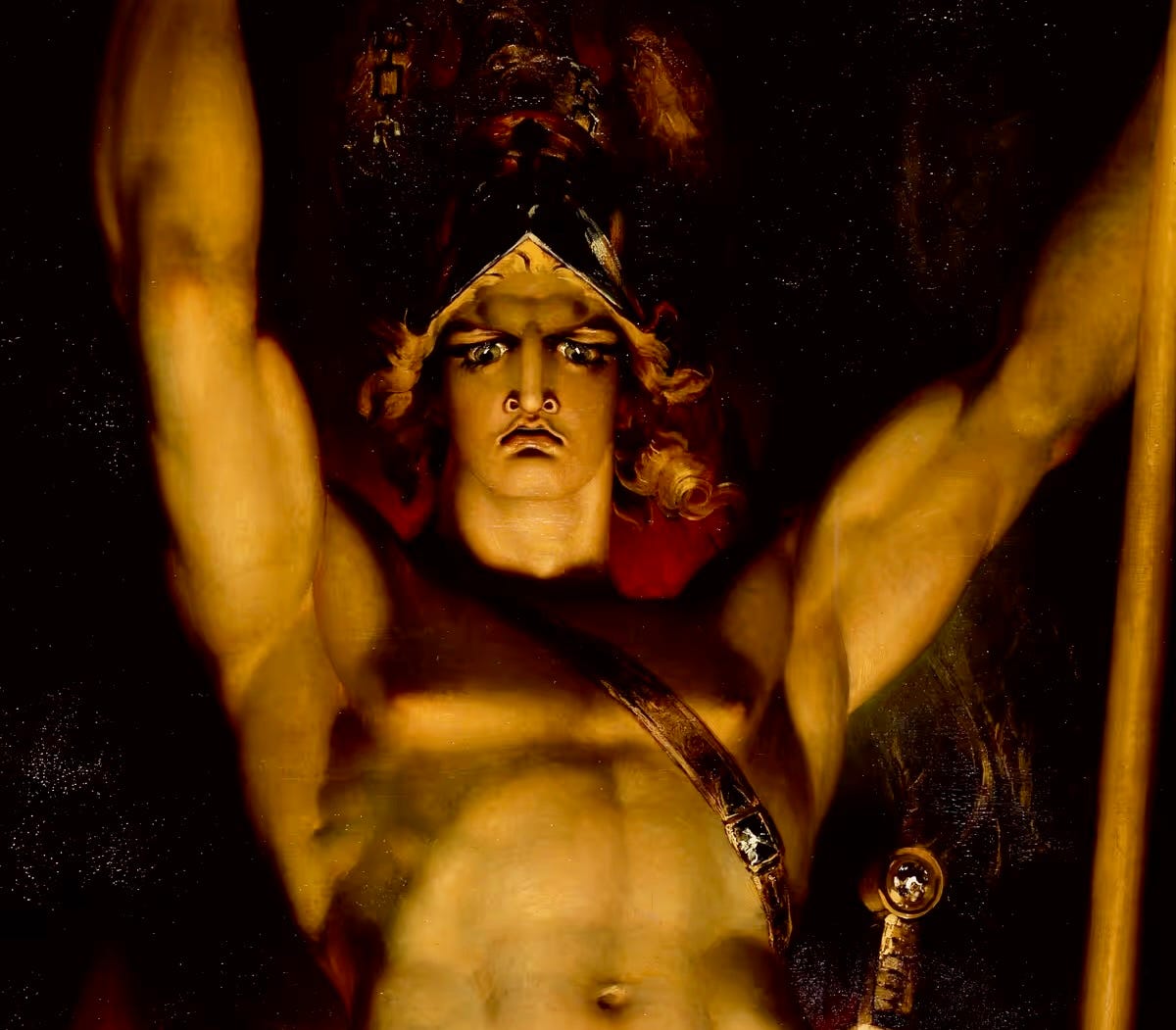
John Milton’s Paradise Lost is considered by many to be the greatest epic poem in the English language. It documents Satan’s rebellion against God, the temptation of Adam and Eve, and their expulsion from the Garden of Eden.
But most shockingly, it does something that no other piece of literature prior had ever dared to do: it portrays Satan in a sympathetic light. His rebellion is cast with a noble veneer, and Lucifer himself is cast as a sort of romantic hero.
This revolutionary depiction, however, wasn’t actually intended to win readers over to Satan’s side. Instead, it is Milton’s way of tricking his audience into seeing things from a different perspective. Unfortunately, it might have been too good a trick, as still many readers today overlook Milton’s real message.
So what does the portrayal of Satan in Paradise Lost reveal about the nature of evil, and the capacity for evil that lurks within all of us readers? Let’s find out…
Reminder: this is a teaser of our paid subscriber essays.
If you’d like to support our work, please consider a subscription. You’ll get:
New, full-length articles 2x per week
The entire archive (200+ articles, essays, and podcasts)
We have just voted to read East of Eden by Steinbeck next in the book club. The first discussion is on Wednesday, August 12, at noon ET — join us!
The Devil Before Milton
But first, let’s begin by comparing Milton’s depiction of Satan with those that came before him.
In the Book of Revelation, Satan is depicted as a dragon; an ancient serpent hurled down from heaven and destined for eternal defeat. As Christianity spread, there arose the tradition of Lucifer having been one of, if not the greatest angel in Heaven before he rebelled. Ultimately, however, his story was one of warning: Dante, for example, portrays him in Inferno as the underworld’s most miserable inmate, frozen in his own evil.
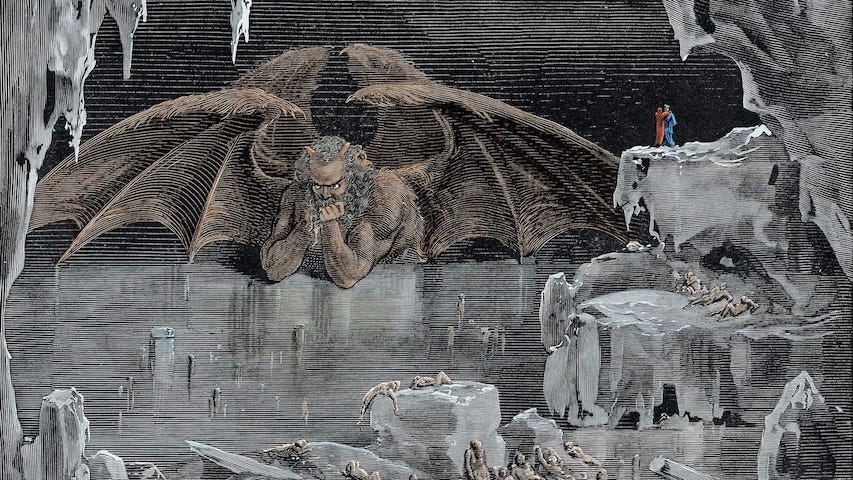
But why did Satan rebel in the first place? Tradition holds that it was because of pride, for Lucifer in his angelic splendor could not stand the thought of God elevating such a miserable creature made of mud, man, to such a high place of glory. Humans, after all, are inferior creatures compared to angels — not of less worth or dignity, but of a lesser order of being in the created universe.
If you’ve ever heard the phrase “pride is the mother of all sin”, it derives from precisely this tradition. Satan’s rebellion stemmed from pride, and that pride led to him setting out to corrupt humanity and prove to God that he was right. His influence in the world leads to evil — thus “pride is the mother of sin”.
In none of these cases is Satan viewed as a sympathetic character. The closest we get to that are depictions of Satan in medieval mystery plays, where he was sometimes portrayed as a comic character and someone to laugh at. Milton’s depiction, as we shall see, was far more revolutionary…
The Seduction of Evil
The Satan of Paradise Lost is unlike any other Satan prior. Here, he is a charming and charismatic rebel, a daring visionary undaunted by God’s tyranny. His battle cry is a rally for anyone looking to throw off the yoke of tyrannical authority:
“Better to reign in Hell than to serve in Heaven!”
In the early books of Paradise Lost (there are twelve in total), Satan is portrayed as a bold leader and gifted rhetorician, inspiring his followers with his speeches. But even more novel, Milton pulls back the curtain on Satan’s interior life. He gives him a conscience and a sensitive side, showing how even Satan himself is conflicted by the destruction he’s wrought on creation. As a cultured lover of beauty, Satan is sorrowed to see creation’s beauty wither.
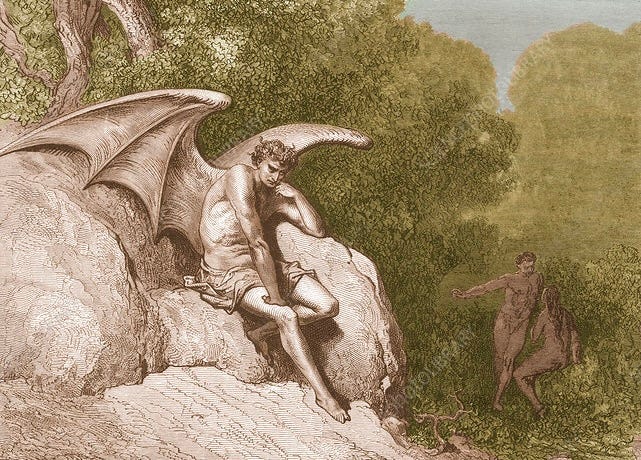
This doesn’t stop him, of course, from continuing on his path regardless. In this dogged persistence, the version of Satan we get in Paradise Lost hearkens back to figures from Shakespearean tragedy. The line “I am in blood / Stepped in so far that, should I wade no more, / Returning were as tedious as go o’er” sounds just as natural in the mouth of Milton’s Satan as it does in that of Shakespeare’s Macbeth (for whom it was originally written).
But why would Milton choose to portray Satan this way?
By the time he wrote Paradise Lost, revolutionary spirit was in the air in Europe, so it’d be easy to think he’s simply offering a critique of that. But actually, he’s pointing to something far more universal, a human flaw that threatens to ruin any attempt — from either side of the political divide — to establish a “perfect” world.
At first, Milton wants you to root for Satan: after all, why should one omnipotent God get to impose his will on everyone else? Shouldn’t a bold, visionary angel be free to forge his own path?
This is cleverly done, because the brilliance of Paradise Lost is that it forces you to confront the very same potential for evil that lurks inside of you — and you will soon learn the truth about rebellion, and finally see evil for what it really is…