


Love might be the most powerful force in the world, yet the English word for it is anything but. For starters, it’s incredibly unclear: what does it mean, for example, that you “love” chocolate? Or that you “love” going to the movies? Do you really love these things in the same way you love your spouse and your children?
Hopefully, the answer is “no”. But why, then, do you use the same word to express your love for such different things?
To the ancient Greeks, this kind of linguistic imprecision would be considered barbaric. This is because they had at least five different words for love. The nuance between these different meanings helped the ancient Greeks better make sense of the type, measure, and intensity of their love for other things and people, and it can help you do the same.
That’s why today, we look at these five ancient Greek words, and discover what they can teach you about the nature of love itself…
Don’t forget to join our online book club!
We just started our 6-week journey through Homer’s Odyssey…

The next discussion is TODAY, June 17, at noon ET — join us!
We are 100% reader-supported. This newsletter is free, but if you’re able to support us, please do consider a paid membership. You’ll get:
Full-length articles 2x per week
The entire library (200+ articles, essays, and podcasts)
1) Storge
Storge (pronounced “store-jay”) is most ubiquitous type of love, arising naturally from basic human networks and relationships. It describes the type of love you have for family, your country, or your classmates: in other words, love that stems from familiarity.
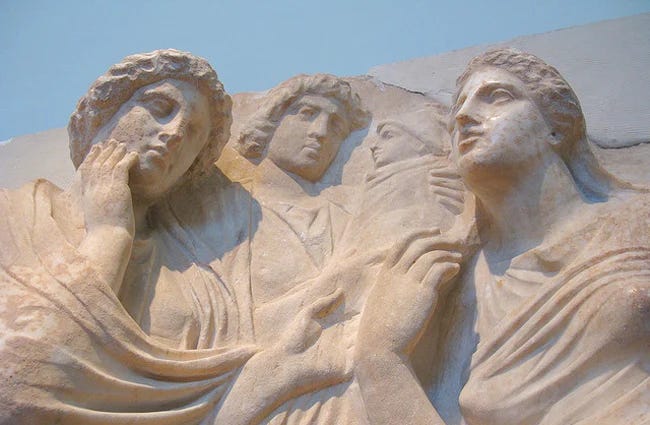
This is not to say, of course, that the love you have for your high school friends is the same you have for your family, but it’s simply to indicate the sort of affection that naturally arises from proximity. It’s the kind of love Antoine de Saint-Exupéry describes in The Little Prince, writing:
“[My rose] is more important than all the hundreds of you other roses: because it is she that I have watered; because it is she that I have put under the glass globe; because it is she that I have sheltered behind the screen; because it is for her that I have killed the caterpillars (except the two or three that we saved to become butterflies); because it is she that I have listened to, when she grumbled, or boasted, or ever sometimes when she said nothing. Because she is my rose.”
Storge is a naturally occurring type of love, but this also makes it easy to take for granted. It is always wise to remember that even though storge seems “built-in”, that doesn’t mean you can act however you want. The bonds of storge love can still be broken by cruelty, or even mere indifference.
2) Philia
If storge is the most natural type of love, philia is perhaps the most unnatural. Philia is love in the sense of close friendship, whether between siblings or schoolmates. It is considered “unnatural” in that it doesn’t just occur spontaneously: character and circumstances must align for a true friendship to begin, and intentionality must be present for it to endure.
For this reason, however, philia is considered a higher-level love in regards to storge. While storge ensures that siblings are endowed with a natural affection for each other, it is philia which enshrines that closeness with lasting love and closeness, especially through the ups and downs of later life.
Perhaps because of its rarity, the ancient Greeks put an incredibly high value on philia. Oxford professor C.S. Lewis once described their affinity for it as such:
…to the Ancients, Friendship seemed the happiest and most fully human of all loves; the crown of life and the school of virtue.
3) Eros
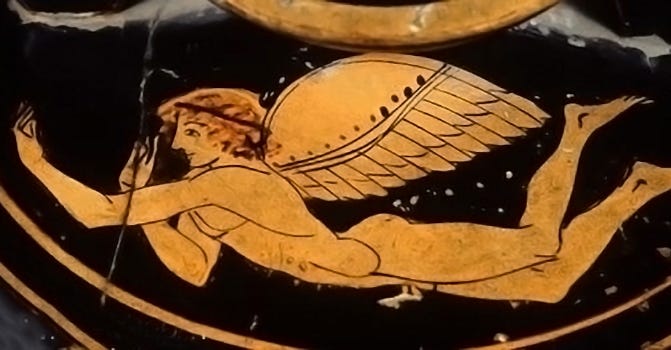
Eros is arguably the most misunderstood type of love. Because of its connection to the word “erotic”, it’s far too easy to simply write of eros as mere lust — but this is a colossal mistake.
Our sister publication The Ascent shared a comprehensive guide to eros, covering its origins in pre-Platonic Greek thought to its role in Christianity, and why it is absolutely essential in order to know and love God.

At its heart, eros is a sort of generative energy that moves souls to action. The direction in which it pushes you, however, varies greatly depending on how you engage with it. It can either push you towards the good, true, and beautiful, or towards madness and mania.
For better and for worse, eros is a love that overcomes reason. The only question is, how will you use that to your advantage, and not your destruction?
(If you’re interested in learning more about eros, we really recommend you check out The Ascent’s article on this topic. It is far more comprehensive than anything we could include here!)
4) Philautia
At its most basic, philautia is the love of oneself. However, just as with eros, philautia has both noble and ignoble forms.
At its best, philautia is the type of self-love that acknowledges one’s innate dignity. It allows you to have compassion for yourself, recognizing your flaws (and resolving to improve them) without sliding into contempt for yourself.
On the other hand, though, an unhealthy form of philautia makes you vain, prideful, and selfish. It makes you avoid criticism for fear of inflicting pain on your ego. Whereas healthy philautia makes you more confident, unhealthy philautia makes you more insecure and fragile.
The ancient Greeks recognized that keeping philautia in proper balance was no easy task. Aristotle proposed that a good litmus test to see how you’re doing is to ask if your philautia leads you towards virtue or away from it. When properly embraced, philautia should always lead you to the former.
5) Agape
This is the highest form of love, the type that most imitates God’s own. Translated into Latin as the Christian virtue caritas (from which we get “charity”), it also means “affection.” But what does this kind of affection look like?
Agape, to St. Thomas Aquinas, meant “to will the good of the other”. It is a kind of unconditional love that seeks the best for the beloved, even when that comes at the expense of the lover. Jesus’s claim that “No one has greater love than this, to lay down one’s life for one’s friends” underscores this self-sacrificial element.

Whereas storge is defined by proximity and circumstance, philia by freedom of choice, and eros by deep desire and longing, agape is best defined by the action of the will, the voluntary decision to love and be faithful even in the worst of circumstances. For this reason, it is the most selfless and constant; the most God-like love you can achieve.
Agape love is so essential that without it, even the most noble and glorious of causes is reduced to nothing. Saint Paul highlights this in the famous passage from 1 Corinthians 13:
If I speak in the tongues of men and of angels, but have not [agape], I am a noisy gong or a clanging cymbal. And if I have prophetic powers, and understand all mysteries and all knowledge, and if I have all faith, so as to remove mountains, but have not [agape], I am nothing. If I give away all I have, and if I deliver my body to be burned, but have not [agape], I gain nothing.
But perhaps the best description of agape comes in the lines that follow. Here, we get to see just a few of the characteristics of agape. In reading the words of Saint Paul, it is clear to see why this love is considered as superior — but not in opposition — to all the others, and why it remains the greatest form of love you can strive for to this day:
[Agape] is patient and kind; [agape] is not jealous or boastful; it is not arrogant or rude. [Agape] does not insist on its own way; it is not irritable or resentful; it does not rejoice at wrong, but rejoices in the right. [Agape] bears all things, believes all things, hopes all things, endures all things.
Thank you for reading!
As mentioned, we highly recommend you check out our sister publication, The Ascent.
There, we are diving deeper into theology, mysticism, and ancient texts. You’ll get one free article every Tuesday, and longer essays every Friday for paid readers.
This was a beautiful read 🩵
Thank you for sharing our article on eros!