

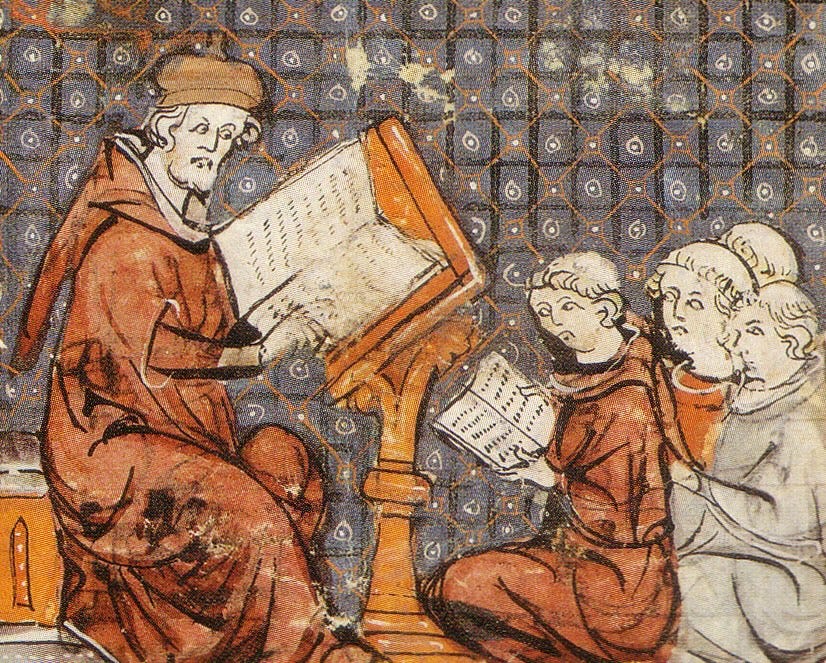
What is the purpose of education? Is it to get a degree and find a high-paying job? Or is it something else entirely?
In today’s world, the phrase “liberal arts” is used by admissions directors to describe a course of study that comprises the humanities and an emphasis on critical thinking. But a brief glimpse at the etymology of the phrase tells a radically different story, and hints at what the purpose of education really is.
In Latin, the “liberal arts” — artes liberales — are “liberal” in the sense they derive from libertas, meaning “freedom”. In other words, the liberal arts are literally the “tools of freedom,” the subjects that make you free to think for yourself and navigate the world around you.
But what are these tools, exactly?
In the Middle Ages, these artes liberales were broken into seven main subjects. These seven were then divided into two groups, the Trivium and Quadrivium. Mastery of the Trivium and Quadrivium was considered essential for anyone to call himself educated, as together they form the backbone of a truly classical education.
Today, then, we look at the seven liberal arts to see how they can help you become truly free in a world that would happily see you anything but. Because unlike our modern system, the medieval world had a coherent vision of education — not as preparation for work, but as a means of shaping your mind and soul…
Our next book club read has been decided…
We have just voted to read Dostoevsky’s The Idiot. The first discussion is on September 23, at noon ET — join us!
We are 100% independent, funded only by our incredible community. Become a paid member and get:
New, full-length articles and essays 2x per week
The entire archive (200+ articles, essays, and podcasts)
The Trivium
The three subjects that comprise the Trivium serve as the foundation of all learning. Not only do they teach you how to think, but they teach you about the very nature of thought itself.
Crucially, no student can move onto the Quadrivium before he masters these three subjects, for his studies would be fruitless without them. Indeed, before setting out, it is important to realize that these disciplines were understood less as distinct “subjects,” but rather as a connected web through which a soul was trained in its capacity to understand the order of reality.
1) Grammar
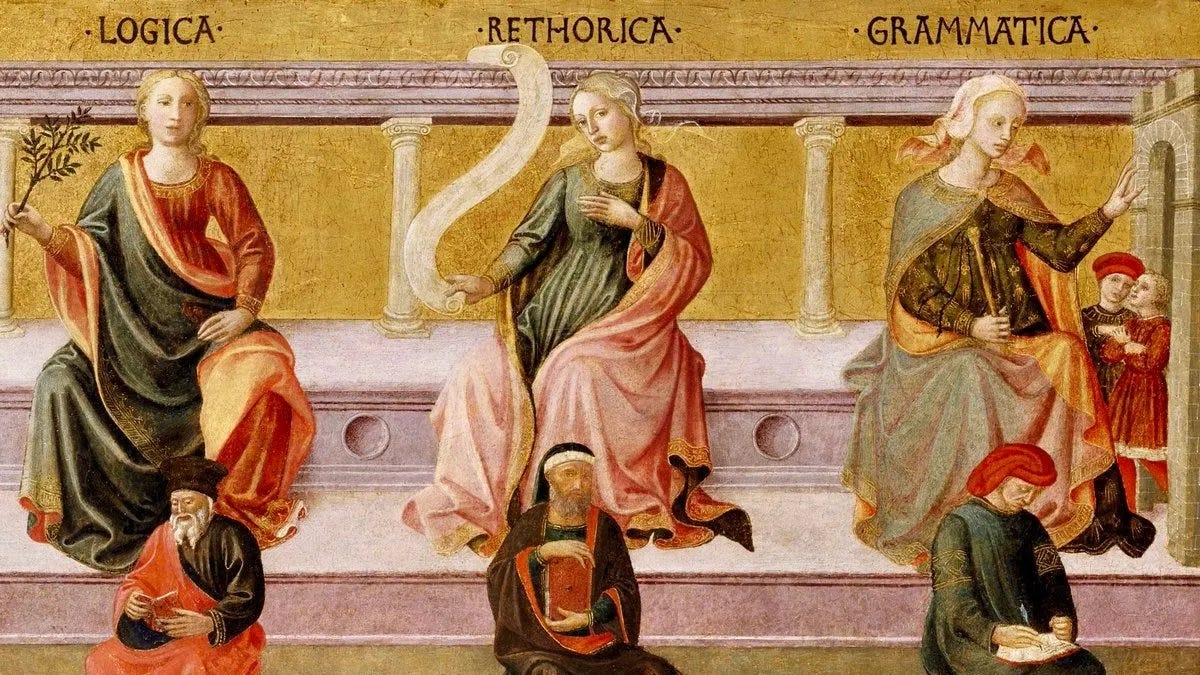
Medieval professors considered grammar to be the gateway to all knowledge. Since you think and express yourself with words, you must have robust knowledge of how words work.
Just as grammar imposes order on language, language imposes order on thought. The best way to express coherent thoughts is to understand the inner workings of language. You must master your own, of course, but it also helps to learn (as all medieval academics did) a classical one like Latin.
But for as necessary as grammar is, it only lays the structural foundations of the metaphorical house of thought. The roof and walls of that house are erected by the next discipline…
2) Logic
If grammar is the ordering of language, logic is the ordering of thought. Building directly on the analytical precision developed via grammar, logic trains you to critically evaluate ideas.
The point of studying logic is to make you invulnerable to lines of reasoning that sound robust, but are in fact flawed. Not only does it help you identify a hidden/false premise in an argument, but it also enables you to think through a philosophy to its real-world implications: what does this look like when taken to its logical end?
In the medieval era, students used texts like Aristotle’s Organon and Boethius’s commentaries to learn how to construct valid arguments and identify logical fallacies. Disputations were also a key part of the curriculum. As almost the entirety of fields like theology, law, and philosophy rests on premises established by logic, mastery of this subject is absolutely key to the formation and governance of a just society.
3) Rhetoric
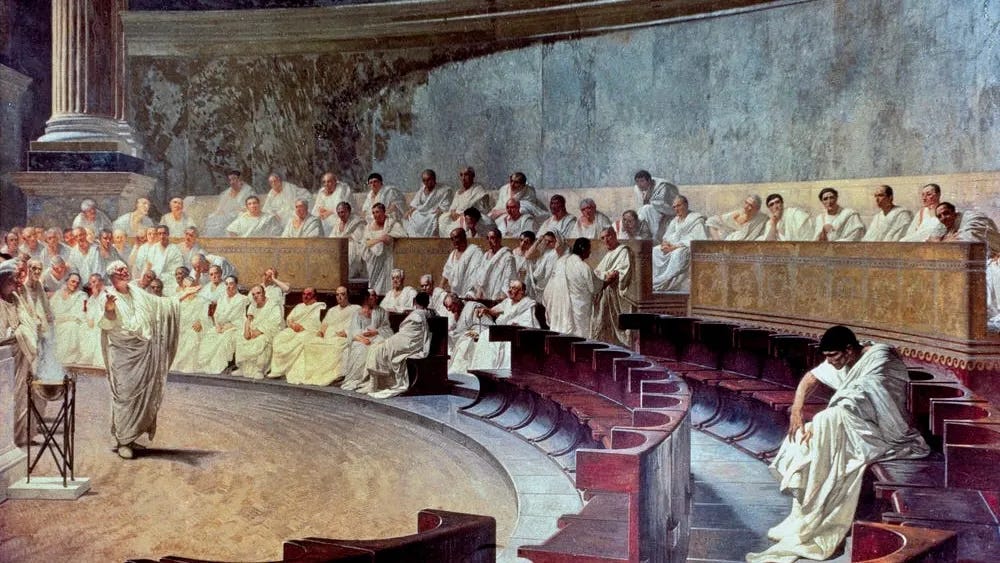
Needless to say, simply knowing how to think rationally isn’t enough. You also need to be able to communicate your ideas to others, too. Rhetoric is the tool that helps you do so with clarity and force.
Unfortunately, the idea of “rhetoric” often gets a bad rap, conjuring up more visions of dishonest politicians than those of just leaders. But historically, skill at rhetoric was viewed as a virtue: given that the truth isn’t always easy to grasp, it requires skilled rhetoricians to help others understand it.
Viewed in this light, rhetoric isn’t just the hobby-horse of a select few, but rather the calling of all those who care about the truth. It’s also why it’s the final subject before you begin the Quadrivium, because no matter what you learn there, none of it makes a difference if you can’t effectively share your knowledge with others.
The Quadrivium, after all, is where your real learning begins. Grammar, logic, and rhetoric are simply the prerequisites for meaningful thought and the pursuit of truth. But they mean nothing if you don’t have real knowledge to communicate.
That knowledge is precisely what the Quadrivium provides. It is the framework that shaped over 1,000 years of brilliant intellectual minds — and perhaps your own, if you’re up to the task. With the Trivium under your belt, you are now ready to understand and be formed according to the pattern of reality…