

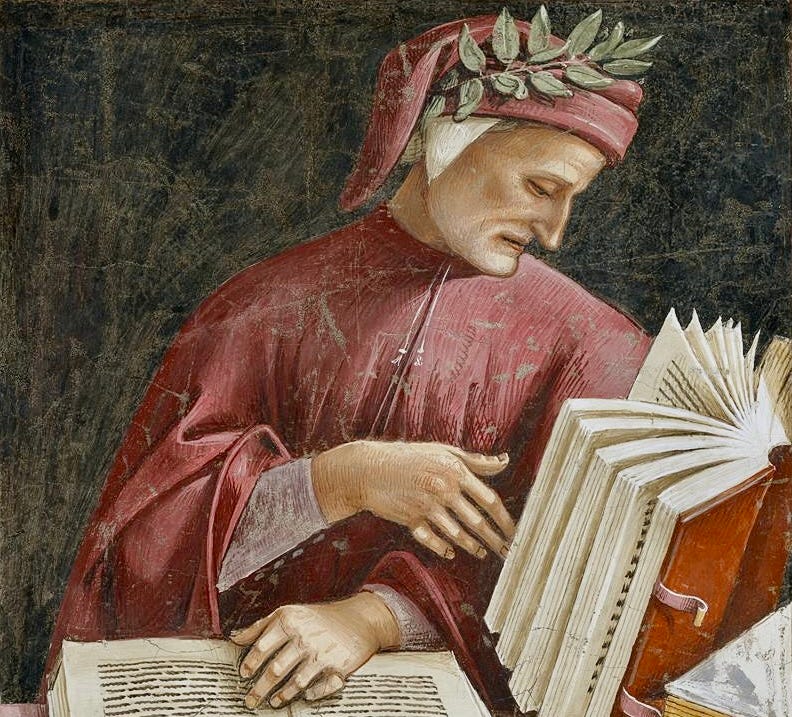
Look at any list of “Great Books” and you’ll find all the usual suspects: Homer, Tolstoy, Cervantes, Dickens, Dumas, and more. Greek, Roman, French, Russian, and English literature receive the most attention, but one group of authors gets unfairly overlooked: the Italians.
Everyone knows Dante, of course, but after him, most would struggle to name even just three Italian authors. This was not always the case, however. As we have written about previously, some of the greatest English writers took their cues from Italian literature, such as John Milton lifting lines for his Paradise Lost right off the pages of Torquato Tasso’s Jerusalem Delivered.
There are historic reasons1 why Italian literature didn’t make it into the Great Books “canon” in the same way French or Russian literature did, but it’s certainly not for lack of quality. Having lived in Italy for the past four years now, I’ve been privileged to discover some of the best of what Italian literature has to offer, and believe it an incredible shame that these works aren’t better known.
That’s why today, I want to share 5 works of Italian literature that absolutely deserve to be included in the Great Books canon.
Forget your Dante, Petrarch, and Machiavelli — the works on this list might not be well known in the English-speaking world, but they are no less impactful than those of Dickens and Dostoevsky…
We are 100% reader-supported. This newsletter is free, but if you’re able to support, please consider a paid membership — it helps us enormously. You’ll get:
Full-length articles 2x per week
The entire archive of content (200+ articles, essays, and podcasts)
1) The Betrothed (I promessi sposi)
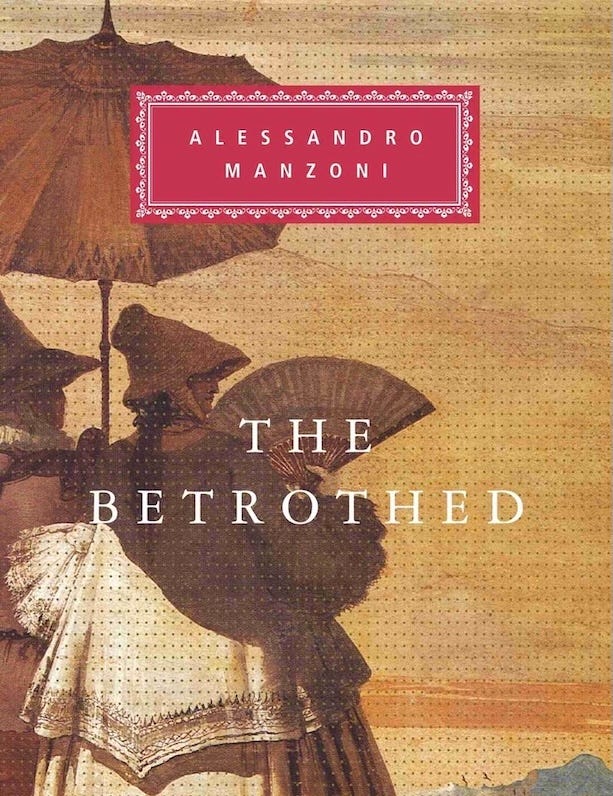
Alessandro Manzoni’s The Betrothed is the national novel of Italy, and has even been endorsed by multiple popes. Most recently, Pope Francis referred to it as “a masterpiece on engagement” and recommended it to all engaged couples in his audience.
Though a lengthier read, Manzoni’s sense of humor keeps the prose fresh and entertaining, and his reflection of the nature of the Christian faith is one that provides material for extended reflection. There are bad priests, saintly aristocrats, evil nuns, and repentant thugs: in other words, everything you could ask for in a work about the honest, real-world experience of faith.
Most importantly, however, The Betrothed is a masterly reflection on the role of Providence in guiding and orchestrating human affairs. Manzoni, an adult convert to Catholicism, explores the varied expressions of la Provvidenza: though seemingly inactive and inconsequential, it is nonetheless present even in one’s most desperate moments, moving silently behind the scenes. Learning to trust in the provision of this Provvidenza is one of the central themes undertaken in The Betrothed, and with good reason — for it is, in Manzoni’s own words, the key to “arriv[ing] joyfully at a joyful end”.
2) The Little World of the Past (Piccolo mondo antico)
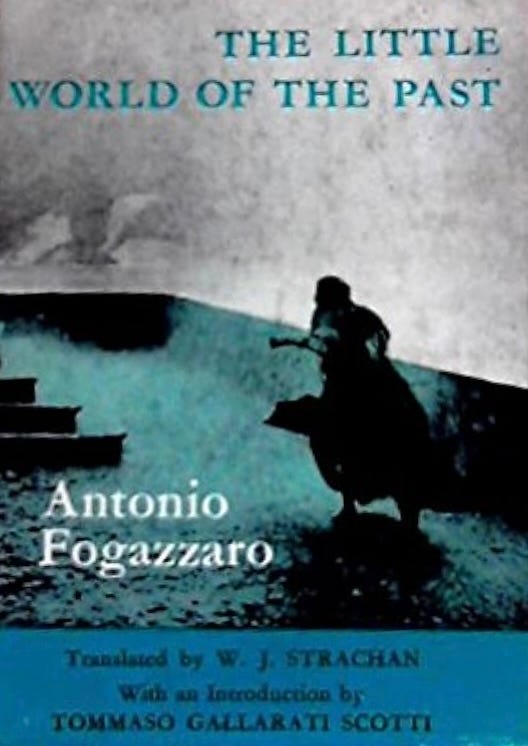
British literary critic Martin Seymour-Smith described Antonio Fogazzaro’s 1895 novel as “rightly considered one of the leading novels of the latter half of the nineteenth century: it is strong in characterization, brilliant in its use of dialogue, and, above all, delightful in its humour.”
It might surprise readers to learn that the main plot of a novel described as “delightful in its humour” is about a couple broken by the death of their child. Tragic though the plot is, the book is revelatory in its explorations of love, loss, resentment, faith, and forgiveness. Fogazzaro’s vivid depictions of each character’s interior life highlight the complexities of real-world conflict and grief, showing how different people approach and process tragedy.
Yet despite its dark premise, Piccolo mondo antico is ultimately about how its two lovers find their way back to each other. The role of religious belief is explored throughout, but never in heavy-handed fashion. Fogazzaro intentionally avoids a triumphalistic approach to faith, preferring instead to depict the small, everyday actions that allow pride to give way to grace, and broken hearts to be made whole again.
3) Pleasure (Il piacere)
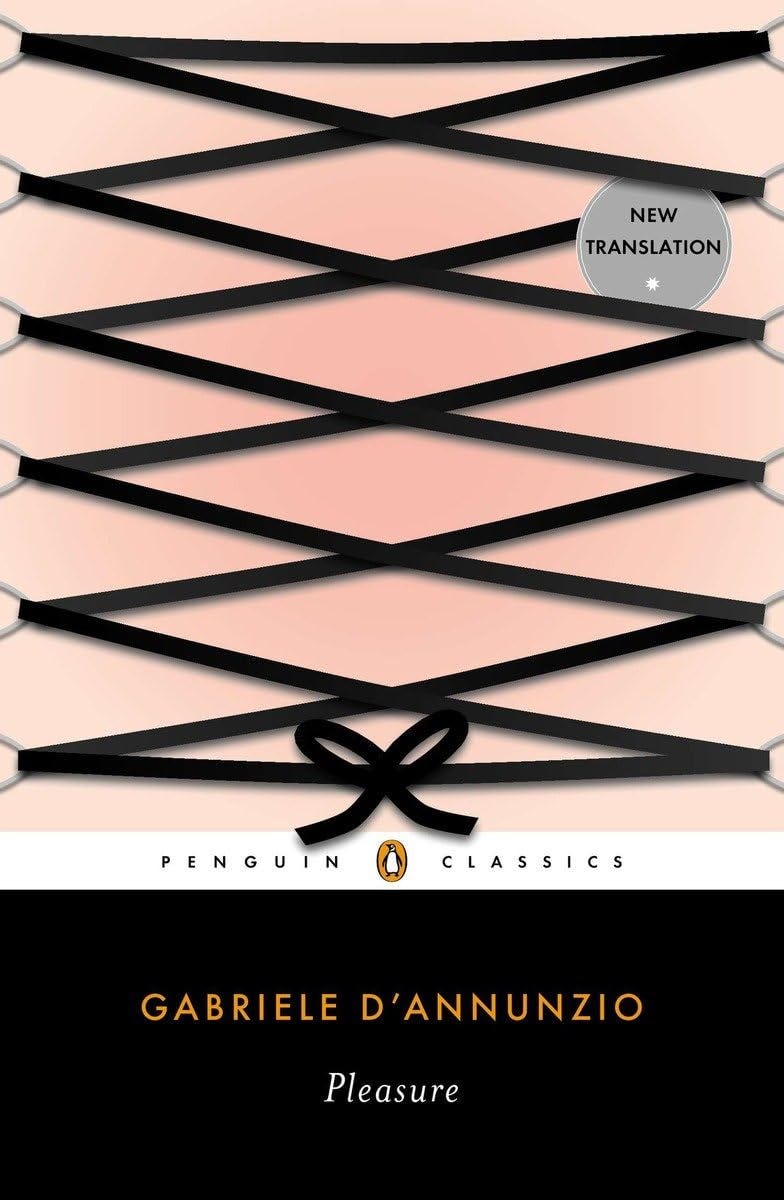
Every Italian has heard the name Gabriele D’Annunzio, though few foreigners could ever tell you who he was.
Decadent author par excellence, D’Annunzio rose to fame as a best-selling novelist, and was considered by many of his contemporaries to be the greatest Italian poet since Dante. He fought in WWI, and after Italy failed to receive the land it was promised by the Allies, he personally led a brigade into the Adriatic port city of Fiume, which he took over and ruled for the next 15 months. He was simultaneously a Nietzschean vitalist, a romantic dandy, and one of the most influential characters in Italian interwar politics.
Because of difficulties with translation, D’Annunzio’s poetry has largely remained confined to the Italian-speaking world, though his novels are slightly more accessible. Chief among them is Il piacere, a story about a hedonistic aesthete and one of the defining works of the Decadent movement. Its prose is arguably even more impressive than its plot, as even the most basic descriptions are crafted with a sense of rhythmic beauty:
All those objects, amid which he had so many times loved and enjoyed and suffered, had for him acquired something of his own sensibility. Not only were they witnesses to his loves, his pleasures, his sorrows, but they were participants. In his memory, each form, each color…was a note in a chord of beauty.
-Gabriele D’Annunzio, Il piacere
4) Jerusalem Delivered (Gerusalemme liberata)
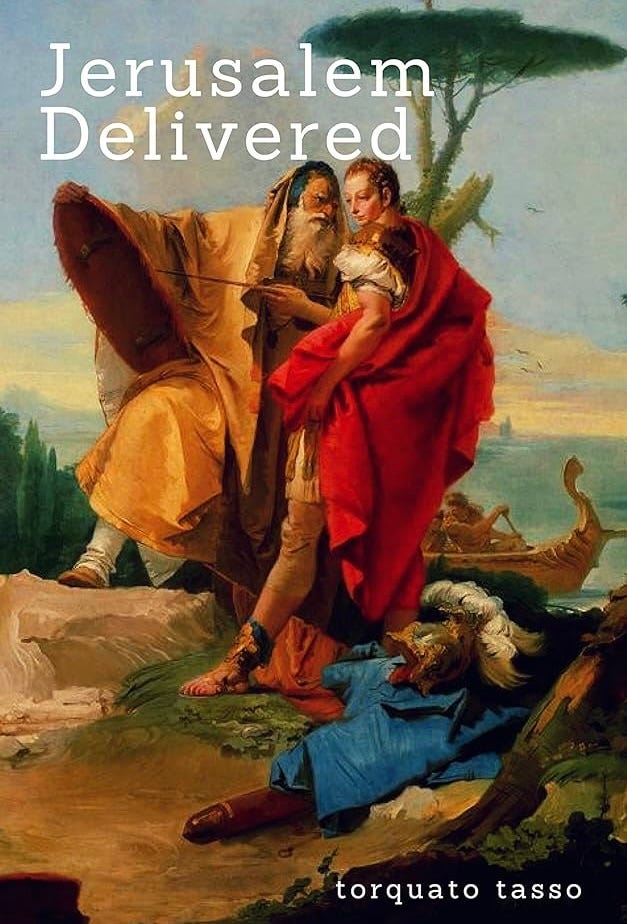
Jerusalem Delivered is a poetic retelling of the First Crusade in 1099. Blending factual historical events with mythological and fantastical elements, it follows Godfrey of Bouillon and the Christian army as they seek to capture the Holy City and deliver it from Muslim rule.
Along the way, a tapestry of characters make for thrilling side-quests and a heightening of the drama. There’s the fiery and errant knight Rinaldo, the seductive sorceress Armida, and the Muslim warrior Clorinda (whose eventual conversion, baptism, and death all take place near simultaneously, making for one of the most heart-wrenching episodes in the poem). Thematically, Jerusalem Delivered explores the conflict between duty and passion, as well as the interplay of divine providence and human free will.
Combining the grandeur of Homeric epics with a distinctly Christian worldview, Tasso’s ability to weave together action and romance in his patented form of literary chiaroscuro earned him the nickname “the Caravaggio of poetry”, and made his work a touchstone for poets across Europe. It is with good reason, therefore, that Milton lists him alongside Homer and Virgil as one of the primary models for his Paradise Lost.
5) Orlando Furioso
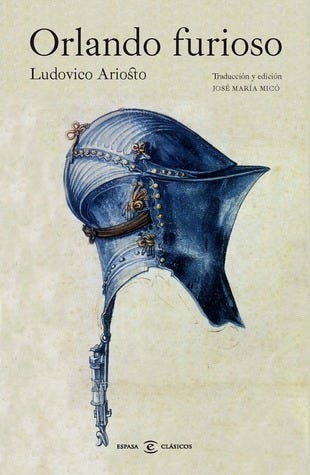
Ludovico Ariosto’s Orlando Furioso is easily the strangest and most fantastical of the entries on this list. First published in 1516 and expanded in later editions, it is one of the three great poems of Italian literature, alongside the Divine Comedy and Jerusalem Delivered.
The poem continues the story of Orlando (the Italian name for “Roland”), a great knight of Charlemagne’s court who goes mad with unrequited love for the beautiful Angelica. The “madness” of his love takes him on a series of bizarre and often humorous adventures, getting him mixed up in the affairs of knights, sorcerers, seamonsters, and enchanted castles — to name just a few of his escapades.
The poem is dazzling in its scope, and the shockingly imaginative power of its author is on full display throughout. For example, one knight even borrows the prophet Elijah’s flaming chariot to take a trip up to the moon! If the idea of a medieval epic brimming with magic, madness, and a healthy dose of humour appeals to you, then Orlando Furioso is sure to delight.
Honorable Mentions
Of course, there are far too many works that could be included on this list, and to limit it to five is to do injustice to the 1,000+ year tradition of Italian literature.
If you enjoyed the books mentioned here, I would encourage you to check out the work of the authors mentioned below. I have suggested one main work to start with for each one:
Giuseppe Tomasi di Lampedusa, The Leopard (Il gattopardo)
Eugenio Corti, The Red Horse (Il cavallo rosso)
Giovanni Verga, The House by the Medlar Tree (I malavoglia)
Umberto Eco, The Name of the Rose (Il nome della rosa)
Italo Calvino, Invisible Cities (Le città invisibili)
Giacomo Leopardi, Small Moral Works (Operette morali)
Grazia Deledda, Reeds in the Wind (Canne al vento)
Have you read any of the works on this list?
Let me know what else you would add…
One major factor has to do with the closely intertwined relationship between the Anglo and French elite, and France’s historically privileged position on the European stage. For example, when works of Russian literature were sent for distribution throughout Europe, they first went through Paris, the main city on the continent. From there, French translations arrived quickly in London, thus cementing the Moscow-Paris-London pipeline and explaining part of why French and Russian literature have such a privileged position in the Anglo “Great Books” canon. Indeed, even Gabriele D’Annunzio first encountered the thought of Nietzsche through French translation.
Beyond the influence of Paris, Italy’s own political fragmentation didn’t help its authors either, as the Italian peninsula wasn’t “united” (read: conquered) until the mid-19th century, and any work published prior to then was often translated into Florentine or Venetian before being exported abroad. Alessandro Manzoni famously re-wrote The Betrothed in a modern variant of Italian, and for this reason it is considered a cornerstone development of the Italian language as it exists today.
The most famous Italian authors, such as Dante, Petrarch, Machiavelli, and Boccaccio, typically belong to the medieval or Renaissance periods, as these had been long established before the idea of a united “Italy” began to take form in the mid-19th century. They were already considered “classic”, and much of the idea behind constructing the canon was to find new, contemporary classics to add, hence the emphasis on 19th century Romantic novels. As this genre was less widespread in Italy than it was elsewhere in Europe, it led to a natural overshadowing of contemporary Italian authors.
Great list! I recently read The Betrothed and just loved it.
I have only read Alessandro Manzoni’s The Betrothed -- beautiful renderings! I will add these to my list.