



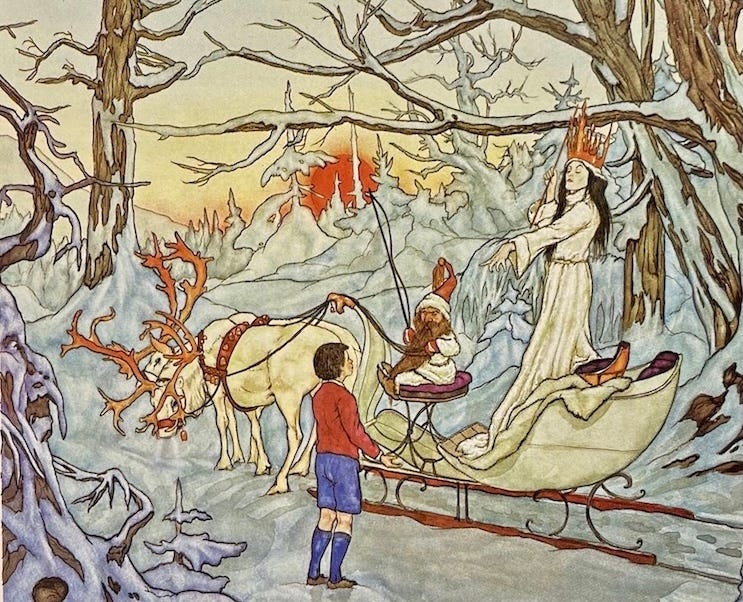
Everyone knows Aslan, the great lion who dies and rises again, is an image of Christ.
But why did C.S. Lewis choose a White Witch and an endless, Christmas-less winter to represent evil?
The answer connects Narnia to one of the most startling images in Dante’s Inferno, and it quietly unlocks one of the deepest and most troubling questions in Christianity: how can a good God permit suffering?
Lewis and Dante do not lecture you. They show you the answer...
Another Look at Narnia
During World War II, the Pevensie children flee to the English countryside to escape the Nazi air raids on London. The children — Peter, Susan, Edmund, and Lucy — are the guests of an eccentric but kind professor who welcomes them to his large country estate. One day, as the children are playing in the old house, the youngest child, Lucy, stumbles through the back of a wardrobe and enters into an enchanted land filled with mythological creatures and adventure.
The children come to know the land as Narnia, and that Narnia is held under the wicked rule of the White Witch, a tyrant who has cast a spell over Narnia to make it always winter but never Christmas. Yet, through their relationship with a couple of talkative beavers, the children come to understand that Aslan, the lion, has returned to Narnia to liberate it from the perpetual winter of the White Witch. Through a series of charming adventures, the children join forces with Aslan; yet, Aslan’s victory over the Witch is not what they expect.
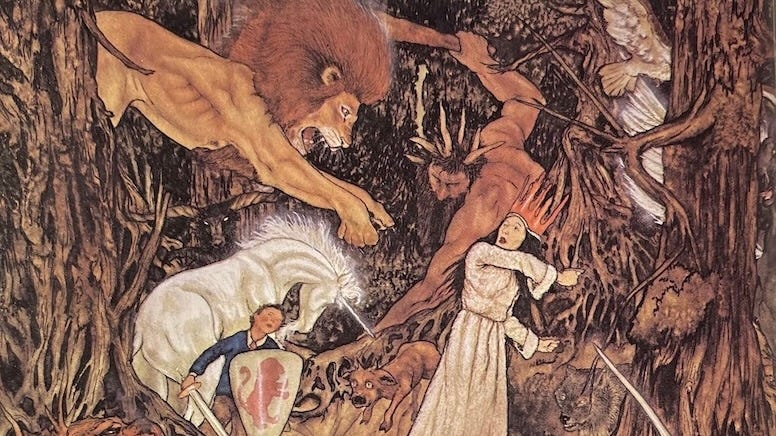
Where they expect him to be a military hero, to find victory in power and conquest, Aslan instead offers himself as a willing victim, a sacrifice, to save the life of another. He lays down his life, and in that ultimate act of love, he is able to receive his life again. It is only in the death and resurrection of Aslan that Narnia finds its ultimate victory over the evil of the White Witch.
C.S. Lewis’ 1950 classic The Lion, the Witch, and the Wardrobe has an enduring benefit for children, because it serves as an excellent introduction for their young minds to the concept of allegory. Habituating a child’s intellect to note the signs of allegory amongst the literal text is a great service to them. It stretches their imagination to observe the layers of a text, and to have patience in unfolding a narrative.
In understanding the signs and symbols of the death and resurrection of Aslan, they may grasp a deeper understanding of the death and resurrection of our Lord. Just as Aslan died to liberate Narnia from the power of the White Witch, so too did Christ die to liberate us from Satan, the prince of this world, and the power of sin and death.
Yet, there is another allegory in Narnia not often discussed: why C.S. Lewis used perpetual winter as an analogue for evil...
The Problem of Evil
In Christianity, there is something called theodicy or “the problem of evil.” You may see the problem like this: God is good. Everything God created is good. Evil exists. How can this be true?
Many other religions and cults have solved the problem by stating there are two gods or forces of equal power, good and evil, and our world is a tension between the two. But, in Christianity, God is the Almighty, the Creator, Being-itself, while Satan is a finite creature, an angel — they are not equal opposites.
Christians face a distinct problem in claiming that God is good. You could ask why a good God would allow people to suffer, but you could also ask why a good God allows evil at all. In Dostoevsky’s The Brothers Karamazov, one of the characters gives a list of horrific acts that have happened against children. It is a difficult read. He uses this not to claim there is no God, but to claim that God must not be good. Many believe that evil shows that either God is not good or He is not all-powerful.
The problem of evil is a serious problem for Christianity.
And one of the first problems that you have to unravel is what is evil. You cannot discuss why God permits evil or whether evil shows God is not good if you do not know what evil is.
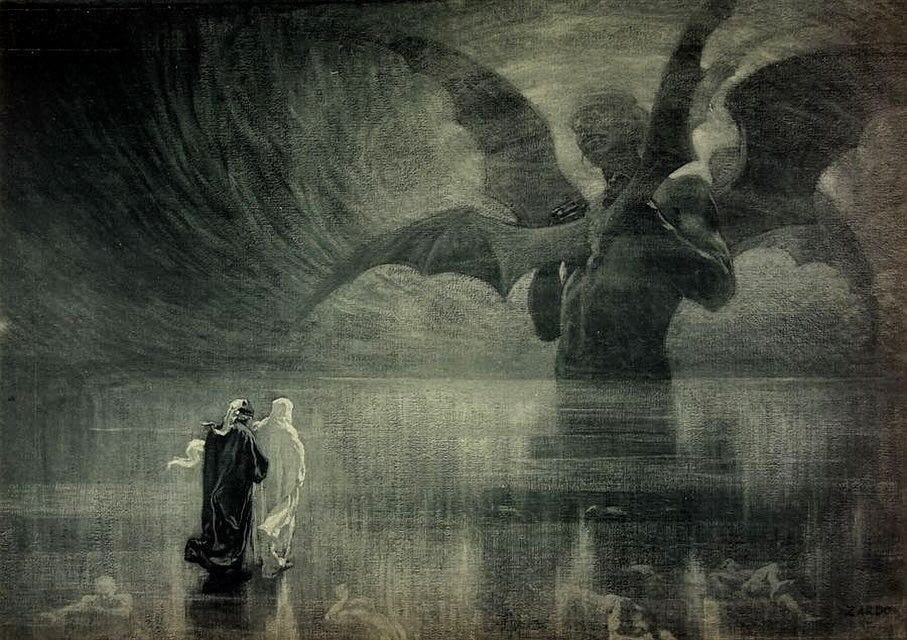
To learn this lesson, you should turn to two great Christian masters: Dante and C.S. Lewis. These two Christian intellectual giants do not tell you the answer. They show you the answer. And these answers are found in the commonality between Narnia and the pit of hell.
What is Evil?
So, how does Christianity address the problem of evil?
St. Augustine, drawing from both Christianity and neoplatonic philosophy, teaches that evil is not real. In other words, evil is only real like a hole in the ground is real. As a hole is a lack of the ground, so too is evil a lack of the good. And just as the hole cannot exist without the ground, so too can evil not exist without the good. In other words, evil is like darkness to light, evil is a lack of something.
It is important that you note that the hole cannot exist without the ground, as Christians hold that evil cannot exist without the good. In other words, because evil is a lack of something, it cannot exist on its own. Nothing can be pure evil. Evil is a corruption, a lack, an absence, a deprivation — but it is not its own reality. In certain ways, it is parasitic — always clings to something else and eroding it.
St. Thomas Aquinas will teach that evil may be defined as a “privation of the good.” To wit, God, the Creator, only creates what is good, but evil corrupts the good and causes it to suffer a privation. For example, the eye is created good and has the purpose (telos) of sight, but evil may corrupt the eye to impede its purpose through sickness or disease. Evil creates nothing new, but rather corrupts what exists.

Even Satan, a creature of God, is fundamentally good, because he exists — God had a purpose for him; but, due to evil, he is now corrupted and the goodness in him is corrupted. But, Satan also shows the origin of evil: free will.
Christians hold that God created beings with freedom, like angels and men, because love must be a gift — it must be freely given. Though the purpose of freedom was to choose amongst goods, it was used to choose what is evil over what is good; thus, evil entered the world not necessarily as a reality but as an unreality.
Notice that for Christians, goodness and being always go together. Creation and existence are a good, because all that God made is good. Evil is non-being, a privation, a lack of the good. It is this lesson that is kneaded into the narratives of both C.S. Lewis and Dante.
The Endless Winter of Narnia
C.S. Lewis uses the Christmas-less winter of Narnia to show that evil has come over the land, and the White Witch is a creature of the cold and the source of this hopeless winter. Recall that evil is a privation of the good, a lack of something, and just as evil is like darkness to light or a hole to the ground, so too can it be seen as cold to heat. Cold is not real in and of itself but is rather an absence of heat.
In other words, the cold makes for a subtle but powerful analogue for evil — and C.S. Lewis, though never explicit in his imagery, arguably uses this traditional image of evil to show what has overcome the land of Narnia.

But you can push this lesson further.
One of the reasons cold works well for evil is because it ceases movement, it is similar to death. The soul, in Latin, is called anima, and it is behind English words like animation, animal, et al., meaning something that moves. Notice that something that is inanimate does not move. So, the cold, which slows and then ceases movement, is contrary to animation, which makes it a good poetic force against the soul, the anima. It is an analogue for evil and death. On the other hand, warmth is seen as facilitating or increasing movement and life and is often poetically tied to God’s love.
So, it is no surprise that, in Narnia, the White Witch’s ultimate power is to turn people into stone. Like the cold, her power to turn people into stone ceases the animation of the creatures, making them seem lifeless, an act contrary to the animating power of the the anima, the soul. It is an analogue to what sin, particularly mortal sin, does to the soul — it kills the life of grace in it. Evil brings death and cessation.
Yet, you must note how these creatures turned to stone are brought back to life: the warm breath of Aslan, the Jesus figure.
C.S. Lewis knew this lesson well, and so did Dante in a very different poetic picture.
Dante’s Pit of Hell
The cold as an analogue for evil is made famous in Dante’s Inferno. Even the name brings a surprising juxtaposition, for the pit of hell is not an inferno but a cold wasteland of ice and wind. Dante knew that the pit of hell, the residence of Lucifer or Satan, was the farthest away from the radiant love of God a soul could fall; thus, it is a freezing lake of ice lacking in both warmth and movement.
The ninth circle of hell, the final circle, has four areas, and in each subsequent area the damned souls are stuck further into the ice until in the last section, that reserved for traitors against their benefactors or lords, the souls are completely frozen in ice for all eternity — lacking both warmth and mobility.
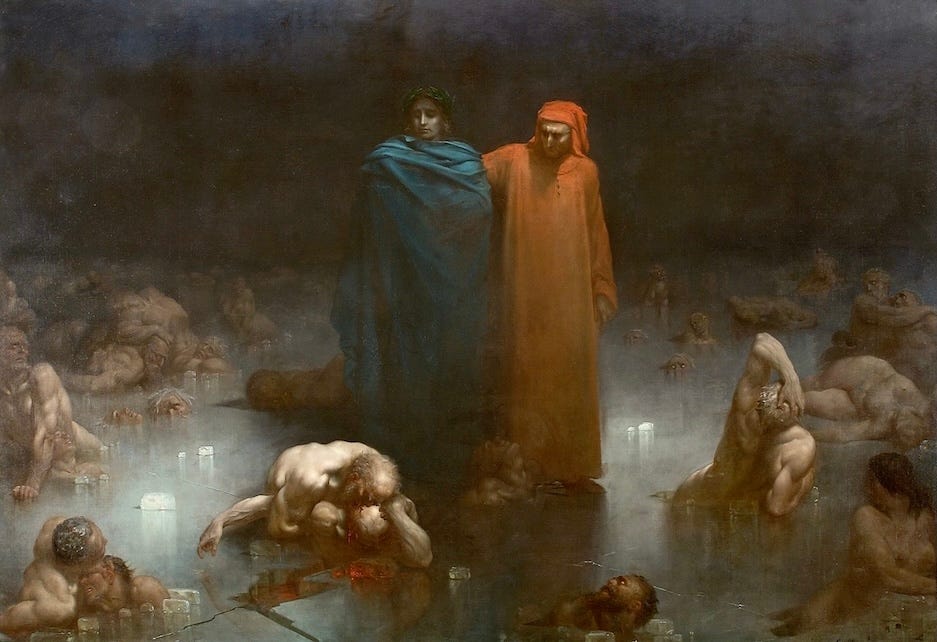
Dante strengthens his poetic picture by showing that the source of the freezing winds of hell is actually the wings of Lucifer, depicted by Dante as a hideous giant creature trapped in the center in the earth. In other words, that which brought evil into Creation now serves as the source of the cold in the lowest pit of hell. And all those souls that acted Luciferian, they were treacherous, now suffer alongside him.
Dante’s frozen pit of hell is often a surprise for first time readers, but once you realize the pedagogy, it is an invitation to rethink the nature of evil.
The Beginning of the Question
Evil is the privation of the good. It is a lack, an unreality that corrupts what is good and beautiful. God does not create evil. He only creates what is good, but evil makes the good suffer a deficiency, like the hole in the ground.
C.S. Lewis and Dante, two masters in Christian thought, knew this well and baked in poetic images to teach you this lesson. You must understand the nature of evil to begin to understand theodicy. In many ways, it is the beginning of a theological question and not the end.
Thank you for reading!
This is an essay that we recently published on our sister publication, The Ascent.
There, we are diving deeper into theology, mysticism, and ancient texts — please join us if that interests you! You’ll get one free article every Tuesday, and longer essays like this every Friday for paid readers…

I just love these essays. I’m glad I found you bud.
Amazing.... Simple, but an astonishing insight...