


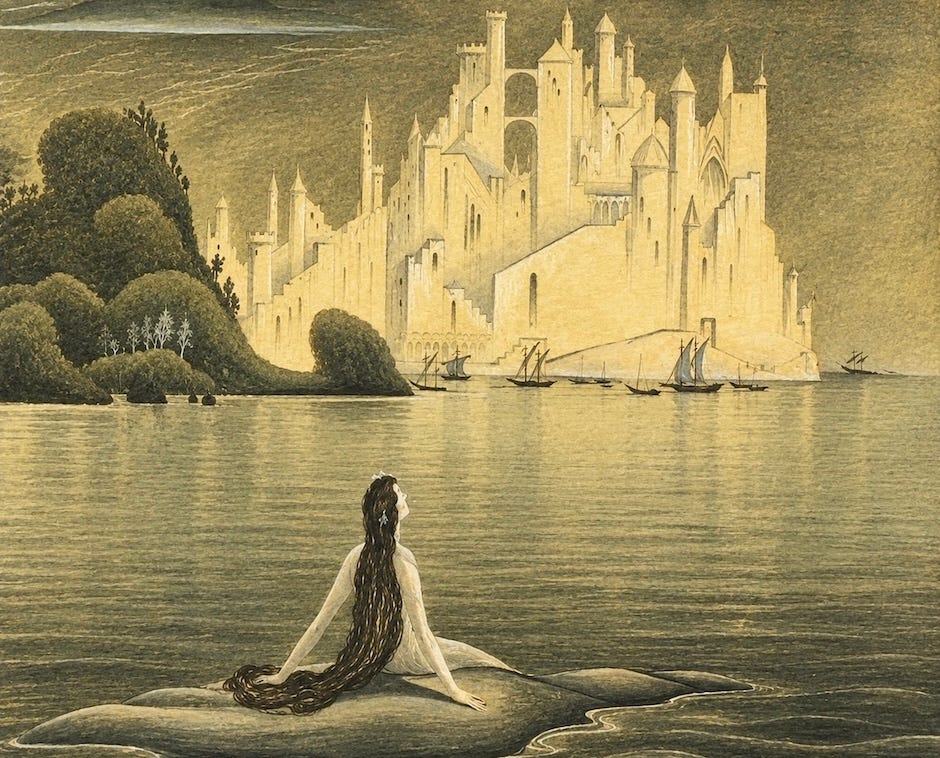
Disney’s The Little Mermaid is one of the most beloved animated films in history. It recounts a tale of desire, heartbreak, and the triumph of true love against all odds.
Or does it?
Although certain aspects of The Little Mermaid feel thoroughly modern — like a teenage girl rebelling against her father — the forces driving the plot are anything but. In reality, The Little Mermaid retraces the steps of a story that’s been around for nearly 2,000 years.
Whether the Disney filmmakers knew it or not, their adaptation of the original Little Mermaid tale didn’t so much update it for the present as it did tap into an ancient archetype. This is no doubt a large part of why it was such a success. But what is this archetype, and what about it resonates with us so powerfully?
Today, we look at the real meaning of The Little Mermaid, and what it can teach you about human nature and man’s search for the eternal…
Our December book club read has been decided…
The Everlasting Man by G.K. Chesterton is next! First discussion is on December 2 — see the reading schedule here.
Read it as a member of our book club. You’ll get:
Biweekly live discussions and weekly reading guides
New, full-length essays every week
Access to our incredible community of readers
The entire archive (200+ articles, essays, and guides)
A Familiar Tale
Let’s begin with a brief overview of Disney’s plot. We are first introduced to Ariel as she scours the sea for relics of the human world, and watch as she takes joy in her abundant collection of “dinglehoppers”, “gizmos”, and “thingamabobs”. Despite the fact she is the daughter of King Triton, the riches of her father’s kingdom aren’t enough to satisfy her, and she yearns to be part of a world beyond her own.
One day, the sea witch Ursula offers Ariel a means of fulfilling this desire. In exchange for human legs, Ariel surrenders her voice and pledges her very self as collateral: should she fail to secure the love of a human prince within three days, she will belong to Ursula forever. Unfortunately, Ariel fails to fulfill the agreement’s terms (in no small part due to Ursula’s interference) and is dragged back down to the sea witch’s lair.
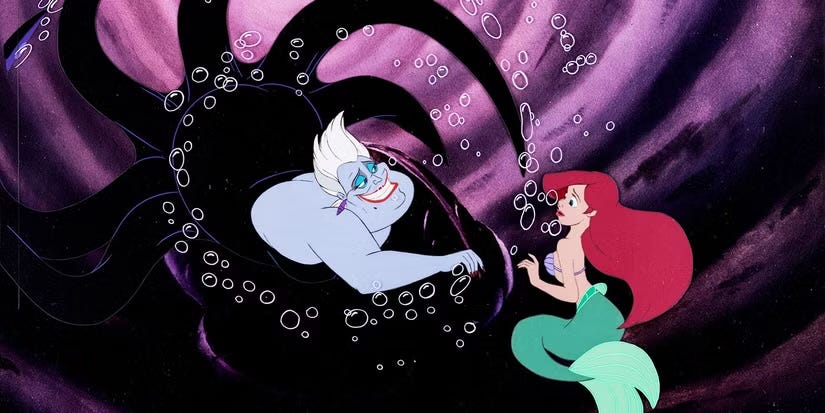
At this point, King Triton arrives to rescue his daughter, but even his power cannot invalidate Ariel’s contract. The only thing he can do is to exchange himself for his daughter — even though it means losing his crown and becoming Ursula’s slave, Triton makes the deal. Ariel is freed, but Ursula now becomes Queen of the Sea.
In the ensuing sequence, Ursula seeks to kill both Ariel and her beloved Prince Eric. Thinking that she has drowned Eric, Ursula turns her attention to Ariel, but Eric arrives just in time to spear the witch with the splintered bowsprit of a ship. Ursula dies, Triton and the other enslaved souls are freed, and order is returned to the ocean.
It’s a fairly straightforward story, but does any of it sound familiar? If you think “yes”, you’re not alone…
The Ancient Origins
It didn’t take long for fans and critics alike to realize that much of Disney’s plot is inspired by another story. On paper, that story is supposed to be Hans Christian Andersen’s original Little Mermaid fairy tale from 1837. But in reality, Disney pulled from a much older source.
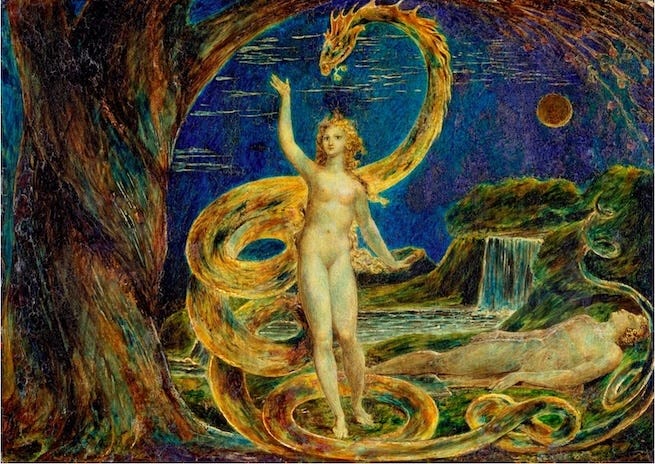
That source is none other than the Bible, specifically the Gospels and the book of Genesis. Ariel, who is given everything by her father on the sole condition that she doesn’t venture above the water, is a stand-in for Adam and Eve, who walk with God in the Garden of Eden and are only forbidden from eating fruit from one tree. Just as Eve falls for the serpent’s lie that eating the fruit will make her “be like God”, so too does Ariel sign a deal with Ursula because she seeks a higher form of existence (in her case, to be human).
Ariel’s forfeiting of her voice is not insignificant, either. The one thing that truly makes her unique, the very thing for which Eric originally fell in love with her, is surrendered in favor of mere sexual allure. Ursula even says this explicitly in the film: “You’ll have your looks, your pretty face. And don’t underestimate the importance of body language!” The fact that Ursula then uses Ariel’s beautiful voice to seduce Eric recalls the Augustinian idea of privatio boni, which maintains that evil cannot create goodness but can only corrupt and employ it for its own ends.
Having failed in her task to win a kiss from the Prince, Ariel learns the hard way what Christian tradition has maintained for 2,000 years: that sin promises freedom, but results in slavery. As she’s carried down to Ursula’s lair, everything seems lost for Ariel, at least until her father, the king, intercedes for her.
Just as the innocent Christ gave his life for those who rebelled against him, so too does King Triton surrender his life and crown for his rebellious daughter. At this point, Ursula appears to have won completely, having usurped the throne and become Queen. The parallels with death’s apparent victory over Christ are obvious, but less so is the fact that Ursula is finally killed by a splintered beam of wood — not unlike that of the Cross.
Even the very end of the film is immensely symbolic: King Triton, restored to his glory, freely grants his daughter the gift of becoming human. This echoes the idea that because of Christ’s sacrifice, what mankind had once sought illicitly (to be like God) is now given freely as a gift (eternal life and unity with the Father).
But if you think this is interesting, wait until you learn about the original Little Mermaid tale. Because while Disney’s adaptation went full Gospel, Hans Christian Andersen’s original story takes a drastically different angle — though it’s no less profound.
In fact, the original Little Mermaid story is arguably even more insightful and moving than the Disney film. It is a tale about the immortal soul, the inadequacy of earthly existence, the redemptive potential of suffering, and how sacrifice leads you to a higher form of love…