

Hello book club,
Our read-along of East of Eden continues! We meet TOMORROW, August 26, at noon ET.
If you missed the first session, don’t worry. You can catch up on the recording here.
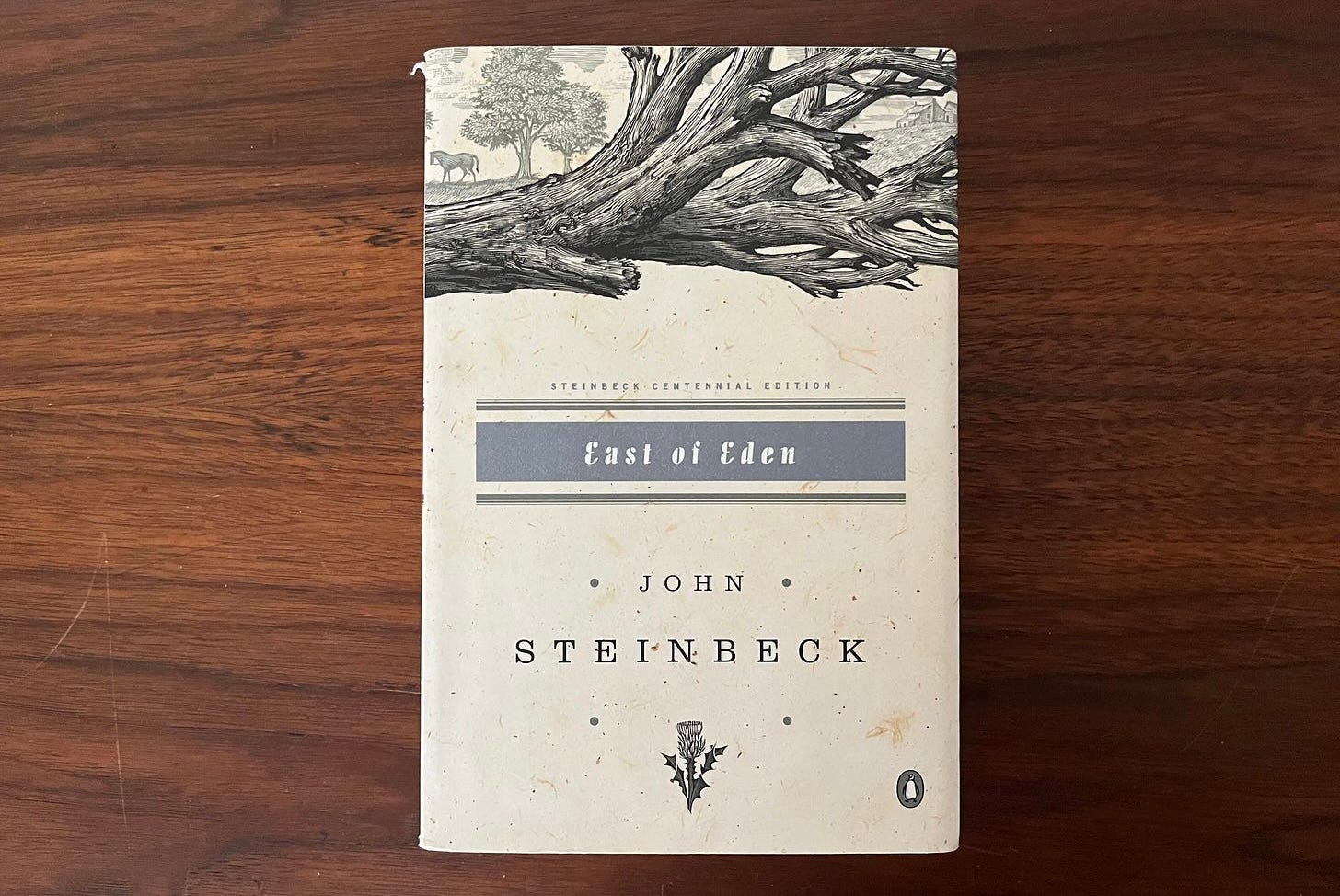
The discussion will be live-streamed via Substack at this link. Note: we are personally using this centennial edition of the book when referring to page numbers.
For those joining our discussion group directly (available to all paid members), the Zoom link is at the bottom of this email…
You can join our inner circle group by taking out a paid membership here:
As a member, you’ll get:
The entire archive of content (200+ articles, essays, and podcasts)
Ability to vote on what we read next…
Chapters 19-33 introduce a continuation of the core philosophical hinge of the novel, namely the exaltation of human freedom. This is most pronounced over the conversation between Samuel, Lee, and Adam about the Cain and Abel story of Genesis 4. Lee reveals that he spent years inquiring into this story through consulting Chinese elders and studying Hebrew.
One of his major concerns was a translation dispute between the King James “thou shalt,” and the American Standard “do thou,” in God’s words to Cain. Lee’s own research suggests a third option, the Hebrew word timshel, which he translates as “thou mayest.”
For Lee, this simple translation becomes the philosophical foundation of the entire novel, and his conception of human nature. Namely, he reckons “timshel,” to be a Biblical precedent for free will — that no matter how corrupt man’s nature may appear to be, he is always promised the agency to be the arbiter of moral actions. Man, through his own freedom, may reign as the conqueror of sin if he so desires it.

Meanwhile, Adam Trask eventually tracks down and confronts Cathy, who’s now running a brothel under a hidden alias. She’s lost her former beauty, and Adam is relieved to find that she no longer holds the power over him she once did. He condemns but pities her, and Cathy, enraged by his newfound disgust, screams and sets a bouncer on him in a fit of rage. Nonetheless, Adam leaves with peace and closure, to Cathy’s chagrin.
Some questions to consider:
Lee insists that timshel, “thou mayest,” is the most important word in the world, because it protects human freedom and man’s ability to rule sovereign over his nature. Does this resolve the tension from Cathy’s introduction in the earlier chapters, where she was described as born to evil? Can “thou mayest” coexist with someone seemingly incapable of choosing otherwise, or does Cathy remain a standing exception to Lee’s theology?
Steinbeck goes into great depth sharing Lee’s account of the elders debating Hebrew grammar. It’s a fascinating literary choice to depict a group of Chinese elders in an American immigrant enclave devoting themselves to the correct translation of a Genesis verse in the original Hebrew: the novel’s central philosophy arises out of a diversity of cultures that coalesce together in a single pursuit of human wisdom.
Why does Steinbeck choose this depiction to ground his central theological claim, rather than simply sharing it through Adam, Samuel, or the narrator? What does that decision suggest about the novel’s claim to universal access to wisdom? Despite man’s freedom, does Steinbeck suggest all men might still be bound by a universal human nature?
Why is Adam’s pity an outrage to Cathy? What changes transpired that she lost her power over him? Is it as simple as her fading beauty, or might there be a deeper transformation in Adam’s spiritual life? Also consider what Cathy’s sudden rage — an uncharacteristic outburst — suggests about the nature of her character, freedom, and moral agency, especially in light of Lee’s theory of timshel.
Share your thoughts below or in the subscriber chat, along with any questions you have — we’ll incorporate them into the discussion!