


Homer’s Odyssey is the world’s greatest tale of homecoming. It shows the lengths to which a man will go to overcome obstacles and return to his loved ones, no matter the cost. It’s the consummate story about the journey home.
Or is it?
Because a quick look at the contents of the Odyssey reveals that Odysseus gets home to Ithaca just halfway through the poem. Half of the epic, in other words, isn’t about the return home, but what you do when you get there.
This aspect of the tale is often overlooked, as most people naturally gravitate towards the fantastical adventures that precede Odysseus’s homecoming. But to Homer, the second half of the poem is surely the most important, and you cannot afford to overlook it.
Today, we explore the true meaning of Homer’s Odyssey by focusing on the events that take place once Odysseus returns to Ithaca. What do they reveal about the nature of love, home, and even war?
Homer’s answer might well surprise you…
Reminder: this is a teaser of our paid subscriber essays.
If you’d like to support our work, please consider a subscription. You’ll get:
New, full-length articles 2x per week
The entire archive (200+ articles, essays, and podcasts)
We’re currently reading Homer’s Odyssey in the book club. The next discussion is on Wednesday, July 1, at noon ET — join us!
An Arduous Journey
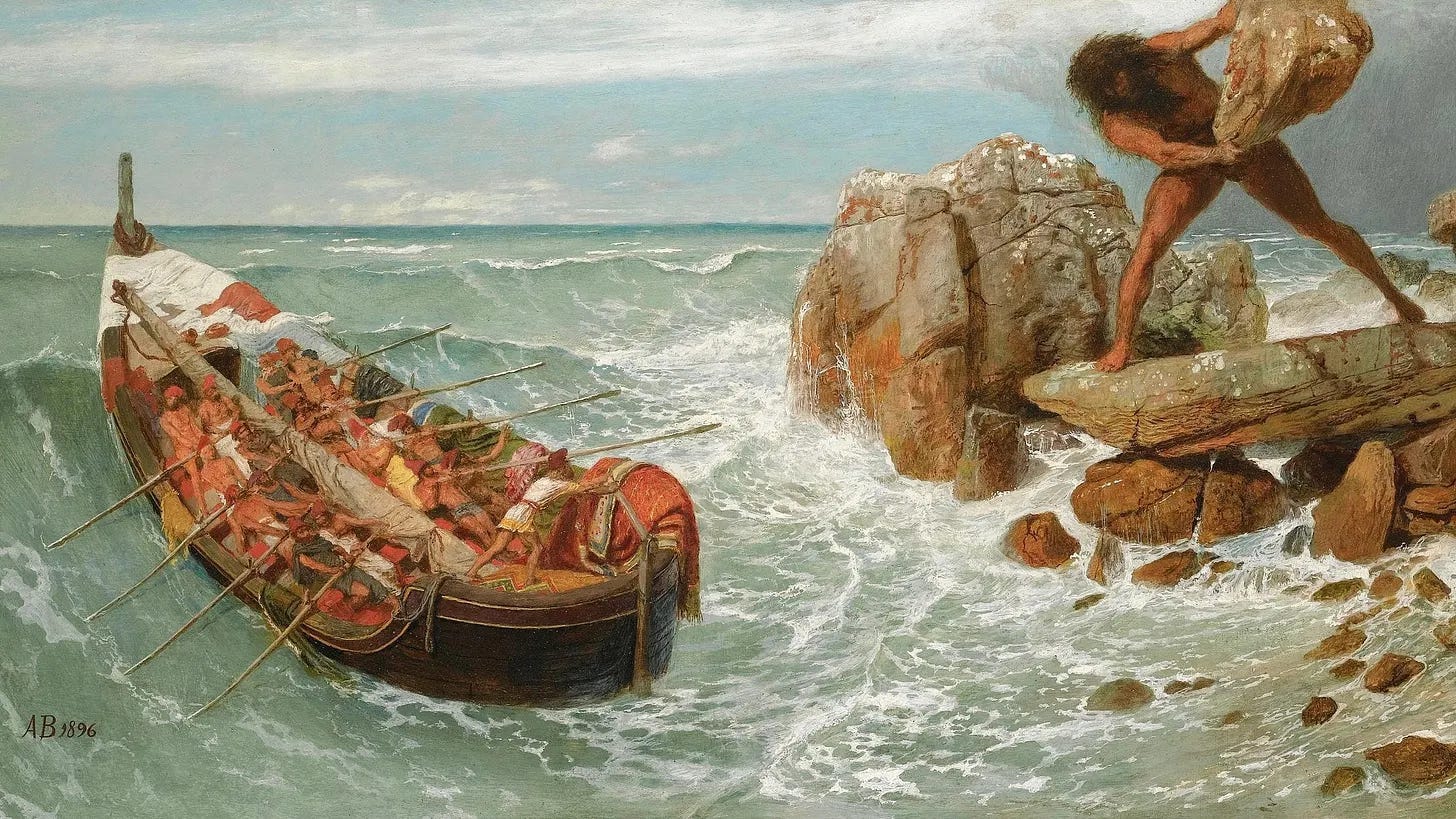
The Odyssey begins in the aftermath of the Trojan War, and documents Odysseus’s attempts to return to his home across the sea. This is the part of the Odyssey people are most familiar with, as this half of the poem is replete with swashbuckling adventure and deeds of daring.
These include Odysseus’s encounter with the one-eyed giant Polyphemus, his harrowing escape from the island of the Lotus-Eaters, his journey to the underworld, and much more. Previously, we’ve written about the symbolic meaning of his confrontation with the Sirens, as well as that of his 7-year captivity on the goddess Calypso’s island.
Over the course of these adventures, the mettle of Odysseus is proven time and time again. While he’s not a perfect man, he’s certainly clever, cunning, and astonishingly brave. You can’t help but admire him, and you begin to realize why he was counted among the most respected Greek generals at Troy.
And yet, for all his daring and valor, Odysseus’s toughest battle still lies ahead. This time, though, it’s not simply a question of strength and arms. There will indeed be a bloody battle in the end, but in the meantime, the real challenge is something else entirely. It’s a struggle so intense that Homer deemed it worthy of half his poem: the challenge of returning home…
A Stranger at Home
One of the most poignant paradoxes of the Odyssey is that after surviving storms, war, and monsters, Odysseus cannot simply walk back into his own home. The hero who conquered all is reduced to a mere shadow of himself the moment he sets foot on Ithaca.
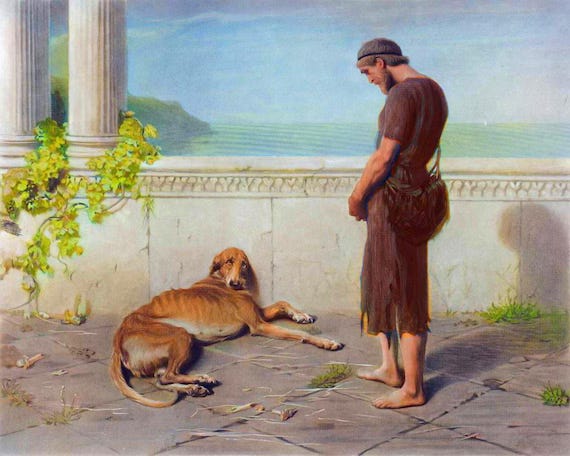
This point is made abundantly obvious when Athena, in order to protect Odysseus, disguises him as a beggar. The metaphysical posture of humility is reflected back out in the physical reality, and Odysseus is made to travel through his homeland as an outsider. In fact, his faithful dog Argos is the only one at first to recognize him.
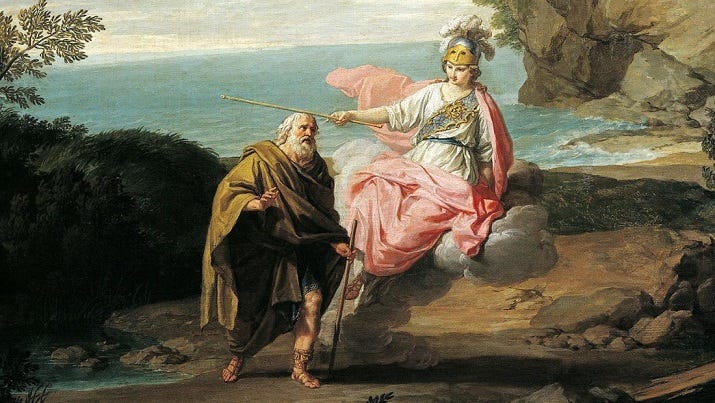
Now, in some regards Odysseus’s beggarly disguise certainly comes in handy for him, as we will see in the next section. But in the meantime, it reminds the great adventurer of a harsh reality: that time creates strangers out of friends and family. Home changes while you’re gone, and so do you. You can return to your home without it ever feeling like home at all.
Odysseus is forced to sit with this sobering truth, and as he does, he also realizes the harm caused by his absence. His son has grown up without a father, his wealth is going to waste, and suitors threaten to end his family line for good. Nature abhors a vacuum, and so do families: what will fill the great vacuum in our hero’s household?
The key to restoring order, Odysseus discovers, requires combat of a different sort. Because homecoming isn’t usually a triumphant return — often, it’s the biggest test. To overcome his enemies and win back his wife, Odysseus must wrestle with a harsh truth.
This final test is everything that Homer’s poetry, in both the Iliad and Odyssey, has been leading up to: an uncomfortable lesson about home and belonging…