


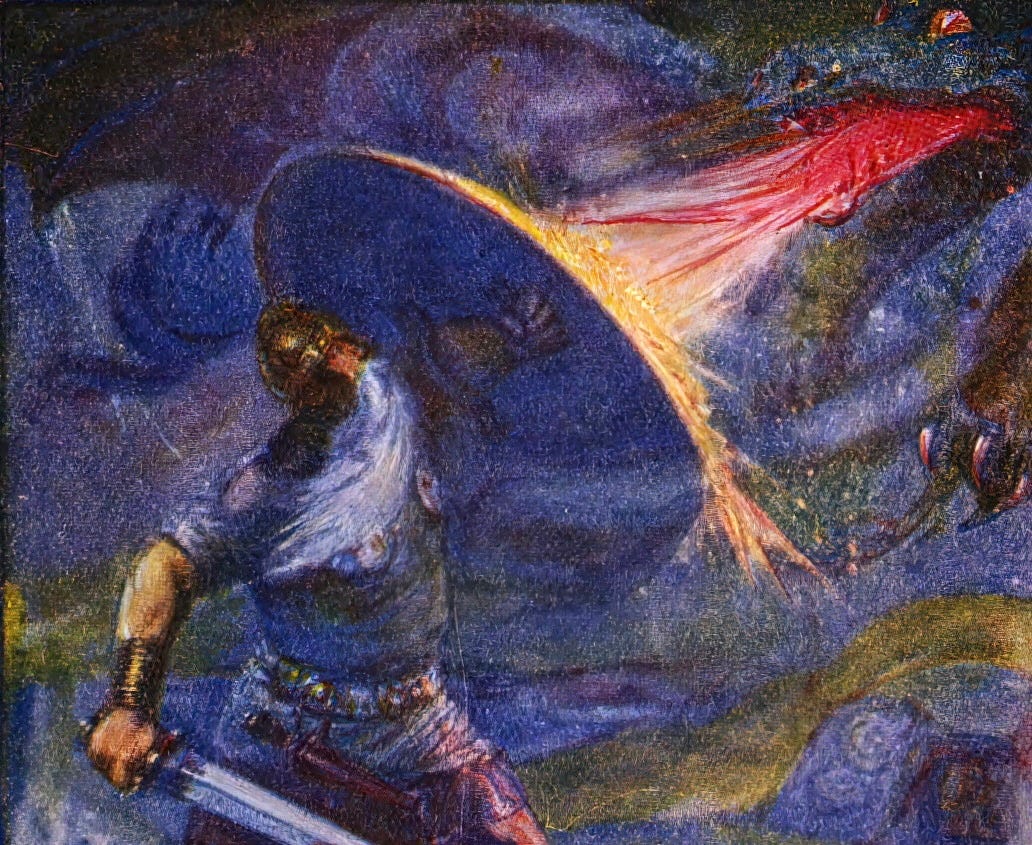
While J.R.R. Tolkien crafted The Lord of the Rings, the medieval poem Beowulf was arguably the one work of literature that inspired him more than any other.
For 25 years, the Oxford professor studied the Old English epic, convinced it had layers of meaning that others overlooked.
In 1936, Tolkien delivered a lecture entitled “Beowulf: The Monsters and the Critics.” In it, he laid out a groundbreaking interpretation of the poem that didn’t just revive Beowulf’s status as a masterpiece but reshaped the way his peers understood heroism, sacrifice, and the eternal battle against evil. Through Tolkien’s work with The Hobbit and The Lord of the Rings, this understanding lives on and still influences us today.
But what is Beowulf, and why did Tolkien see it as the key to creating his own life’s work?
Well, what he discovered changed the face of literature forever…
Reminder: this is a teaser of our paid subscriber essays.
If these articles have meant something to you, please consider becoming a paid member to support this work. Every subscription truly makes a difference.
We are 100% independent, which is only possible because of you. There are no ads here, only independent writing devoted to the True, Good, and Beautiful:
As a member, you’ll get:
New, full-length essays and articles every week
Biweekly book club discussions and reading guides
Access to our incredible community of readers
The entire archive (200+ articles, essays, and podcasts)
The Story of Beowulf
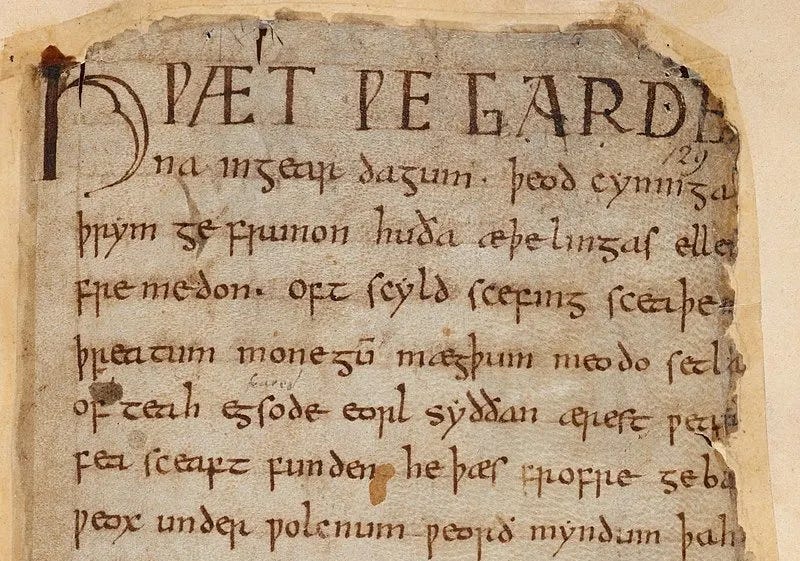
Beowulf is an Old English epic poem set in 6th-century Scandinavia, composed around the 8th to 10th centuries. It’s the oldest surviving epic written in the English language and survives in a single manuscript, the Nowell Codex — written by Christian scribes looking back on their culture’s pagan past.
The poem blends myth, history, and moral allegory to offer readers a glimpse into the warrior culture of the Anglo-Saxons, although, curiously, the poem doesn’t feature any Anglo-Saxons, nor does it take place in England! (If you’re curious to go deeper into the archetypal significance of this story, check out our book club discussions on it from last year).
The story follows the heroic Geat warrior Beowulf as he travels to Denmark to aid King Hrothgar, whose mead hall is being terrorized by the “shadow-walker” named Grendel. To give you a sense of the horrifying depth of the epic’s villains, Grendel is described as a descendant of Cain, the treacherous murderer of Biblical origin — one who is “wearing God’s anger.”
…for the Maker had proscribed him with the race of Cain. That bloodshed, for that Cain slew Abel, the Eternal Lord avenged: no joy had he of that violent deed, but God drove him for that crime far from mankind. Of him all evil broods were born, ogres and goblins and haunting shapes of hell, and the giants too, that long time warred with God…
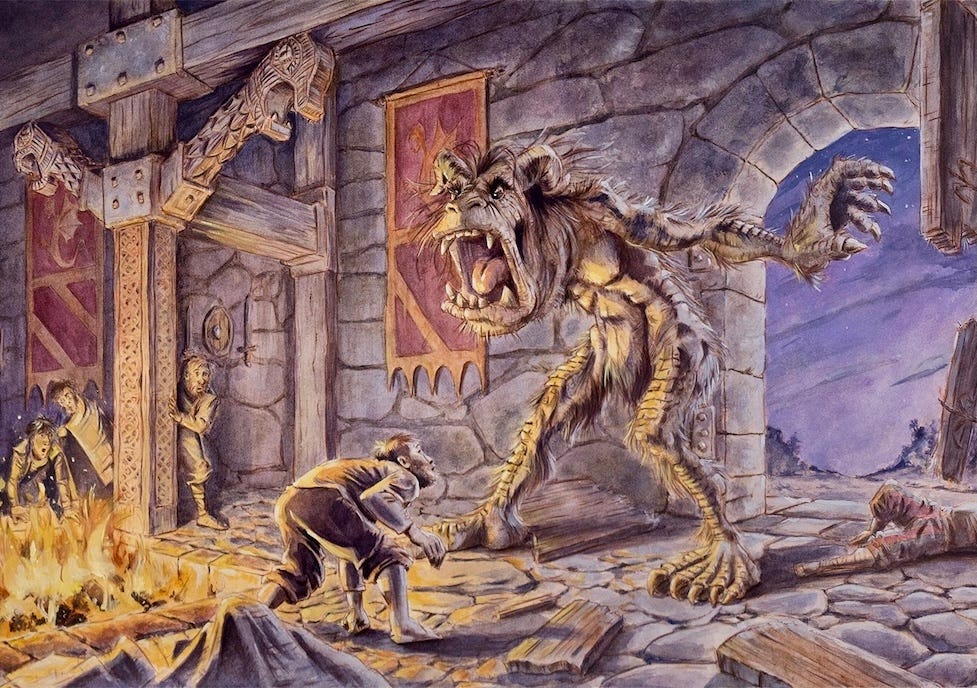
One evening, when Grendel bursts into the Danes’ mead hall once again, all the men draw their swords. However, this time, Beowulf is present to help. Insisting that he’s Grendel’s equal, Beowulf chooses to battle the beast without weapons, and engages it in hand-to-hand combat (I’ll come to what this means in a moment, but among other things it is a symbol of innate power and righteousness, elevating the battle as a pure contest between order/civilization and savagery). With his bare hands, Beowulf succeeds in tearing off Grendel’s arm, forcing the monster to flee to its lair, where it later dies.
The Danes celebrate, but their relief is short-lived — Grendel’s vengeful mother strikes the very next night. Beowulf then pursues her to her underwater lair, and another deadly battle (packed with sexual and religious symbolism) ensues. Finally, Beowulf emerges victorious once again.
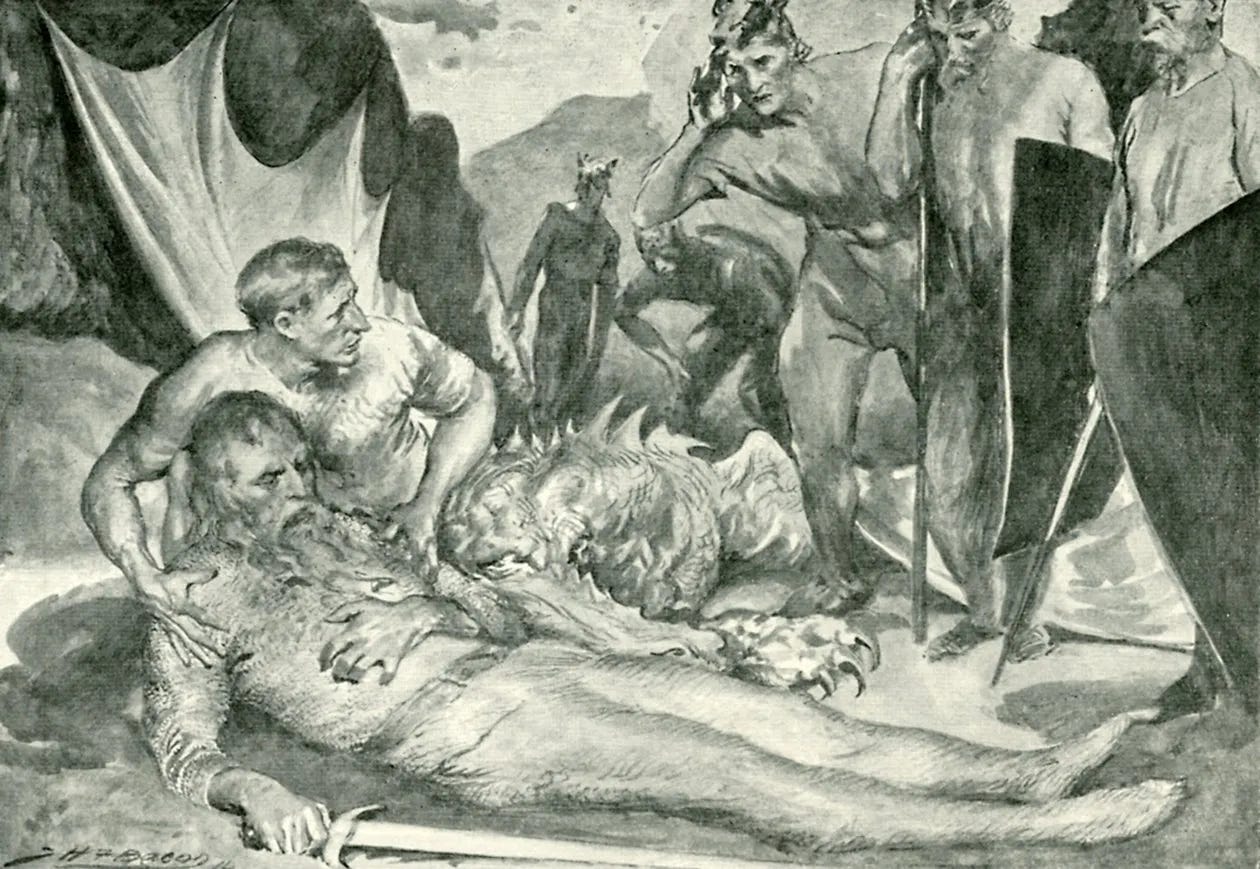
At this point, the poem skips ahead several decades. Beowulf has returned home, become king, and ruled for years as a wise and just leader. But one day, a dragon is awakened from its slumber and begins attacking his people. Beowulf faces down the dragon and slays it, but not before he’s mortally wounded. As the Geat king dies from his wounds, the poem ends with his people mourning over their fallen leader:
On a height they kindled the hugest of all
funeral fires; fumes of woodsmoke
billowed darkly up, the blaze roared
and drowned out their weeping, wind died down
and flames wrought havoc in the hot bone-house,
burning it to the core. They were disconsolate
and wailed aloud for their lord’s decease.
A Geat woman too sang out in grief;
with hair bound up, she unburdened herself
of her worst fears, a wild litany
of nightmare and lament: her nation invaded,
enemies on the rampage, bodies in piles,
slavery and abasement. Heaven swallowed the smoke.
The poem Beowulf meditates on mortality, legacy, and the fragility of order in a chaotic world. It is as much about the hero’s quest for glory as it is about the impermanence of human life. But people didn’t always view it as such.
Tolkien’s Revolutionary Reading
So, what did Tolkien see in it that nobody else could?
At the time he began studying Beowulf, the poem was valued predominantly as a historical and linguistic artifact. Scholars mined it for clues about Anglo-Saxon culture but dismissed its moral or literary merits. Tolkien argued this was misguided and declared that Beowulf should be studied not as a historical curiosity but as a work of art.
To Tolkien, it was a work of art as profound as almost any other in the canon, for it delivers something eternal about the nature of evil and how to overcome it. It is certainly not a simplistic tale about one hero’s triumph in battle.
What Tolkien understood about the poem became integral to the works he would go on to write himself, and this understanding changed literature. You see, Beowulf was not written as a tale of distant heroics — it has much to say about your own daily fight against the darkness.
It is a story with many layers of meaning…