


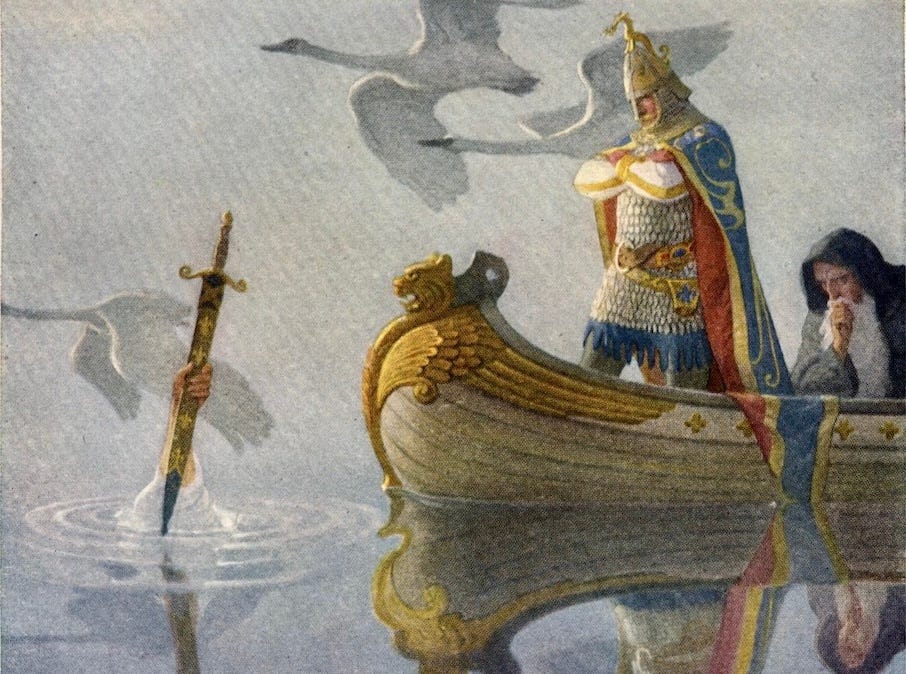
Few legends are as popular as the Knights of the Round Table. The story of King Arthur has survived for well over 1,000 years, and with good reason: it is the foundational myth of England, and by extension, the entire English-speaking world.
From Tennyson’s Idylls of the King to Tolkien’s The Fall of Arthur, each generation has taken up and breathed new life into the ancient Arthurian tales. But across all these retellings, one powerful symbol remains unchanged: the sword in the stone.
Most modern readers see the sword in the stone as nothing more than a fantastical flourish to a mythical tale. But in reality, it is something far greater: a symbol of authority, power, violence, and adventure.
Today, we look at the powerful symbolism of the sword and what it can teach you about discerning your calling. At the same time, we’ll look at what the symbol reveals about the true nature of adventure — and the ancient warning it has for those who seek it out…
Our next book club read has been decided…
We will read A Tale of Two Cities by Dickens next!
Our first discussion is on November 4 — see the reading schedule here.
Read this great novel as a member of our book club, and you’ll get:
New, full-length essays and articles every week
Biweekly book club discussions and reading guides
Access to our incredible community of readers
The entire archive (200+ articles, essays, and podcasts)
The Sword in the Stone
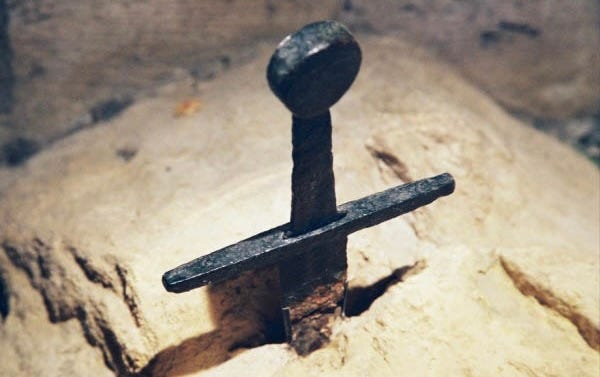
The story of the sword begins with a crisis of succession. King Uther Pendragon dies without an heir, throwing the realm into chaos. Disorder and violence threaten to bring the kingdom to its knees, but finally a miracle occurs: on Christmas Day, a sword appears embedded in a stone in the churchyard.
The sword promises to bring an end to the chaos, as its blade bears the inscription: “Whoso pulleth out this sword of this stone and anvil, is rightwise king born of all England.” All the knights present immediately try their hand, but none are able to remove the sword.
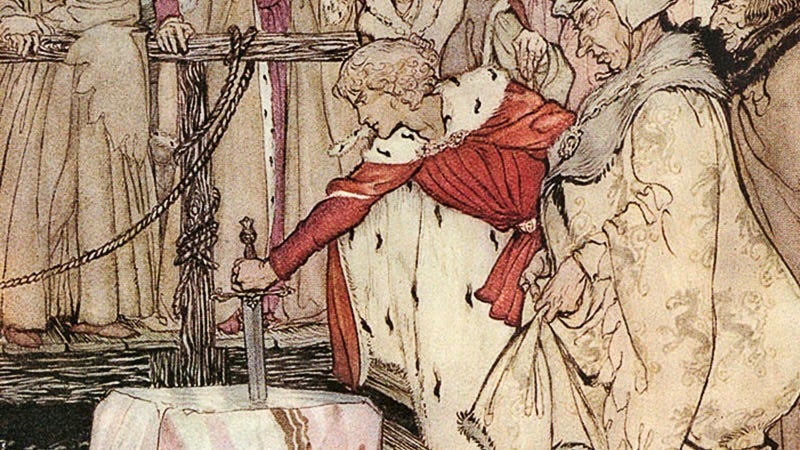
Then, on New Year’s Day, a tournament is held. The knight Sir Ector attends with his son Kay and foster son Arthur. When Kay realizes he forgot his sword, Arthur rushes back to retrieve it, but can’t access their lodging. On his way back to the tournament he spies the sword in the stone and, not wanting his brother to go swordless, removes it to bring it to Kay.
Once word gets out that the sword is missing, it comes to light that Arthur is the one who removed it. Sir Ector and other nobles swear their allegiance to him, thus confirming Arthur as king. But this, of course, is only the start of the story.
Modern interpretations are quick to suggest that Arthur only wins the sword because “power belongs to him who least desires it”. But as we shall see, this couldn’t be further from the truth.
Because the next time a sword in the stone appears — and yes, there is another — the man who wins it flips this idea completely on its head…
The Chosen Knight
Fast forward several decades, and Arthur is now a long-established king. He is married to Guinevere and presides over the Knights of the Round Table. But his days of hosting tournaments and banquets quickly come to an end the moment the second sword appears.
When a squire rushes into Arthur’s court to announce something incredible floating down the river, the king and his knights all rush outdoors. There they spot a floating block of red marble, and in it, another sword. But this time, the inscription is different:
Never shall man take me hence, but only he by whose side I ought to hang, and he shall be the best knight of the world.
Everyone looks to Lancelot — the greatest knight among them — to draw the sword, but he refuses, knowing it’s not for him. Arthur then commands Gawain to attempt removing the sword, but he fails. Another knight, Percival, tries too without success. But then Galahad, the most recently knighted man among them, arrives and declares the sword is meant for him. He approaches, takes the sword with ease, and places it into a sheath he brought specifically for it.
Already, we see a dramatic reversal of the original Arthur story: Galahad did not discover his destiny by drawing the sword, but drew the sword because he knew his destiny. What’s more, shortly after he draws the sword, the Holy Grail appears to the knights at their banquet, thus setting off the adventure of the Grail Quest.
It is in this moment that the sword reveals its greatest meaning. Just as Arthur draws his sword at the beginning of his kingship, so Galahad draws his immediately before embarking on his spiritual quest. In both cases, the sword signifies a calling that must be fulfilled.
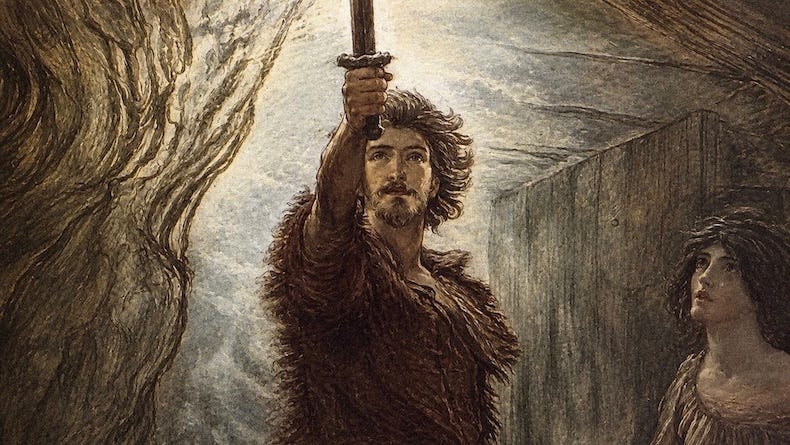
But what does it look like to step into your calling? How do you live the life you’re meant to live when you still fall so short of greatness?
Of what use is this longstanding myth to us now?
Fortunately, the sword answers all these questions and more, by showing what it really means to embrace your destiny in life. There are many layers to this story…