

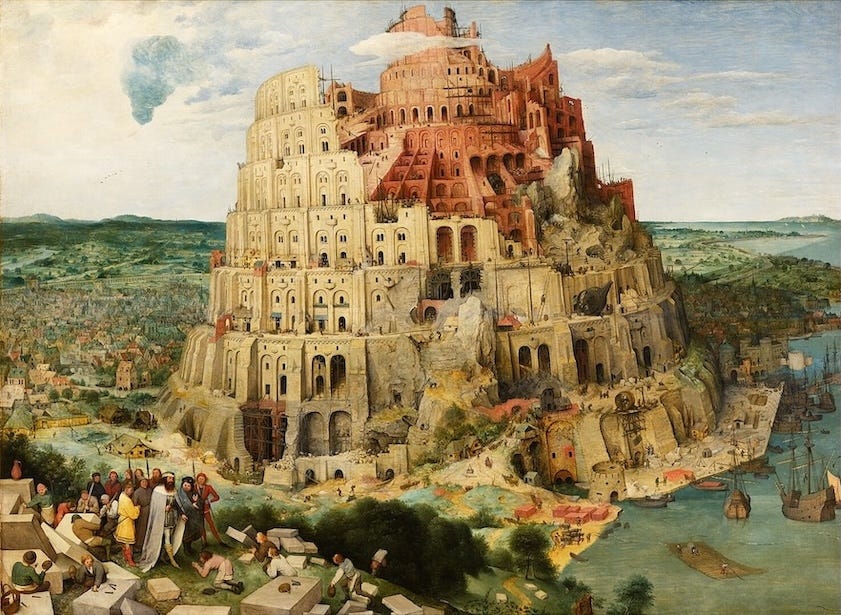
On the surface, the story of the Tower of Babel is straightforward: men try to build a tower to reach the heavens, and God stops them by making them speak different languages.
But already, this deceptively simple plot raises a slew of questions: why doesn’t God want men to reach him? Is he really intimidated by what they might achieve? Why does he punish them?
Some read the story of Babel as a warning against technological innovation, and others as a warning against urbanization. But as we shall see, the God of the Old Testament isn’t concerned about either of these things. Rather, he’s focused on something else entirely: on making sure humans don’t make the same mistake that got them expelled from Eden.
To understand why this is, though, we first have to look at the culture of the Ancient Near East to learn what God was actually worried about at Babel, and why he thwarted the people’s efforts.
But as we do so, an unsettling reality will become apparent: that despite our beliefs about God being far different from those of the people at Babel, we are no less in danger of committing the same mistakes…
Reminder: this is a teaser of our members-only deep dives.
To support our mission and get exclusive content every week, please consider upgrading for just a few dollars per month. You’ll get:
New, full-length articles 2x per week
The entire archive of content (150+ articles and podcasts)
Membership to our bi-weekly book club (and community chat room)
Our book club is currently reading Tolkien’s The Fellowship of the Ring! The next discussion is on Wednesday, December 3, at noon ET — join us!
The True Purpose of the Tower
Before we examine the meaning behind the Tower of Babel, we first need to ask a simple question: what kind of a building was it? Fortunately, we can be fairly certain of the answer.
In ancient Mesopotamia, ziggurats were the structures men built to protrude from the earth and reach towards the heavens. In fact, their name derives from the words zaqārum, which means “to protrude”, or “to build high”. In all likelihood, the Tower of Babel was a ziggurat — but this doesn’t mean that ziggurats were designed for man to reach the heavens.
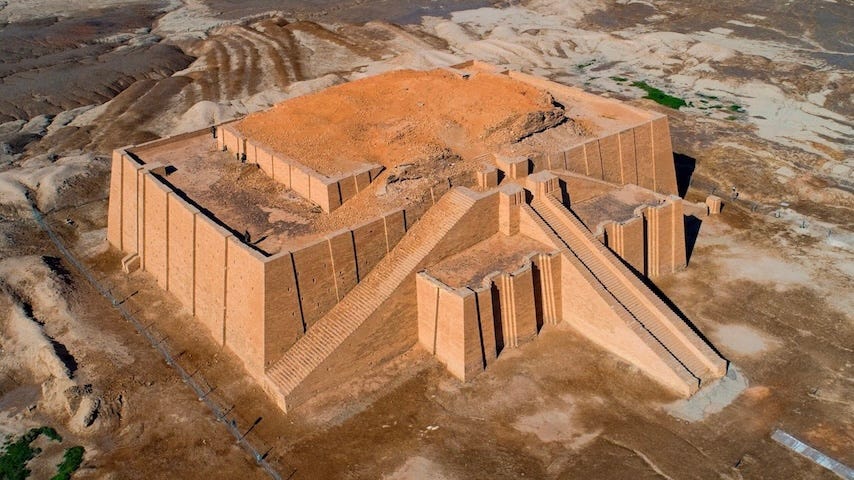
Instead, the purpose of ziggurats was to serve as a ladder, not for man to ascend to heaven but for the gods to come down to earth and create sacred space within the city. Ziggurats were the bridge, therefore, between humanity and the divine, and this is reflected in their names. The City of Larsa Ziggurat, for example, was called “temple that links heaven and earth”, and the Sippar Ziggurat the “temple of the stairway to pure heaven.”
In Genesis 3, humans lost access to this sacred space when they were expelled from the Garden of Eden. As such, the Tower of Babel seems like an honest attempt to reclaim it by establishing a bridge between heaven and earth.
But as we shall see, the builders at Babel had a much more ambitious plan…
The Needs of the Gods
What begins as an attempt to re-establish sacred space within the city of Babel quickly turns into a quest for something much greater:
Then they said, “Come, let us build ourselves a city and a tower with its top in the heavens, and let us make a name for ourselves, lest we be dispersed over the face of the whole earth.”
-Genesis 11:4
Many will be quick to point to the line “let us make a name for ourselves” as the sin of pride, and the reason Babel failed. But in fact, the line that follows is much more interesting. Why did the Babelites think they would be “dispersed over the face of the whole earth” if they didn’t build a tower?
To understand why, we must look to the commonly held religious beliefs of ancient Mesopotamia. Ziggurats, as we have noted, were built to allow gods to come to earth and create sacred space in a city. But there was an additional reason why gods came to earth: to get what they needed from humans.
The religions of the Ancient Near East anthropomorphized their gods to a remarkable degree: it was believed that gods had needs like food, drink, and sex, and that it was the humans’ duty to meet those needs. In his book Mesopotamia: Writing, Reasoning, and the Gods, French historian Jean Bottéro outlines the daily needs of the god Anu as such:
6 vessels of barley-beer
5 vessels of labku beer
1 vessel of nasu beer
1 vessel of beer from a jug
1 alabaster vase of milk
4 vessels of “pressed” wine
21 sheep of first quality (for each meal)
25 sheep of lesser quality, not fed with grain
2 fat-tailed oxen
1 suckling calf
The ancient Mesopotamians believed that if they met the needs of the gods, then the gods would give them resources, and they would not have to “disperse” to seek them elsewhere. In other words, meeting the needs of the gods was how you stopped being nomadic and started building civilization.
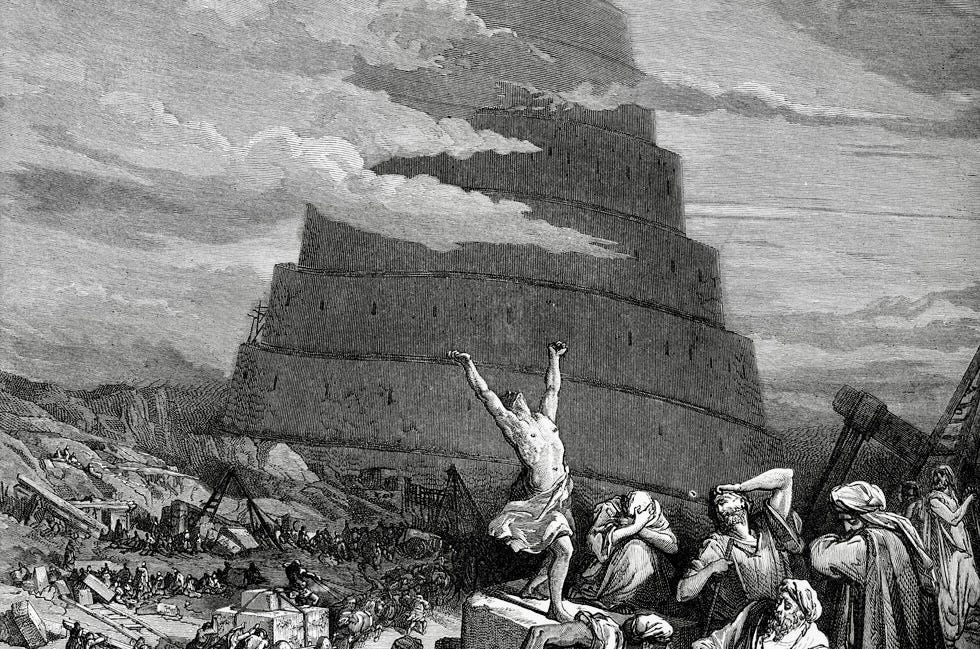
But this only makes it more difficult to understand God’s reaction. Why would he punish the desire to create sacred space on earth, and to have your needs met?
When he first sees the Tower of Babel, he even sounds scared, saying “this is only the beginning of what they will do…nothing that they propose to do will now be impossible for them.”
The fact is, God is scared, but not in the way you think. His real fear isn’t what the humans will do to him, but what they’ll do to themselves. That’s why he decides to bring it all crashing down — and why we must be careful not to repeat the Babelites’ same mistake…