


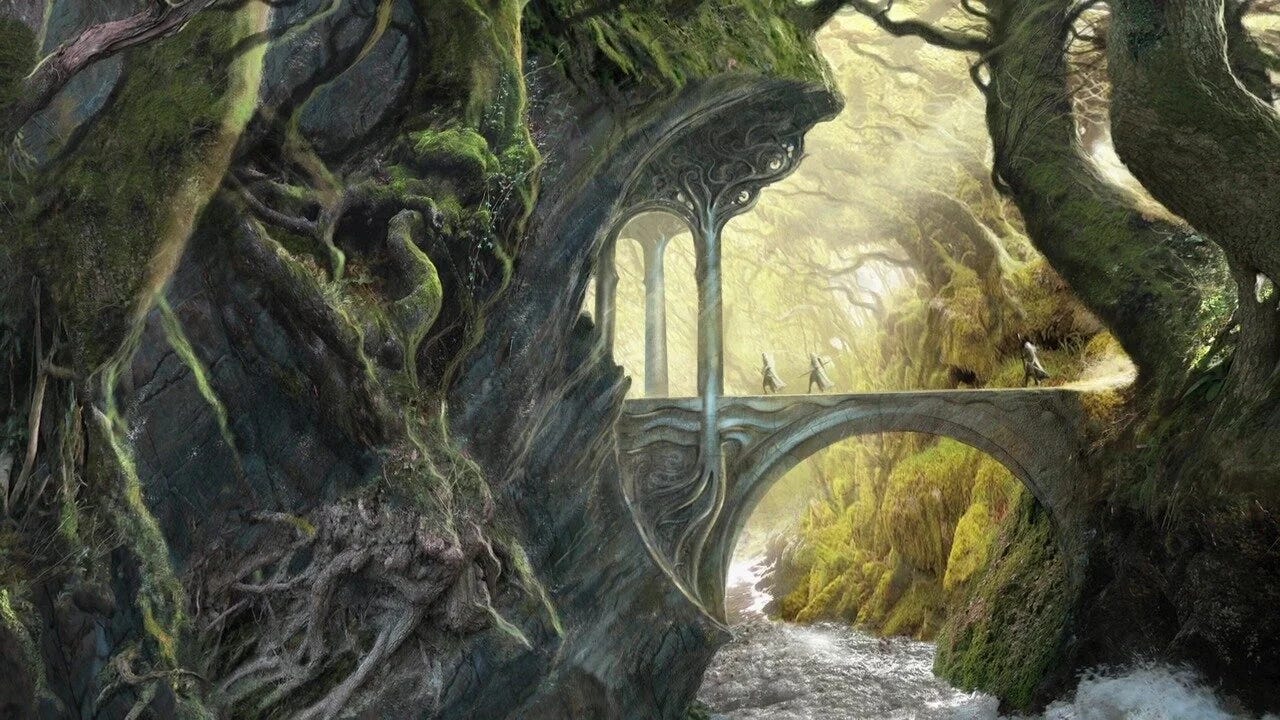
Lots of people are talking about “enchantment” recently: how we lost it, the consequences of losing it, how we might re-enchant our world again.
But precisely what enchantment means is hard to pin down. To many, it is the idea that the world we inhabit is not fully explainable by us. That our world is inherently meaningful, and so too our participation in it.
Put another way, it is not simply that the nearby forest may play host to mysterious forces or creatures, but that your own journey through the trees is participating in some greater story that you cannot fully know.
For J.R.R. Tolkien, enchantment could be identified as something more specific: something approximating the feeling of un-possessive love or wonder.
I’ve personally found learning to cultivate this perspective to be incredibly useful. Tolkien reveals how…
Reminder: this is a teaser of our paid subscriber essays.
If you’d like to support our work, please consider a subscription. You’ll get:
New, full-length articles 2x per week
The entire archive (200+ articles, essays, and podcasts)
Delight Vs. Control
One of my favorite things about Tolkien’s writing is how he takes time out of the plot to describe single trees in great detail. He gives them the dignity of their own names, personalities, genealogies. Why?
It is well known that Tolkien abhorred the desecration of nature by industrial society. He saw it as his role to speak up for trees, which in our world are voiceless: “In all my works I take the part of trees against all their enemies.”
More fundamentally, Tolkien underscored the importance of tending to things without regard for how you could use them. A living tree, just the way nature intended, is more beautiful than anything we could use it for or carve from it.
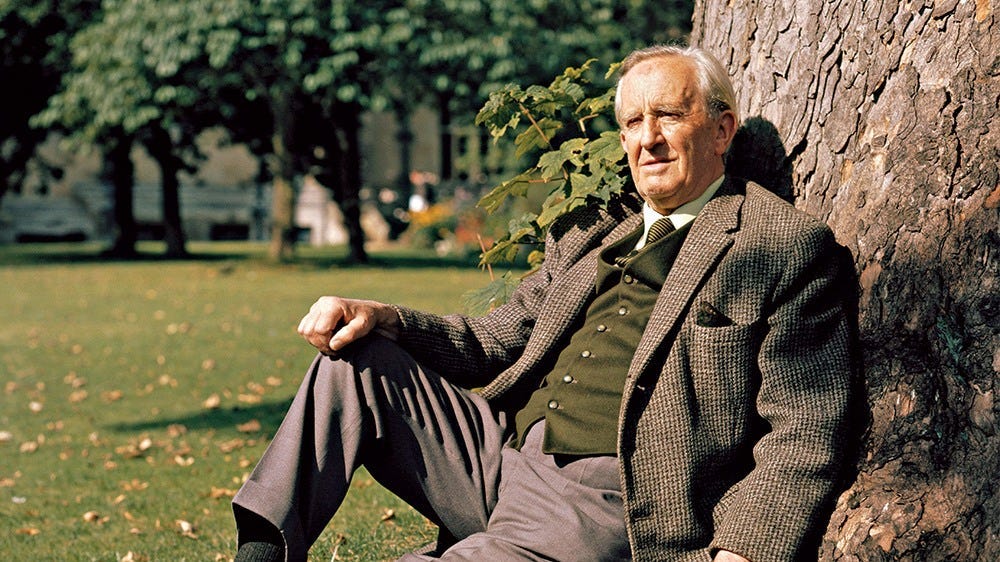
Modernity (or synonymously, the dis-enchanted state) sees nature as a set of extractable and farmable resources, which can be fully understood through rational inquiry. Modern man sets out to master nature (including his own human nature), and to transcend his physical circumstances. The enchanted man experiences the inherent wonder of things and wishes only to live among them, with a kind of un-possessive love for them.
The Lord of the Rings explores the tension between those who seek to control the world (Sauron, Lord of the One Ring) and those who seek only harmony with it (the Hobbits or Tom Bombadil, who treats the Ring with frivolity). Relinquishing one’s desire for control is your first step back toward enchantment, because control is enchantment’s polar opposite.
Learning to love things without fully understanding them is related to this. Things impress wonder upon us (a sunset, an intricate facade, a gnarled tree) because there is a dimension to them that we cannot explain. Not knowing precisely how something (or someone) works, or why it makes us feel a certain way, helps us to see the inherent value in it.
Tolkien advises us to be comfortable with the idea that we cannot understand all things, and to seek harmony with the way they are instead. But does he give any clues as to how to actually recover this state of wonder?
Faërie Vs. Magic
The first clue to achieving re-enchantment is in how Tolkien distinguishes enchantment (or “Faërie” in his nomenclature) from magic.
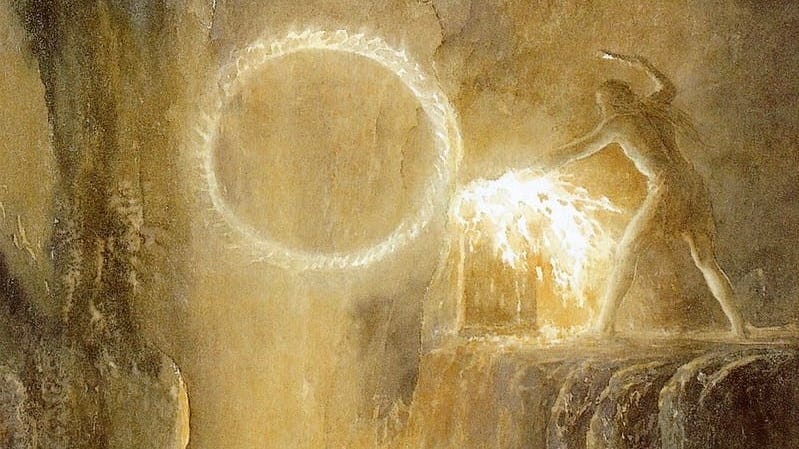
Sauron’s One Ring is a vulgar thing of magic, because magic seeks power by making an alteration in the primary world (it is no coincidence that the words “magic” and “machine” have the same ancient root ‘magh-’ meaning “to be able, to have power”). Sauron’s magic ring is a machine of total control.
Enchantment, by contrast, is “artistic in desire and purpose,” says Tolkien. It seeks to create anew rather than to change what is there. The high art of Tolkien’s Elves is an analogue for enchantment.
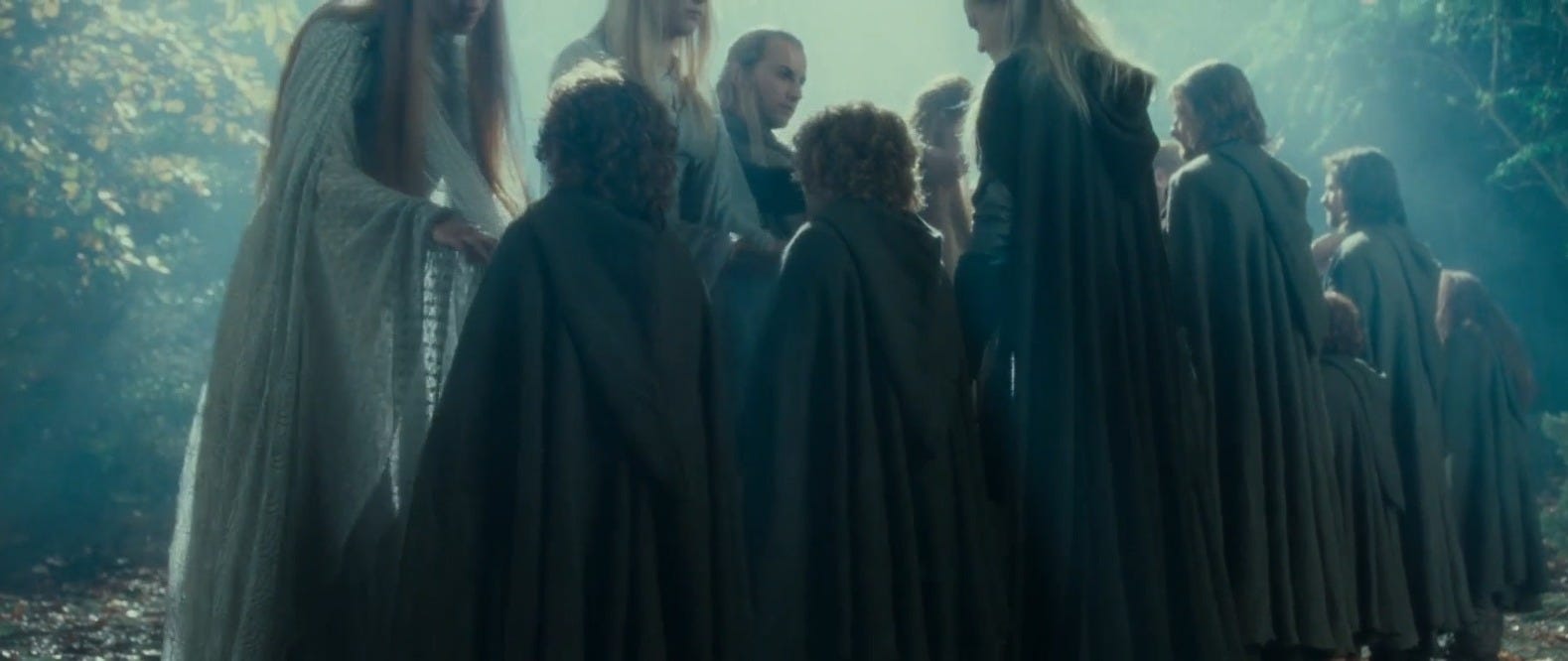
For instance, the Elven cloaks of Lothlórien, gifted as camouflaging garments to Frodo and company, were created in harmonious alignment with nature. When Pippin asks if these are “magic cloaks,” the confused Elves respond:
“Leaf and branch, water and stone: they have the hue and beauty of all these things under the twilight of Lurien that we love; for we put the thought of all that we love into all that we make.”
Elvish craft works alongside, not against, the power of the land. The Elves embody the kind of enchantment that Tolkien was after because their creations are rooted in a desire to create out of love and reverence for the land. They enhance one’s participation with original creation, and never seek to transgress its inherent nature. When we say “enchantment,” what we mean is a closer and more meaningful relationship with the world around us, and this is what characterizes the Elves.
So, practically speaking, what does our road to recovery look like?
It’s easy to talk about wonder and “un-possessive love” of things. But if you already know how a tree works — its biological form and process by which it grows — how do you see it as a thing of wonder again? What can we do as people of modern times?
Fortunately, Tolkien answered this question in an essay…