


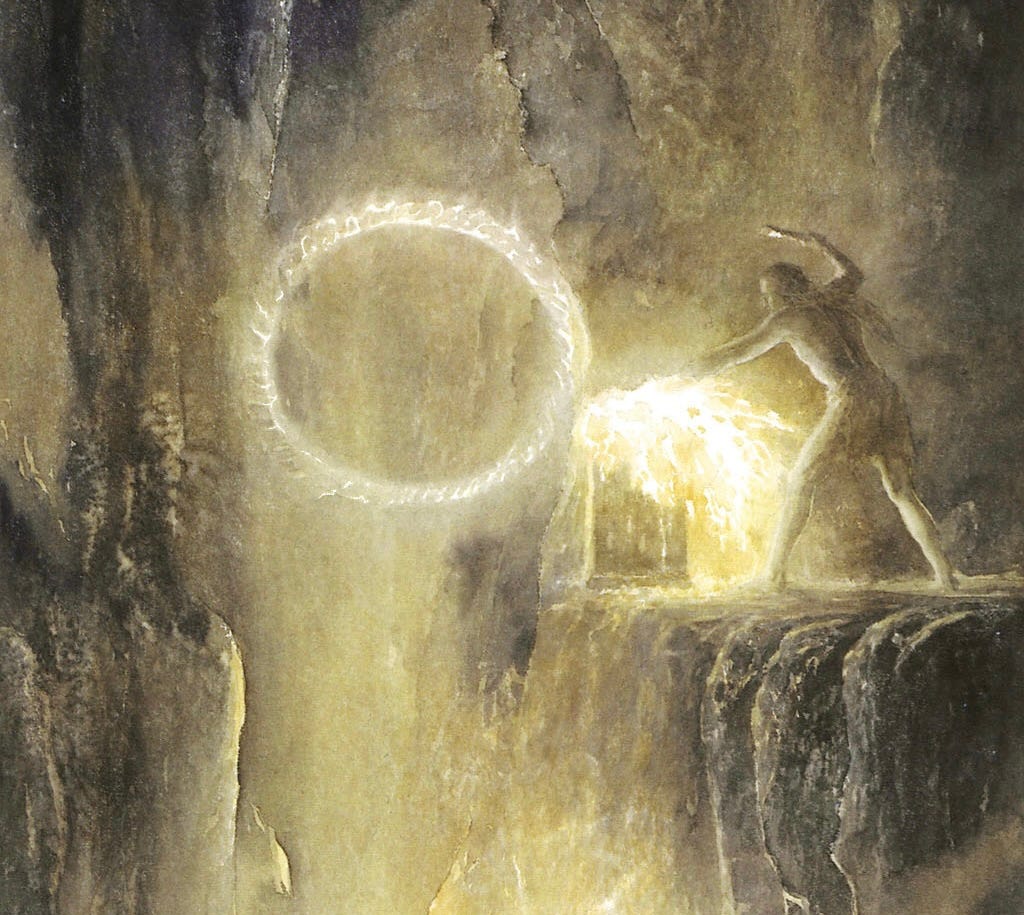
We are living through one of the great transfers in human history: the transfer of our mental faculties.
We have already handed our sense of direction to the GPS and our memory to the search bar. Now too, at long last, writing and thinking are being surrendered to the machine.
This transfer is understandably seductive. It feels free: Claude, Grok, and ChatGPT do the work for us, we save a bunch of time and effort, and we get to keep the results for ourselves. Right?
J.R.R. Tolkien would have recognized this Faustian bargain instantly, because his mythology was written, in large part, to expose precisely this. In The Lord of the Rings, we find that evil operates by surrendering personal sovereignty to what Tolkien called “the Machine.”
Tolkien, a veteran of WWI, had first-hand experience of how machines of war can rip apart an entire continent. But he was brilliant enough to also see the much more insidious power of technology: its ability to slowly rot the user from within.
The Lord of the Rings, then, is a cautionary tale about the use of technology. The threats and temptations posed by LLMs and algorithms may be different from the technology of Tolkien’s day, but his warning about the Machine is just as relevant as ever.
Here is Tolkien’s warning about technology, and what he suggests is the antidote…
Don’t forget to join our book club!
We just started East of Eden by Steinbeck. It isn’t too late to join: the next discussion is on Wednesday, August 26, at noon ET!
You can watch back the first session (on Chapters 1-18) here.
We are 100% independent, funded only by our incredible community. Support us with a paid membership and you’ll get:
Full-length articles 2x per week
The entire archive (200+ articles, essays, and podcasts)
Sauron’s Bargain
Explaining the One Ring to Frodo at Bag End, Gandalf says of Sauron:
“He made that Ring himself, it is his, and he let a great part of his own former power pass into it, so that he could rule all the others.”
Sauron, desiring absolute power, begins by giving his own power away and pouring it into the Ring. In return, the Ring lets Sauron’s will act on a scale that his own physical presence could never reach. This is how the Machine works; it offers the user external power, but that power must be paid for.
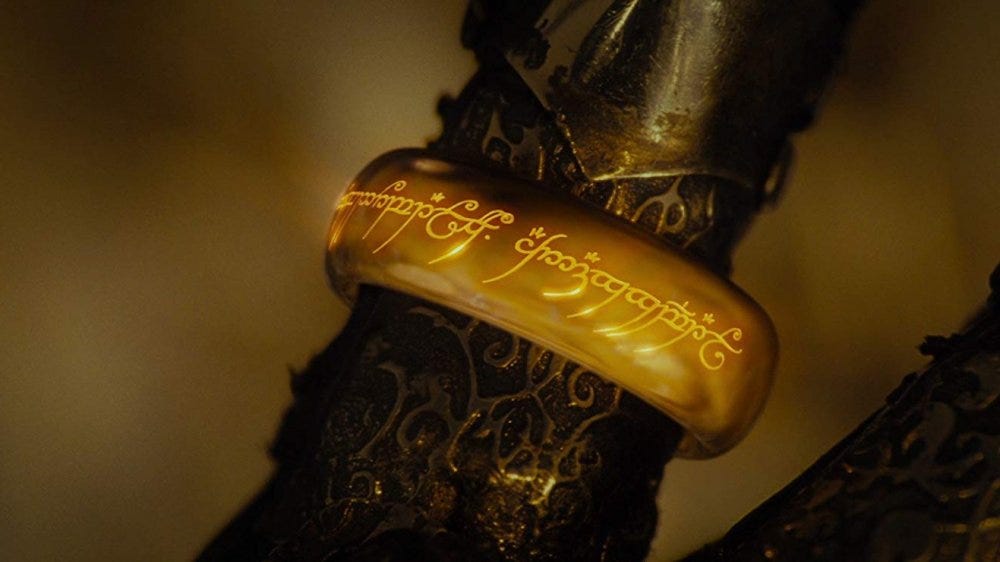
What this means is that Sauron’s existence now hangs on a thing that can be lost, or indeed, destroyed by the unlikely figure of a hobbit. Symbolically, this shows that when you externalize your strength, what you feed into the Machine may be amplified and “improved,” but it is no longer yours. Sauron’s Faustian bargain leaves him vulnerable:
The Ring of Sauron is only one of the various mythical treatments of the placing of one’s life, or power, in some external object, which is thus exposed to capture or destruction… A man who wishes to exert ‘power’ must have subjects, who are not himself. But he then depends on them.
—J.R.R. Tolkien, Letter 211
Of course, it’s not only Sauron. We see how the self is diminished with all who come too close to the Ring. Gollum’s lifespan may be extended by it indefinitely, but his life becomes a hollowed out husk — lonely, pointless, and entirely enslaved to the Ring itself.
Should We Trust Technology?
So, does Tolkien mean to disparage all technology use? Surely technology has played an important role in human history, lifting the masses from food shortage and back-breaking menial labour. Is Tolkien merely a Luddite to be ignored?
Well, consider what Tolkien precisely meant by “the Machine.” In a letter to his publisher, he once wrote:
By the [Machine] I intend all use of external plans or devices (apparatus) instead of development of the inherent inner powers or talents — or even the use of these talents with the corrupted motive of dominating: bulldozing the real world, or coercing other wills.
—J.R.R. Tolkien, Letter 131
Tolkien’s concern, then, is when technology is a substitute for inner growth. Thus, a good way to judge your own technology use is to ask: has using it in some way diminished your inherent capability or agency?
Has LLM use diminished your capacity to compose an essay, or think up original ideas? Has your GPS worn down your sense of direction?
In other words, is it helping you grow, or is it offering to grow for you?

But if this is the standard, how are you to navigate a modern world that almost seems to worship technology; in which screens and software are an increasing part of virtually every aspect of life?
If The Lord of the Rings is a cautionary tale about technology, then what does it suggest is the antidote?
Fortunately, Tolkien provides a way to resist the Machine — and better understand the legitimate role of technology — by instead cultivating power within. To understand his radical answer to the Machine Age, we have to go and see the Elves…