


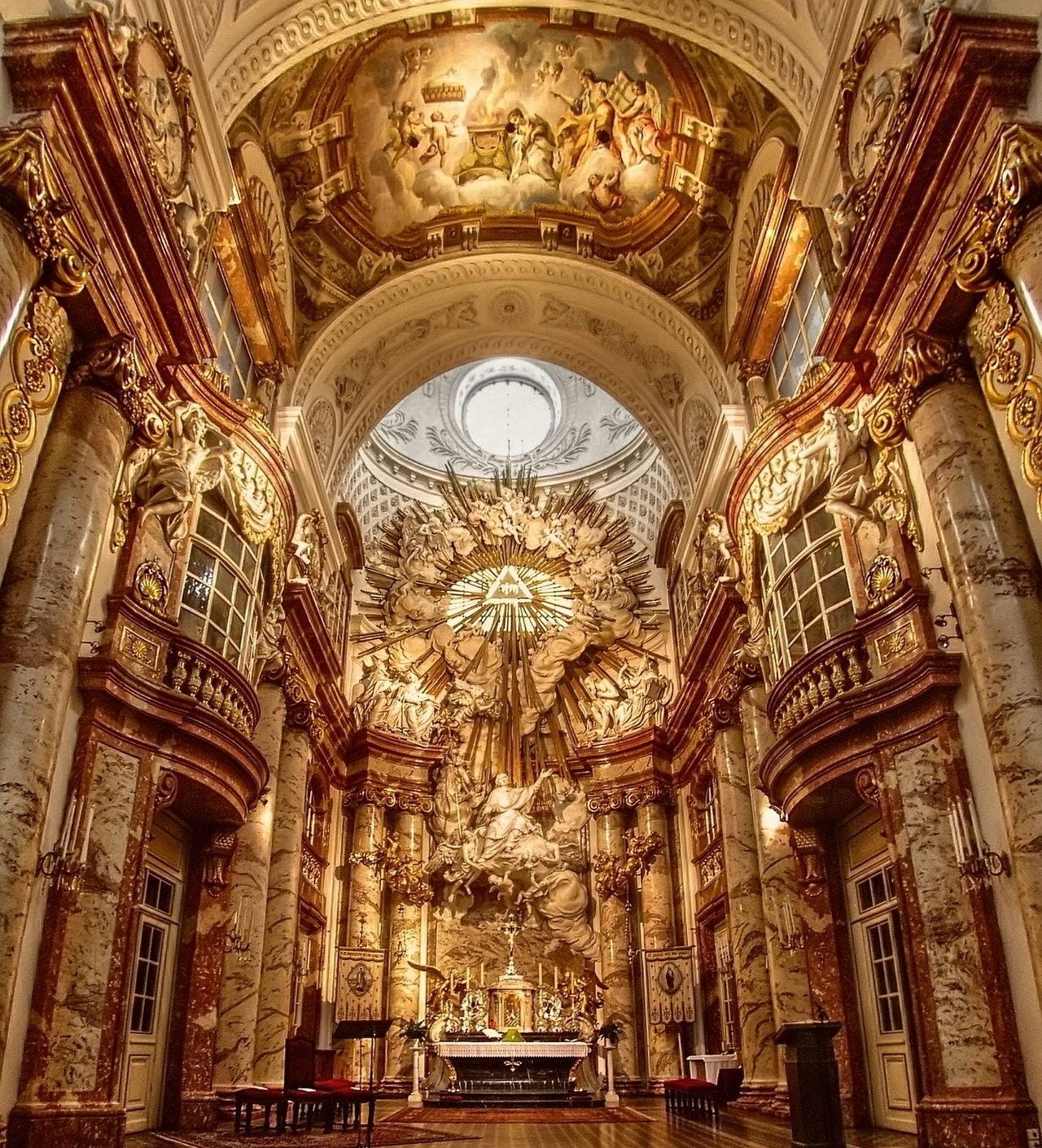
Few styles of art are as polarizing as the baroque. Immensely rich in detail, baroque art is a feast for the eyes, a drama-filled cacophony of light, color, and motion. People either love or hate it: for some, it is ornate and otherworldly, for others, it is gaudy and vulgar.
But as strong as most people’s opinions on baroque art are, few stop to ask the question, “what actually is it?”
In the popular imagination, the baroque has nearly become a caricature of itself, so much so that it’s easy to lose sight of what it originally stood for.
Today, then, we explore what makes baroque art truly baroque, and what the answer reveals about the power of art to shape the mind and soul…
Don’t forget to join our book club!
We’re about to start East of Eden by John Steinbeck! The first discussion is on Wednesday, August 12, at noon Eastern Time — join us!
We are 100% reader-supported. This newsletter is free, but if you’re able to support, please consider a paid membership. You’ll get:
Full-length articles 2x per week
The entire archive (200+ articles, essays, and podcasts)
“A Desire for the Stupefying”
But first, let’s begin by looking back to the origin of the term “baroque” itself. It originates from the Italian baroco, a word used to describe an overly complicated syllogism in Aristotelian logic.
This term wasn’t used by artists of the period, but rather by art historians writing centuries after. One of them, the 18th-century neoclassicist Francesco Milizia, described the baroque as “the superlative of the bizarre, the excessive, and the ridiculous”. The philosopher Benedetto Croce deemed it “an artistic perversion, dominated by a desire for the stupefying”.
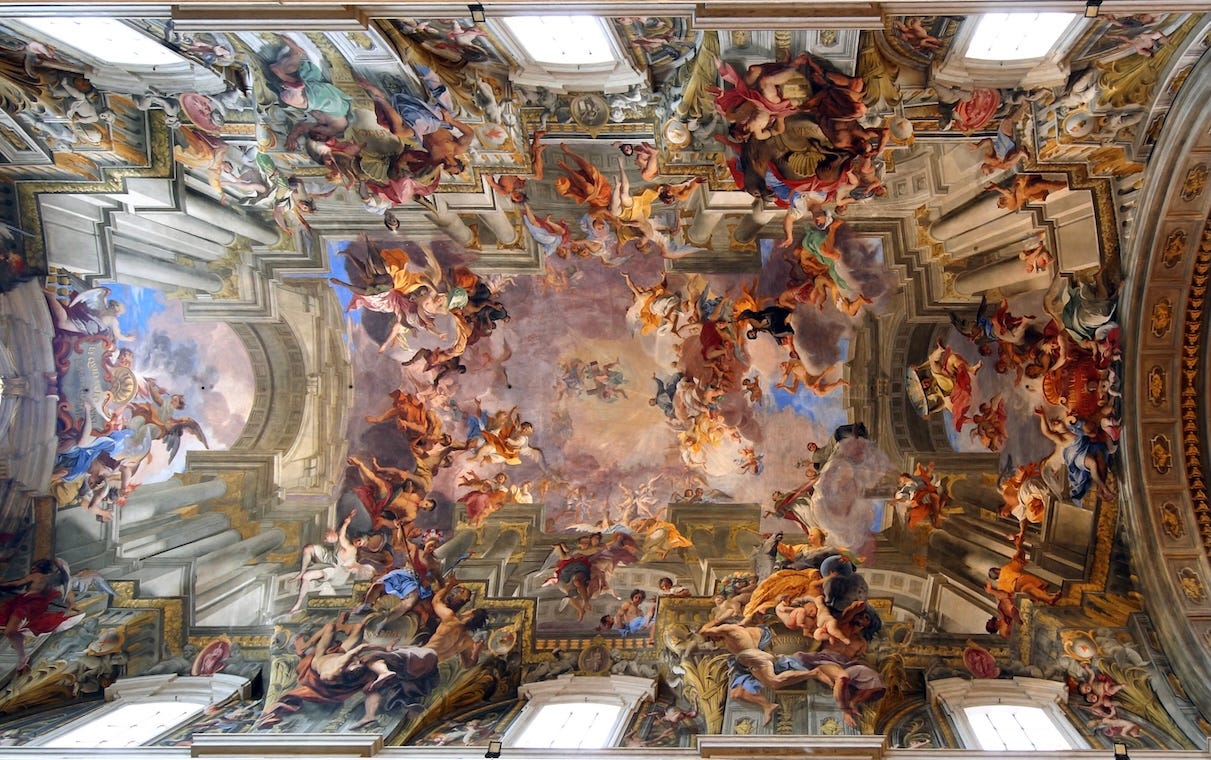
But of course, these men were biased with their own perspectives on artistic refinement, and sought to impose on the baroque an identity it didn’t claim for itself. If you had asked someone from a century prior what they thought the baroque was, their response would have been quite different…
Vulgar, or Vulgaris?
Following on the heels of the Renaissance and its subtle evolution into mannerism, baroque art pursued a no-holds-barred approach to the artistic vision. This was partially a reaction to the religious and political developments of its day: as the Protestant reformation encouraged iconoclasm and the destruction of religious images, the Catholic baroque responded with an affirmation of creation’s splendor.
Was it vulgar? Absolutely — but not in the way you think. The Latin adjective vulgaris was used to describe something that was “of the common people”, and baroque was certainly vulgar in this way. As the historian Martyn Rady writes:
The Baroque uses a semiotics [the study of signs and symbols] that is easily understood. At its heart lies allegory, which is often disclosed in the form of an emblem—a motif or pictogram that sums up an attitude, action, or aspect of the human condition.
In Baroque art, however, the motif is often combined with verses that explain its meaning…[it] is above all a learning tool, and there is no point instructing in a language that the audience cannot understand.
-Martyn Rady, The Habsburgs
In other words, baroque art was designed to speak to the heart, mind, and soul of everyday men and women. All of its allegories, emblems, grand designs and ornate minutiae served one very specific purpose, and it’s the reason why the Catholic Church was quick to endorse the baroque as its very own…
Glimpses of Heaven
In the mid-16th century, Pope Paul III summoned the Council of Trent to respond to the crisis of the Reformation. In the council’s 25th session, they covered one of the most hot-button issues of the day: the role of art in the Christian faith.
Contrary to the views of Protestant reformers, the Church affirmed that art plays a vital role in the life of faith, and should be used to instruct believers and inspire devotion to God. As Rady notes, the council declared that:
Art should be in the service of religion and should appeal to the emotions, even to the extent of giving ‘a glimpse of heaven’…The Baroque was in this respect another way of affirming Christ’s redemptive grace, which He has bestowed on all humankind.
So while Baroque art seeks to awe and overwhelm, at its core there is a deeper purpose: to lead you to the divine. Imposing statues and soaring marble columns testify to God’s grandeur, while fine embellishment and ornamentation reflect God’s attention to even the smallest of details.
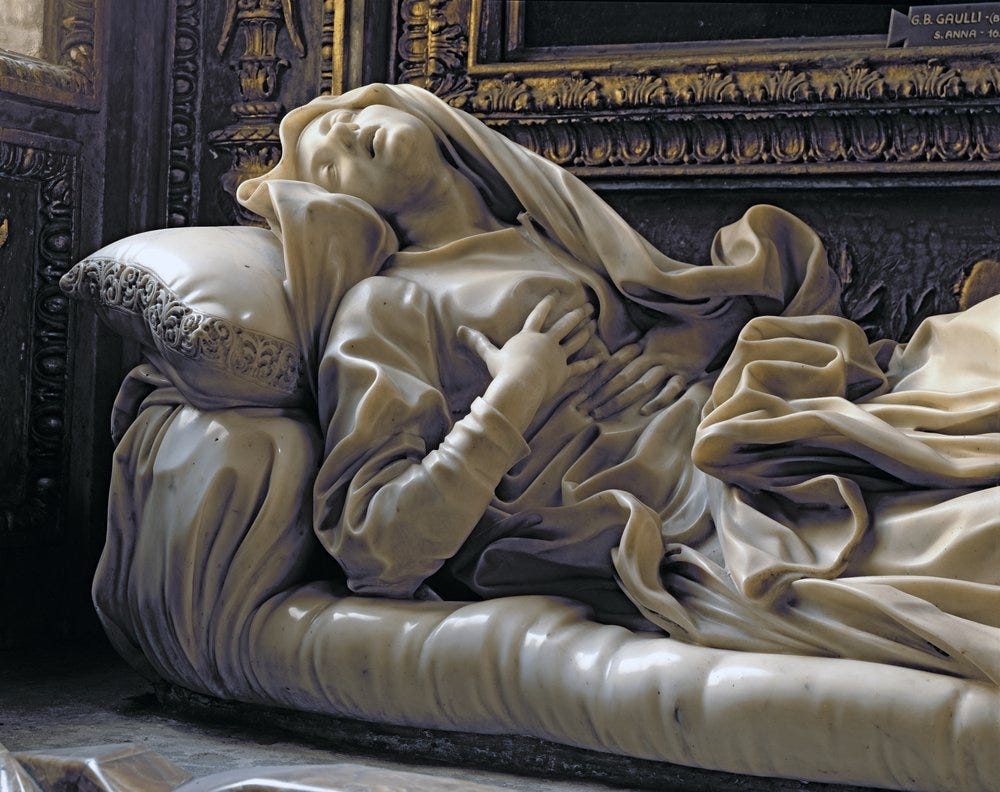
Baroque depictions of the saints, portrayed rapt in ecstasy or ascending to the Heavens, point to the fact that you too can partake in these things. The baroque, in other words, is a call to participation: a call to join in the timeless and eternal drama of the Christian story.
For these reasons, the Catholic Church leaned into the baroque as its evangelical tool of choice in its Counter-Reformation efforts. But it’s also why, despite its many critics, baroque art still resonates with so many people today.
Centuries after its inception, the baroque remains just as awe-inspiring as it did in its heyday. Because although tastes have evolved, one aspect of the human experience remains thoroughly unchanged: man’s hunger for the divine and the soul’s quest for eternity. To the extent that specific works of Baroque art speak to this, they remain just as beloved and timeless as ever.
I love the baroque, both musically and in image, and I’m mystified by some people’s reaction to it. The vivid visions are the point, the complication is the point, a stairway up in ear and eye. As far as I’m concerned, if it isn’t Baroque… don’t fix it.
"The baroque, in other words, is a call to participation: a call to join in the timeless and eternal drama of the Christian story."
Beautifully said.