


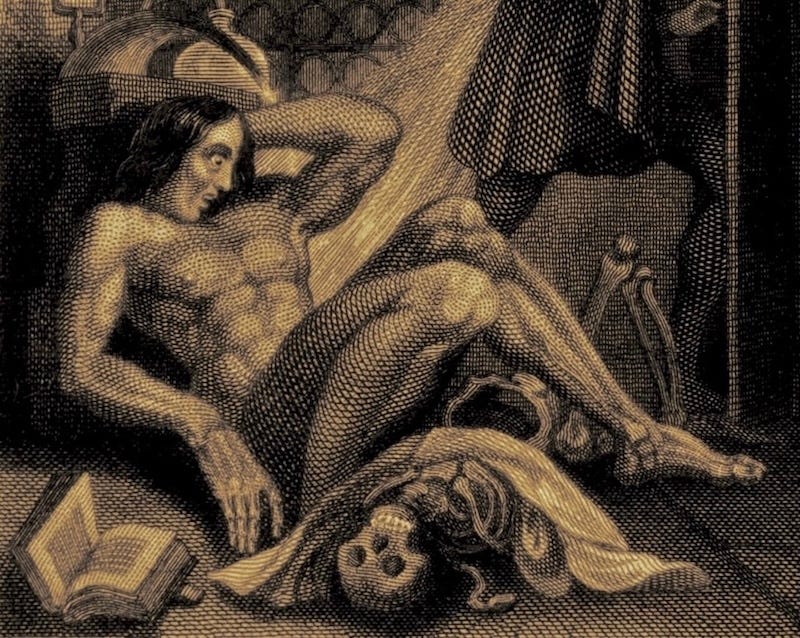
Mary Shelley’s Frankenstein is one of the greatest works of science fiction ever written.
In it, you may recognize prophetic parallels between the artificially created intelligence of Frankenstein’s monster and modern AI, and pertinent warnings about the dangers of hubristic technological advancement.
Much more importantly, though, the novel demonstrates why technological progress must always be guided by an understanding of what makes human life unique and precious. In drawing out the disaster of Frankenstein’s monster, Shelley is really addressing the fundamental question:
What exactly makes human life valuable, and can that value ever be successfully manufactured?
First published in 1818, Frankenstein has a lot to say about our own technological moment…
Industrial Revolution and Romanticism
The Industrial Revolution brought an unprecedented expansion of factory production. Many human artisans, who had once crafted clothing, tools, and other goods by hand in their own workshops, were driven out of business by those who could make similar products quicker and cheaper with factory labor — and forced to become operators of the same machinery that put them out of work.
Working conditions in the factories were also notoriously inhumane, and a far cry from artisans’ former lives. Shifts were long, arduous, dangerous, unsanitary, and there were few protections for children who worked. Children faced harsh punishments for disobedience or failing to meet production targets.
This shift in the status quo of labor also brought a great loss of artistry in everyday goods, owing to the streamlined designs required for mass production. In response, the Romantic movement sought to emphasize human work and artistry over the machine-made. Its adherents celebrated art, literature, and ideas that took a human-centric point of view, believing that there must be more to life than the pursuit of wealth and progress, particularly that which is pursued despite its harm to human beings.
It is from this perspective that Mary Shelley, just 18 years old, began writing Frankenstein, the tale of a young scientist who builds a human-like creature using the body parts of corpses. When the creature awakens, the scientist becomes terrified of his own creation and flees, only to later return to find that the creature has left. By the end of the book, the creature has wreaked havoc on many families’ lives, and Victor Frankenstein is left to confront the terrible consequences.
The Technocratic Paradigm
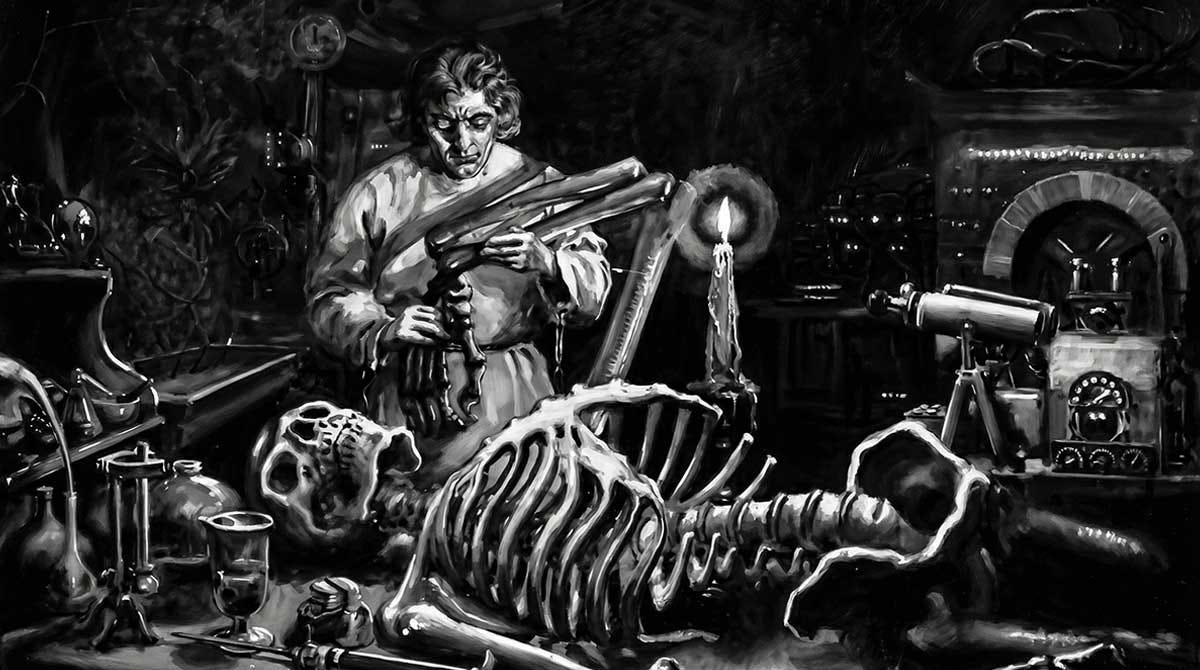
Shelley saw how a revolutionary industrial age, in its hyper-rationalistic pursuit of progress, failed to ascribe sufficient dignity to human beings. This is the essence of what Pope Francis once called the technocratic paradigm: a worldview that treats the advancement of technology for its own sake as the highest good, subordinating human well-being to the pursuit of ever-greater technical power. This reductionist paradigm, because it lacks a transcendent and intrinsic account of human worth, struggles to see a human being as more than the sum of its parts (and appendages), its intelligence, and its ability to perform tasks.
Victor Frankenstein embodies the technocratic paradigm, for he dreams of overcoming the limits of human existence by discovering the secret of life. He sees a person as a collection of measurable functions and works painstakingly to create a being of perfect proportions. Yet when he finally “succeeds,” his creation repulses him:
“His limbs were in proportion, and I had selected his features as beautiful. Beautiful!—Great God!”
Victor, who sought the glory of being a creator without the responsibility of caring for his creation, abandons the creature at once.
Yet Victor’s achievement is undeniably remarkable: left to his own devices, the creature learns to speak, reads great works of literature, reflects on the nature of justice, and even develops a longing for companionship. While secretly observing the De Lacey family, the creature comes to admire their kindness — he longs to participate in their lives, to love and be loved. But wherever he turns, his appearance provokes fear and rejection.
What this story so beautifully communicates is that we are not merely intelligent beings defined by our capacity to reason or perform tasks. We are also vulnerable and relational beings, whose lives are shaped by love and the recognition of others. We need a lot more than to be brought into existence: we need to be welcomed into a world of relationships through which we learn to love and to act virtuously.
In other words, Victor Frankenstein can manufacture a “life,” but he cannot manufacture the love that human life needs to flourish. He lacks understanding of what life is actually worth and fails to see something intrinsic to love about the life he created. Indeed, the real worth of a human being lies precisely in that element of him which cannot be mimicked, manufactured, or “scaled.” Technologists ignore this axiomatic truth at their — and our — grave peril.
What Is Special About Us?
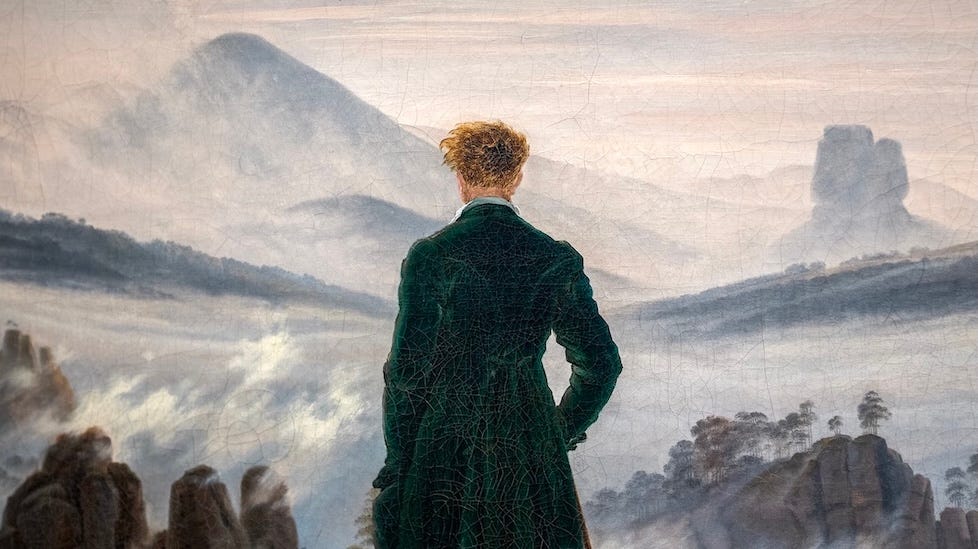
Shelley suggests that a human life is incalculably more than its intelligence or what it can achieve by way of output. Human life possesses an intangible and inherent worth, because it is uniquely in connection with something transcendent. It has a soul that is shaped by love.
In the final few pages of the novel, we read Victor’s own advice, delivered in hindsight, on how to live a fulfilling life:
“Seek happiness in tranquility and avoid ambition, even if it be only the apparently innocent one of distinguishing yourself in science and discoveries.”
True human flourishing lies in distinguishing oneself in matters that lie beyond the realm of technological advancement, or any other form of earthly achievement. A human being is defined not by his achievements, but by what he loves.
A technocratic paradigm that truly believes it can create consciousness, “perfect” humanity, or replicate the entire worth of a human being will always lead to seriously dark consequences. It will always lead to evaluating human lives by their measurable outputs.
To avoid such a disaster, you must find and embrace some form of worldview that recognizes there are things about our nature that cannot be manufactured. Not in a factory, not in a laboratory, not in a data center.
Human beings are made in the image of something that you won’t find here on Earth.
Thanks so much for reading!
If these articles have meant something to you, please consider becoming a paid member to support this work. Every subscription truly makes a difference.
We are 100% independent, which is only possible because of you. There are no ads here, only independent writing devoted to the True, Good, and Beautiful.
🚨 Our next book club read has been decided…
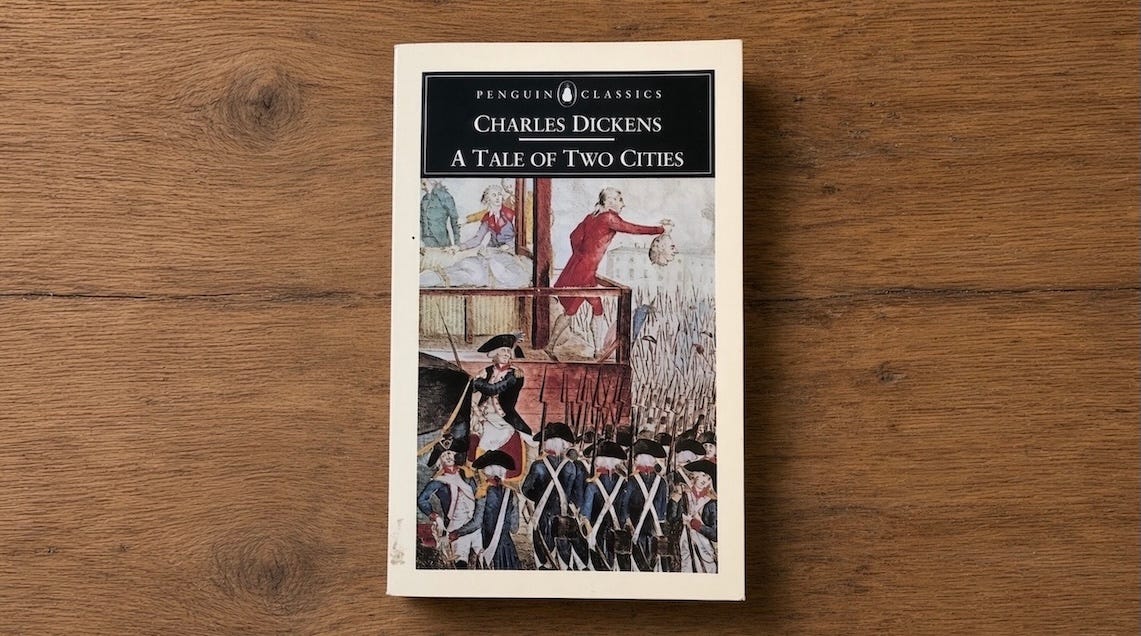
We will read “A Tale of Two Cities” by Charles Dickens next!
The first discussion is on November 4. You can see the reading schedule here.
The opening lines of this great novel have never felt more relevant…
“It was the best of times, it was the worst of times, it was the age of wisdom, it was the age of foolishness, it was the epoch of belief, it was the epoch of incredulity, it was the season of Light, it was the season of Darkness, it was the spring of hope, it was the winter of despair, we had everything before us, we had nothing before us...”
Our news cycle is an endless procession of doom. There are a thousand reasons to despair. It feels as though our time is uniquely chaotic, that an old order is collapsing and what lies ahead is beyond control. But we have been here before.
Dickens takes us into the hysteria of the French Revolution and a society utterly consumed by vengeance. But he also shows how an act of self-sacrificial love can redeem it. Indeed, “Death may beget life.”
You must live now by refusing to be part of the cycle of decay. The counter to the mob is YOU, and the redemption of your own life. You are called to discover life even in the midst of terrible evil and death. The darkest times are the setting for the greatest acts of love.
This is one of the most powerful novels ever written. Please read it with us.
If you’re wondering how our book club works or how to participate, check out this page on how to join.
Become a paid member of our book club and you’ll get:
New, full-length essays and articles every week
Biweekly book club discussions and reading guides
Access to our incredible community of readers
The entire archive (200+ articles, essays, and podcasts)
Another beautiful piece, thank you.
What I like most is that Victor's sin is not creating the creature, it is running away the moment he sees it. He does the technical part and rejects the role of the father. That is where everything you mention comes together: artisans turned into factory parts, the obsession with progress, and a creature that learns to speak, reads Milton, and only asks for someone to look at it without disgust. It says so itself, it should have been his Adam, but it ended up being the fallen angel. Something similar is happening with AI. Everyone asks what a machine is capable of doing, and almost no one asks what we owe to what we create, or to the people it displaces. Great article, the kind that leaves you wanting to reread the novel.