


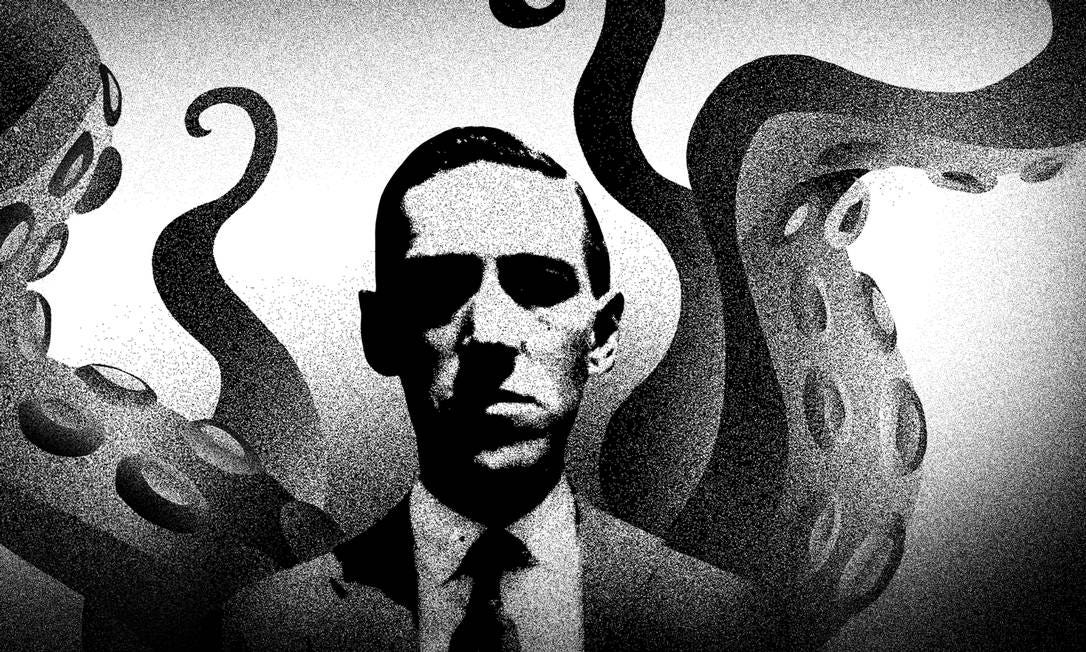
It is said that horror is the most moral of literary genres. A strange claim at first, but it makes sense when you think about it: something can only horrify by arousing a moral instinct, and only by knowing what is good can you recognize what is evil.
Horror has taken many shapes and forms over the centuries. In the 1800s, Edgar Allan Poe transformed the genre from tales of external monsters to introspective psychology, depicting how guilt and obsession can destroy the mind. Often, his narrators are themselves the true monsters of the story. Yet for as modern as Poe seems, he is not the main influence on the type of horror we know today.
Best-selling novels like Stephen King’s It and the world famous TV series Stranger Things all take their cues from another man: H. P. Lovecraft. A prolific writer of over 70 short stories, Lovecraft transformed the genre by making it about an unspeakable horror somewhere out there, something unnameable and beyond human comprehension. Knowledge of these hidden realities often leads to madness, as characters succumb to an overwhelming sense of cosmic dread.
Lovecraftian horror clearly resonates with people today, as the success of a show like Stranger Things clearly indicates. But to better understand why it resonates, you must turn to the work of Lovecraft himself.
Today, we look at five stories that best capture the specific horror of Lovecraft’s tales, and explore what they reveal about our own modern and cosmic insecurities…
1) The Statement of Randolph Carter
This story doesn’t typically feature in the “best of” lists of Lovecraftian tales, but it is thoroughly representative of Lovecraft’s style. It features a man, the eponymous Randolph Carter, testifying in court about the disappearance of his friend and colleague.
What makes the story so eerie is that throughout it, the horror in question is never named directly. It’s alluded to, hinted at, felt, and even heard, but never seen. You know that Carter ends up safe because he’s in court giving his testimony, yet that doesn’t alleviate the rising tension or underlying fear.
From a purely textual point of view, the story is also fascinating for the way it is presented. Written in Lovecraft’s signature journalistic style, the dry and matter-of-fact approach contrasts with the vague and unknowable dread that undergirds the story’s main plotline. It’s a short and easy read, too: pound for pound, it’s one of Lovecraft’s most hair-raising stories.
2) The Shadow Over Innsmouth
If The Statement of Randolph Carter is a good tale to whet your appetite, The Shadow Over Innsmouth is one to keep you full for days. It is the longest story on this list, and one of the main installments in Lovecraft’s famous Cthulhu Mythos.
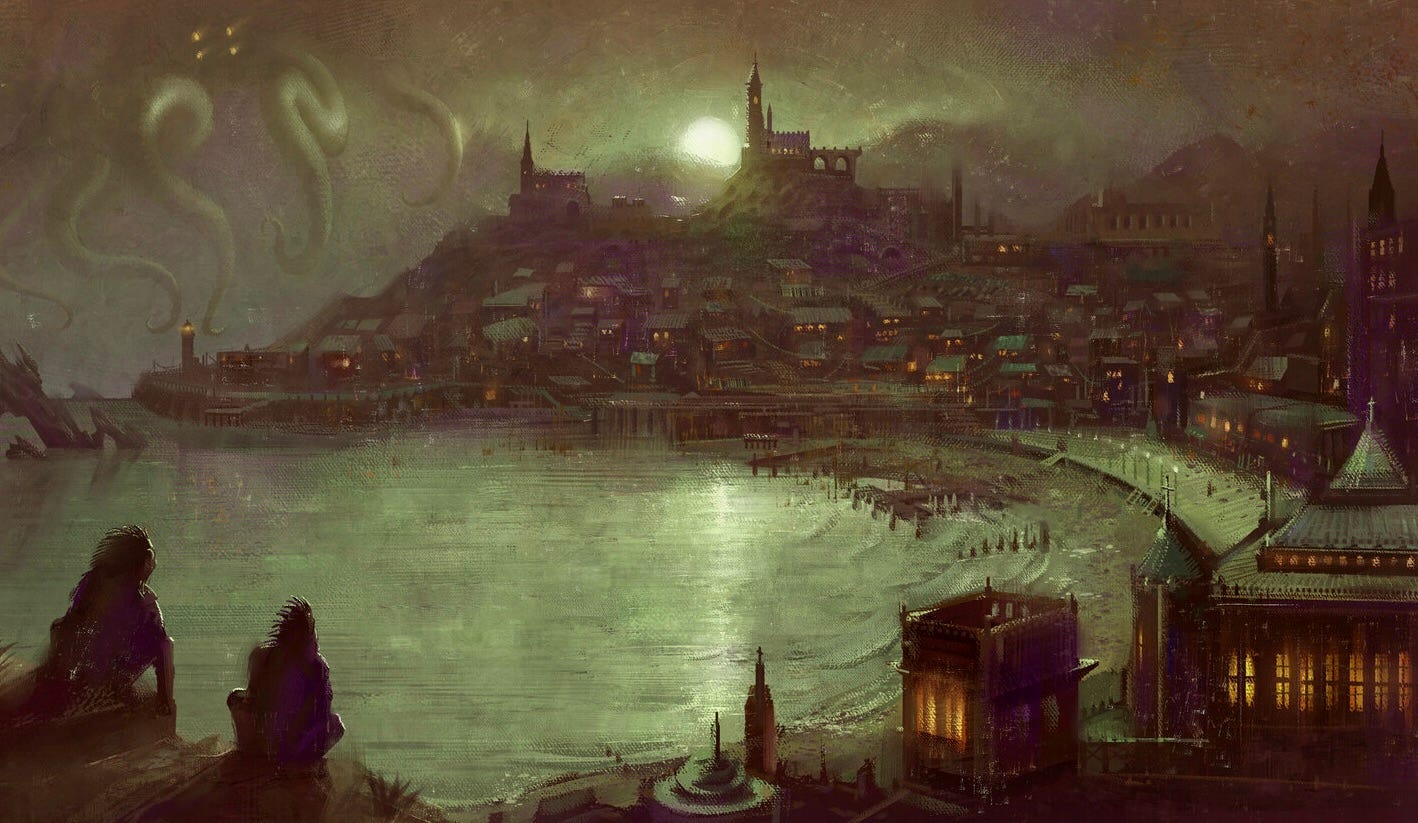
The story follows a man sent to investigate strange reports about the inhabitants of Innsmouth, and the saga of encounters keeps you on the edge of your seat throughout. From the investigation to the discovery, the terrifying pursuit, and the tale’s tragic end, there is no shortage of exhilarating material.
But the most Lovecraftian aspect of all is the story’s conclusion, where the narrator comes to an unexpected and shocking revelation (sorry, we can’t give too much away!). It is textbook Lovecraft in that the line between worlds and cosmic realities is blurred, and in the end, you’re not sure which side is worse to be on…
3) The Whisperer in Darkness
If you like aliens, this one’s for you. Another one of Lovecraft’s longer stories, it follows a professor’s correspondence with a man who encounters an extraterrestrial race of beings on his Vermont farmstead.
An abrupt change of tone in the latter’s writing prompts the professor to visit the farm, whereupon he gets far closer to the action than he ever imagined. However, in typical Lovecraft style, the power lies not in what does happen but what doesn’t happen, or better yet what could have happened. A vague, uneasy feeling of discomfort slowly builds throughout the piece, bringing you tantalizingly close to the horror, but never quite touching it…
4) The Rats in the Walls
Blood, violence, and gore are integral parts of many sub-genres of horror, but they are noticeably missing from Lovecraft’s work. This story is one exception.
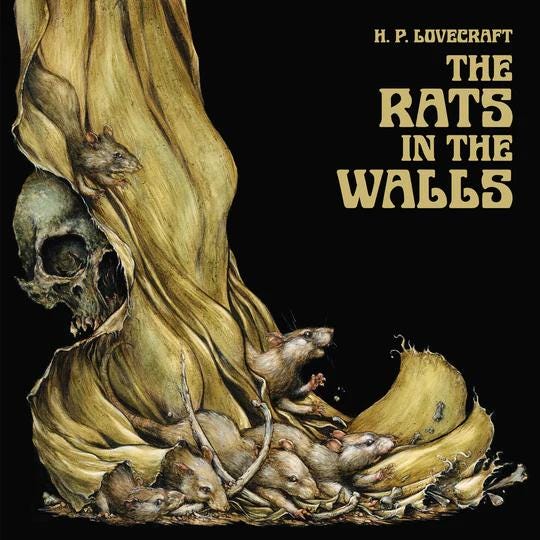
In this and in other regards (such as the fact the story is set in England, whereas most of Lovecraft’s tales transpire in America), The Rats in the Walls is atypical of Lovecraft’s larger corpus. Yet at the same time, it’s unmistakably Lovecraftian. Cryptic themes of fate and ancestral evil haunt the piece throughout, and the plot centers around the main character’s descent into darkness.
What that darkness looks like, exactly, will be left to the reader to discover. This story isn’t for the faint of heart, but it’s one of Lovecraft’s most riveting.
5) The Call of Cthulhu
How could any list be complete without this one? The Call of Cthulhu is the foundational story in Lovecraft’s greater Cthulhu Mythos, and demonstrates his remarkably creative capacity for world-building. It focuses, perhaps rather obviously, on the great monster Cthulhu, a terrifying cosmic entity and “High Priest of the Great Old Ones”.
But just because the story features such a frightful behemoth, don’t be fooled into thinking that’s what it’s all about. The real horror, as with much of Lovecraft, is not a specific monster but rather the terror of discovering you’re caught up in a spiritual reality far greater than you ever realized. Whether you like it or not, there’s no getting out.
In this way, Lovecraftian horror can be read as a dark inversion of Christian cosmology. Both posit that you inhabit a reality populated by vast, powerful forces beyond ordinary perception. The difference, though, is that Christian cosmology frames this hierarchy within a moral order governed by God, whereas Lovecraft presents a cosmos that is chaotic, indifferent, and devoid of human significance: in other words, the most terrifying horror of them all.
Thank you for reading!
The opening claim is the one worth arguing about. Horror as the most moral genre because only a moral instinct can be horrified. It sounds paradoxical until you sit with it. Lovecraft understood this better than most: his narrators aren't frightened by evil. They're frightened by indifference. Which is worse.
H.P. Lovecraft is one of my son's favorites. Even as a young kid, he loved horror stories. (We read so many Goosebumps!) I had not heard of him until my son introduced me to him. It's not my favorite genre, but I'm glad it exists for readers like my son.