


Few verses of Scripture are more hotly debated than the opening lines of the Bible. Does the Book of Genesis provide a historically accurate account of the Earth’s creation, or a metaphorical one? Does the Hebrew word yôm (often translated as “day”) indicate a literal 24-hour day, or does it mean a period of time, like an era?
For most people discussing the historical accuracy of Genesis, these questions are at the forefront of their mind. But in wandering into these debates, they all too easily lose sight of a far more interesting — and more significant — question: why are there seven days of creation in the first place?
Today, we look at the reasons behind the seven days of creation, and what the implications are for the rest of the Bible story…
Reminder: you can support us and get tons of extra content for a few dollars per month.
New, full-length articles 2x per week
The entire archive of content (150+ articles, essays, and podcasts)
Membership to our bi-weekly book club (and community of readers)
We are currently reading Tolkien’s The Fellowship of the Ring in our book club. The next meeting is on Wednesday, December 3, at noon ET — join us!
Days 1-3: Creating the Domains
And God said, “Let the waters under the heavens be gathered together into one place, and let the dry land appear.” And it was so. God called the dry land Earth, and the waters that were gathered together he called Seas. And God saw that it was good.
-Genesis 1:9-10
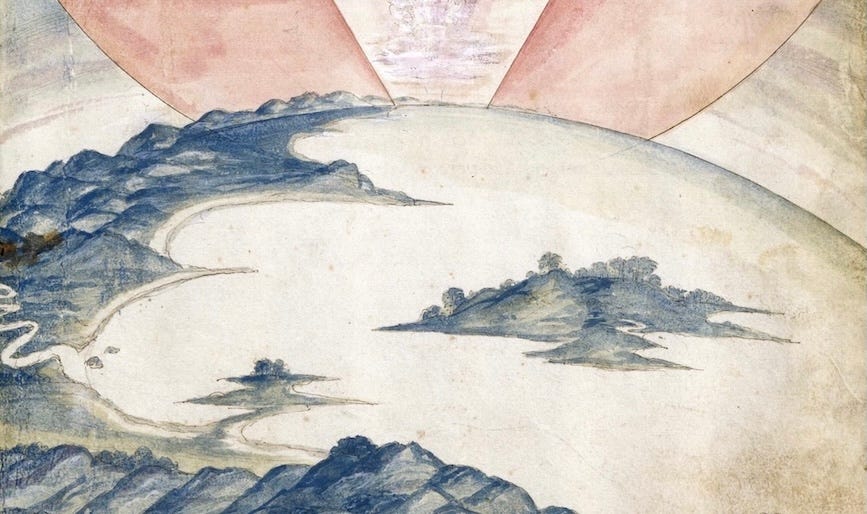
The first three days of creation are characterized by God creating realms, or domains, to be inhabited. On the first day he creates the realm of time itself by separating the light from the dark to create day and night. On the second he creates the Heavens, and on the third he creates the dry land and the seas, as well as the plants that spring up on the dry land.
Already in these first three days of creation we have a foreshadowing of the doctrine of the Holy Trinity, the “three in one” God. But more importantly, we have an indication of why God decides to create in the first place: the hint comes in the form of the types of plants he causes to spring up on the dry land.
These plants are not ferns or mosses, but rather “plants yielding seed, and fruit trees bearing fruit in which is their seed.” This reveals that God is not creating merely for his amusement, but to sustain the life of other beings.
It is in the next triad of days that we see exactly what type of beings he has in mind…
Days 4-6: Filling the Domains
And God said, “Behold, I have given you every plant yielding seed that is on the face of all the earth, and every tree with seed in its fruit. You shall have them for food.”
-Genesis 1:29
Over the course of the next three days, God populates the realms he just created. On the fourth day of creation, he populates the heavens with the sun, moon, and stars. On the fifth day, he fills the seas with fish and the sky with birds. Finally, on the sixth day, he creates “livestock and creeping things and beasts of the earth.”

Up until this point, the phrase “and God saw that it was good” is used to conclude each act of creation. This provides a subtle yet important reminder of the role of the physical world in Christianity: it is not an impediment to the non-physical spirit, but rather a good in and of itself. However, even the goodness of the physical world is outshone by God’s next creation:
Then God said, “Let us make man in our image, after our likeness. And let them have dominion over the fish of the sea and over the birds of the heavens and over the livestock and over all the earth and over every creeping thing that creeps on the earth.”
-Genesis 1:26
After creating man, “God saw everything that he had made, and behold, it was very good.” The word “very” here is a new addition, and an indicator of man’s relationship to nature: when he lives in light of how God made him, the goodness of the created world is enhanced by man’s presence, not degraded. The next line concludes the chapter: And there was evening and there was morning, the sixth day.
In just six days, God has created everything. Why, then, do we say that there are seven days to creation?
Day 7: Filling the Cosmic Temple
So Solomon observed the festival at that time for seven days, and all Israel with him.
-2 Chronicles 7:8
Only by looking back to ancient Hebrew history can we decipher the true meaning of the seven days of creation. In the Book of Leviticus, for example, when God orders the inauguration of the Tabernacle, the ceremony required to do so takes seven days. In the Book of 1 Kings, Solomon dedicates the Temple with another seven-day feast.
Both the Temple and the Tabernacle are the places God goes to dwell amongst his people; where he “takes up residence” in a sacred place. In Genesis, it is no different: God rests on the seventh day, and he does so by going to dwell in his newly created cosmic temple.
This concept is underscored by the absence of a phrase you’d expect to see at the end of the passage: “and there was evening and there was morning, the seventh day.” This formula had been used after all the previous six days of creation, but is noticeably missing after the seventh. By omitting this phrase, the author of Genesis sends a clear message: the seventh day is not ended. We are living it right now. God is dwelling among us.
The account of creation in Genesis 1, therefore, is not primarily concerned with questions of history or science. Rather, it is most concerned with showing how God created the universe as his cosmic temple, and came to dwell within it.
God doesn’t, in the ancient Hebrew understanding, simply set up the world and leave it to run by itself. He instead steps into the midst of it — and not for the last time…
Thank you for reading!
If you’re interested in reading more emails like this one, check out our new sister publication: The Ascent. There, we are diving deeper into theology, mysticism, and ancient texts…
One free article every Tuesday, and longer deep dives every Friday for paid readers…

If you haven’t already check out Dr Michael Heiser’s Unseen Realm - documentary on YouTube based on book of same name. Excellent stuff - talks all about the cosmic geography- understood in ancient times but long forgotten in modern times Adds immensely to the study of scripture. Yes there is only one Yahweh to whom none compare.
Amazing! A great article.