


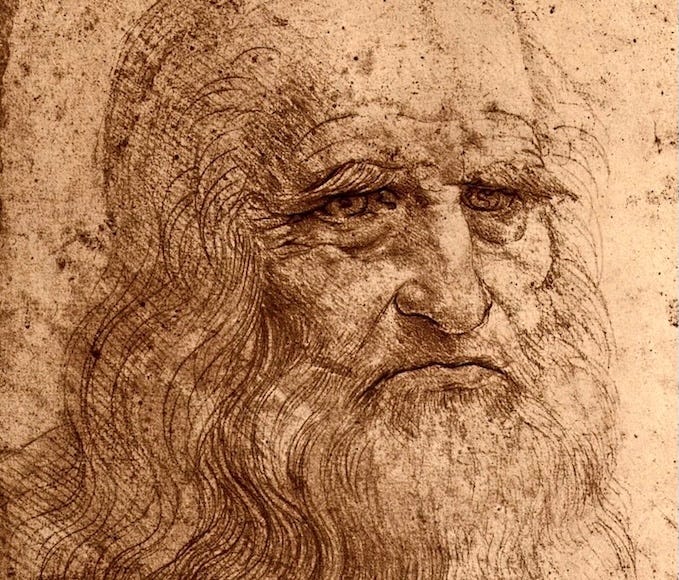
The main ingredient behind Leonardo da Vinci’s incredible success can be boiled down to one thing: curiosity. His intense curiosity was the engine of his genius, propelling him to make groundbreaking observations and contributions across various fields.
From anatomy to botany, cartography to engineering, architecture to warfare, his interests knew no bounds. His deep knowledge of these diverse fields allowed him to make connections between seemingly disparate disciplines, and elevate his art in the process.
Leonardo’s notebooks, which contain thousands of pages of sketches and drawings, bear witness to his expansive mind: detailed studies of war machines, architectural plans, rock formations, drapery studies, anatomical dissections, and depictions of natural phenomena like whirlpools.
Unfortunately, this same curiosity was also Leonardo’s Achilles’ heel. The breadth of his interests often prevented him from seeing projects through to completion, as his focus was constantly shifting. The very curiosity that fueled his innovative spirit also scattered his attention, resulting in numerous neglected paintings.
How is it that a Renaissance genius with a career of over 50 years didn’t ever complete more than 20 paintings? Let me explain…
Thank you for reading this year! If you’d like to support our work, please consider taking out a paid subscription — it helps us enormously. Plus, you’ll get:
New, full-length articles 2x per week
The entire archive of content (150+ articles, essays, and podcasts)
Membership to our biweekly book club (and community of readers)
We are currently reading the Old English epic poem Beowulf in our book club. The next discussion is on Wednesday December 31, at noon ET — don’t miss it!
A Story of Two Artists
To preface what’s to come, let’s be clear and affirm that the quality of an artist isn’t measured by the quantity of his artistic output. Painting more doesn’t mean you’re a better painter.
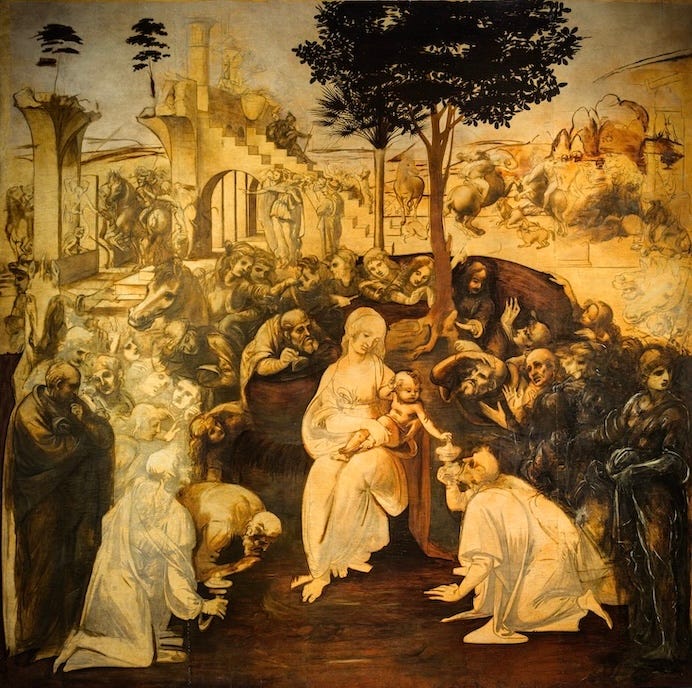
That said, it is true that when compared to the output of his contemporaries, Leonardo’s surviving portfolio is shockingly sparse. Only about 10 completed paintings by da Vinci survive today, and even when accounting for known lost works passed down through copies, the total number of his paintings barely reaches 20. For an artist who spent a lifetime drawing and sketching in his notebook, this is a remarkably low number.
To put this in perspective, consider Leonardo’s contemporary Sandro Botticelli. Sandro and Leonardo were only seven years apart in age, and both grew up in the Palazzo Medici under the patronage of Lorenzo the Magnificent. Botticelli, whose body of work includes the famous paintings The Birth of Venus and La Primavera, completed over 130 paintings in his lifetime.
Botticelli and Leonardo were close friends, despite the fact that the latter wasn’t too fond of the former’s artistic sensibilities. Leonardo frequently critiqued his friend’s work, and famously remarked that Botticelli made “very dull landscapes.” Had Botticelli ever caught wind of this, one can only imagine his retort: “Well, at least I make them!”
External Factors
When Leonardo wasn’t busy criticizing other artists, he was often traveling — a fact that certainly contributed to his inability to complete many projects. Throughout his life, Leonardo moved between Florence, the Papal States, the Republic of Venice, and the Duchy of Milan, among other places.
Each relocation brought both new opportunities and new distractions, making it difficult for him to maintain continuity in his work. These frequent moves were often driven by the need for patronage, political instability, or personal safety, further complicating his ability to see projects to fruition.
Additionally, geopolitical events in the unstable Italian peninsula often interfered with his more ambitious projects. Take for example his unrealized equestrian statue, commissioned by the Duke of Milan.
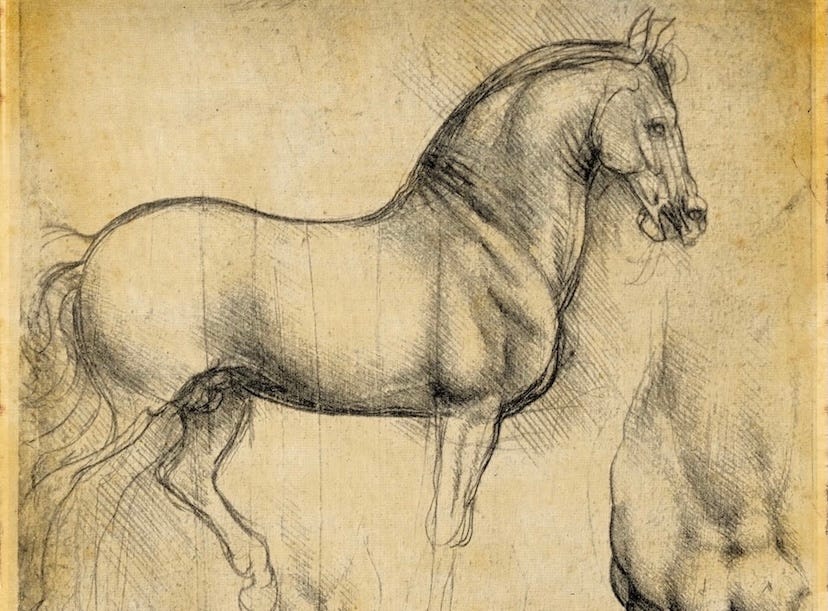
Leonardo labored for over a decade designing and preparing this colossal bronze sculpture of a horse, which was intended to be the largest equestrian statue in the world. However, due to the Italian Wars, the bronze meant for the statue was repurposed for cannon making, and the project abandoned. Leonardo’s clay model was eventually destroyed by French soldiers (who used it for target practice), and the project was consigned to the trash heap of history.
But while certain events were outside of his control, Leonardo was still aware that he himself was often an impediment to his own artistic vision. Specifically, it was his unbridled curiosity that distracted him from completing projects as he would have liked.
Several biographers and contemporaries of Leonardo remarked on this lack of output, but it was the artist himself, of course, who was his own harshest critic. At the end of his life, Leonardo had some shockingly harsh words to say in retrospect about his career.
Here is what he said, and what his words can teach us today…