


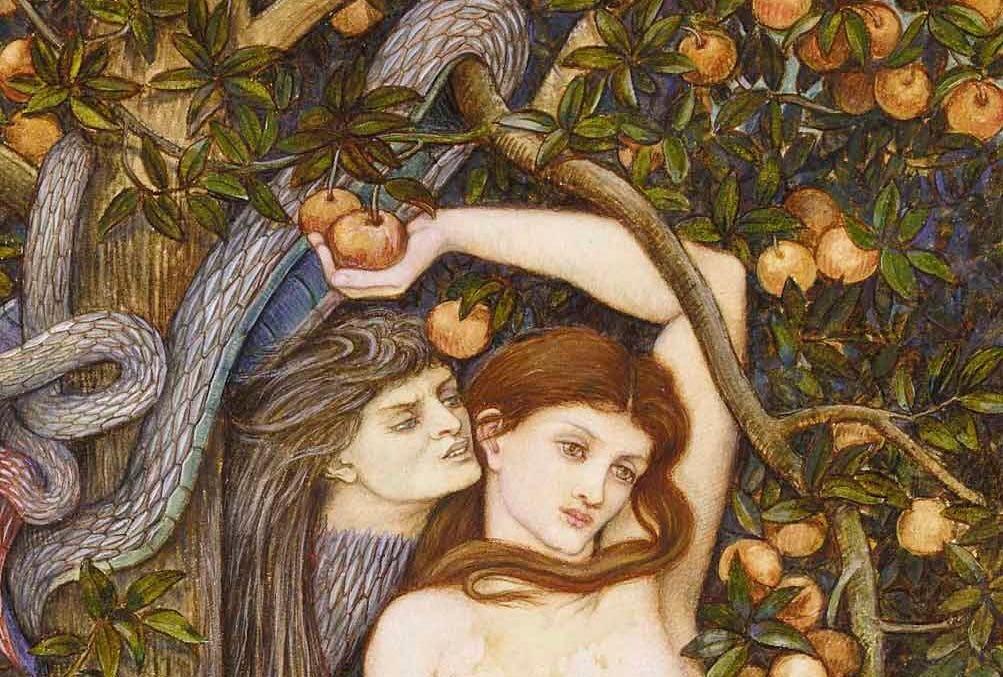
Everyone knows the story of Adam and Eve: In the Garden of Eden, the serpent tempts Eve to eat an apple. She then offers it to her husband, who also takes a bite. Suddenly aware of their nakedness, Adam and Eve now cover themselves with leaves. When God finds out, he casts them out of the garden forever.
The only thing is, one part of this story is completely made up: the apple. Everyone takes it for granted that Eve ate of an apple, but the biblical text doesn’t actually specify that detail. It simply says that Eve took a bite of “fruit”.
So why, then, does everyone think she ate an apple? Why is Eve portrayed with a fig in Michelangelo’s Sistine Chapel, and with a cluster of grapes in Eastern iconography?
Does it really matter what kind of fruit she ate?
Today, we look at the history of the forbidden fruit, and what it has meant to different people throughout the world and across the ages…
We are 100% reader-supported. This newsletter is free, but if you’re able to support, please consider a paid membership — it helps us enormously. You’ll get:
Full-length articles 2x per week
The entire archive (200+ articles, essays, and podcasts)
Ancient Puns & Piety
In the original Hebrew manuscripts, the fruit Eve eats is called peri. This is a non-specific, generic word for “fruit”, and it is used to reference both literal produce and the result of one’s efforts. What most translations of Deuteronomy 28:4 render as:
The fruit of your womb will be blessed, and the crops of your land and the young of your livestock
…is actually written in the original language as:
“the fruit of your womb, the fruit of your land, and the fruit of your livestock”
So how is it that this non-generic word ever got misconstrued as an apple? The answer has to do with a play on words. In Latin, the word for apple is mālum. The line above the a (called a macron) indicates a long syllable. Without it, the word is pronounced differently, and becomes something much more sinister: malum, or “evil”.
This wordplay was simply too good for medieval theologians and artists to not use, and so it was that the apple became a visual shorthand for sin, the Fall, and forbidden knowledge. By the High Middle Ages, the imagery of the apple was dominant in art and manuscripts throughout Europe.
Centuries later, the English poet John Milton consciously pulled from this tradition while composing his Paradise Lost. By describing Eve as eating an apple, he gave new life to this medieval tradition and enshrined the imagery for good — in the English-speaking world, at least…
Figs & Fidelity (or lack thereof)
Not everyone was a fan of the mālum/malum wordplay, however. Perhaps most famously, Michelangelo rebelled against it with his depiction of Eve in the Sistine Chapel.
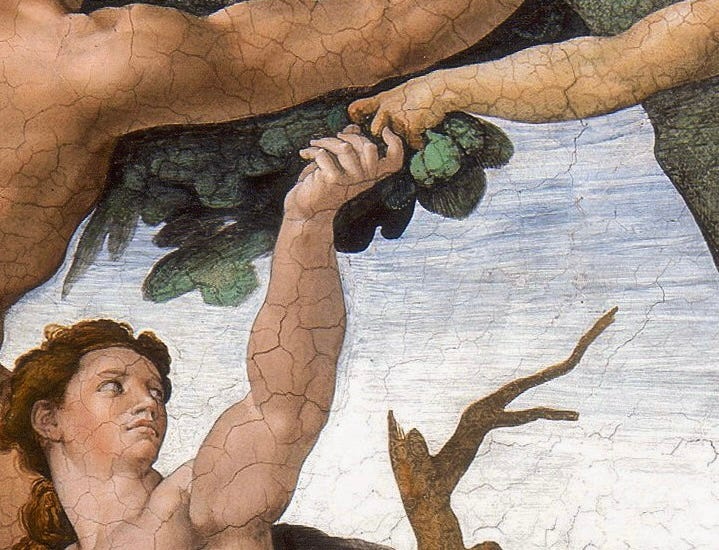
By the time Michelangelo began work on the ceiling in 1508, the apple was already a visual cliché in religious art. But Michelangelo, to his credit, cared about far more than simply avoiding clichés. As an avid student of Scripture, he knew that Adam and Eve covered themselves with fig leaves after eating the fruit. And where did they get the fig leaves? From the fig tree, of course, and perhaps the one from which Eve ate of the forbidden fruit.
Michelangelo’s portrayal of Eve with a fig emerged less from a bucking of tradition than it did from the artist’s close reading of Genesis. But as with all things Michelangelo, this did not mean it was bereft of symbolic meaning. Since figs ripen quickly and spoil easily, Michelangelo considered it the perfect fruit to represent false promises and the decay of sin.
The Vine & the Wine
In Eastern Christendom, however, things evolved very differently. Whereas Latin’s dominance in the West led to mālum/malum becoming ubiquitous, the different languages of the Eastern churches impeded such a development. As a result, depictions of the fruit in Genesis took on a unique character of their own.
Largely speaking, the fruit in question was simply overlooked. When compared to the disobedience of Adam and Eve, the detail about the specific type of fruit they ate was considered irrelevant. That said, Eastern artists and iconographers did occasionally make use of one fruit in particular.
Grapes are the fruit which most commonly appear in Eastern depictions of Genesis 3, and for good theological reason. It all begins with Jesus’s words in John 15:
“I am the vine; you are the branches. If you remain in me and I in you, you will bear much fruit; apart from me you can do nothing.”
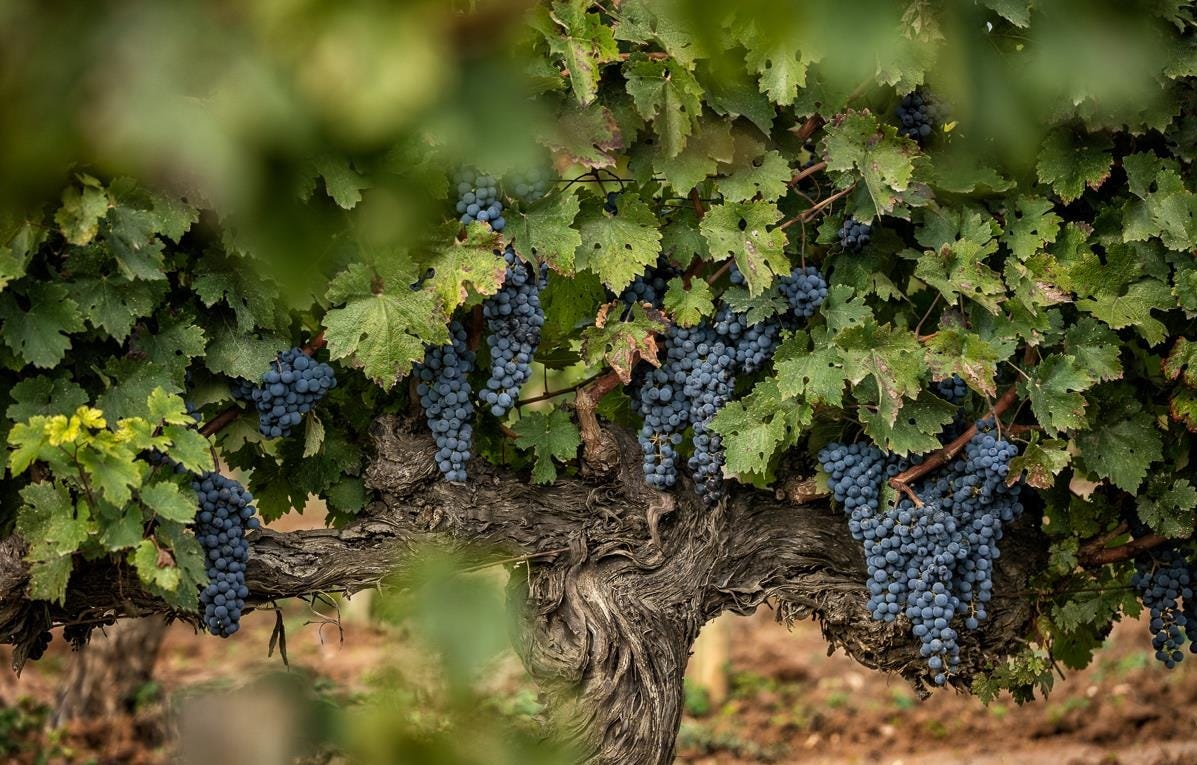
To portray Adam and Eve as having plucked a bunch of grapes from a tree is thus to show a departure from Christ as the true vine; a rupture of communion with God. But at the same time that the grapes represent man’s fall, they also point to the source of his eventual salvation — the blood of Christ as spilled on the cross:
And he took a cup, and when he had given thanks he gave it to them, saying, “Drink of it, all of you, for this is my blood of the covenant, which is poured out for many for the forgiveness of sins. I tell you I will not drink again of this fruit of the vine until that day when I drink it new with you in my Father’s kingdom.”
-Matthew 26:27-29
In light of this passage, grapes symbolize not just man’s separation from God, but also the blood of Jesus shed on the Cross and made present in the Eucharist. So even while reflecting on original sin and man’s fall from grace, the image of grapes gestures toward a future in which humanity is grafted back into the vine, and restored to full communion with God.
A forbidden fruit, but a fitting one.
What I think is interesting is how the depiction of the apple is now associated with revolutions and change. Apple records, Apple IPhones. Snow White’s Apple (which put her to sleep). And even an apple fell on Newton’s head.
Great piece; appreciate this! I'm with Michelangelo that it was a fig. In Luke 19, while the Greek for "tree" that Zacchaeus climbs is rendered a "sycamore," some translations render it a "sycamore fig" - that same scene..."the son of Man has come to seek and to save what was lost." Definitely a harkening back to Genesis...