

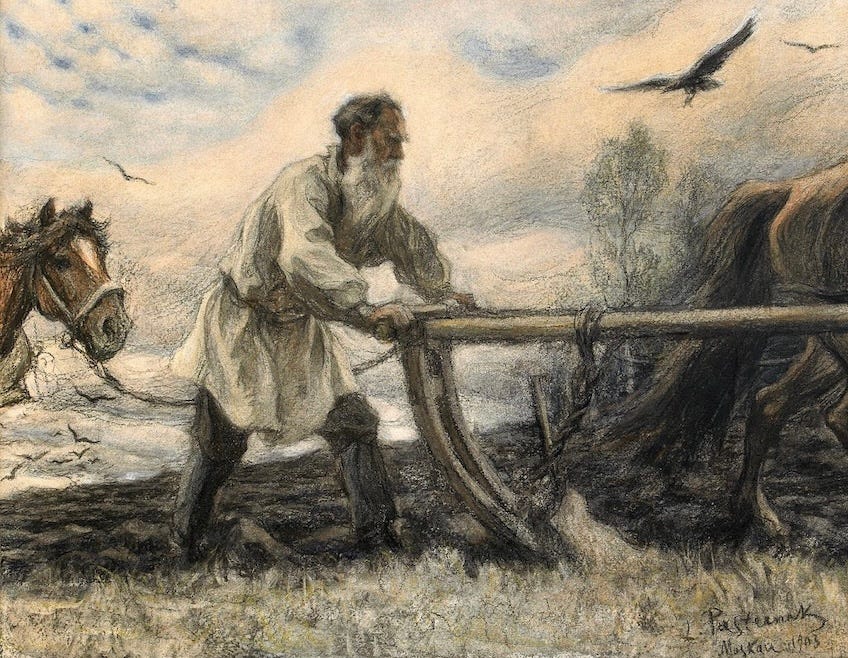
You only have one life, so how will you live it?
This is the question Leo Tolstoy asks of readers in his famous novella The Death of Ivan Ilyich. But what does a short story about death have to do with life?
According to Tolstoy, everything.
While most people think the secret to dying well is having lived a good life, The Death of Ivan Ilyich seems to suggest the opposite — that actually, the key to living a good life is knowing how to die a good death. Unfortunately, however, our culture doesn’t prepare us for death, partially because it does its best to make you forget it even exists.
But by looking back to Tolstoy, you can begin to rediscover the key to living a life of flourishing. That’s why today, we explore both the warning and wisdom of the Russian novelist’s greatest short story, so that you can live your life to the fullest and make sure it doesn’t go to waste…
Reminder: this is a teaser of our paid subscriber essays.
If you’d like to support our work, please consider a subscription. You’ll get:
New, full-length articles 2x per week
The entire archive (200+ articles, essays, and podcasts)
The Problem
In The Death of Ivan Ilyich, Tolstoy shines a light on many of the ills of high society. From performative politesse to the shallowness of a life lived to impress others, Tolstoy dissects the hypocrisy of the late 19th-century Russian bourgeoisie.
Yet the main problem he identifies isn’t confined to a time, place, or social class. Rather, he takes aim at something universal that impacts people everywhere: the fear of death.
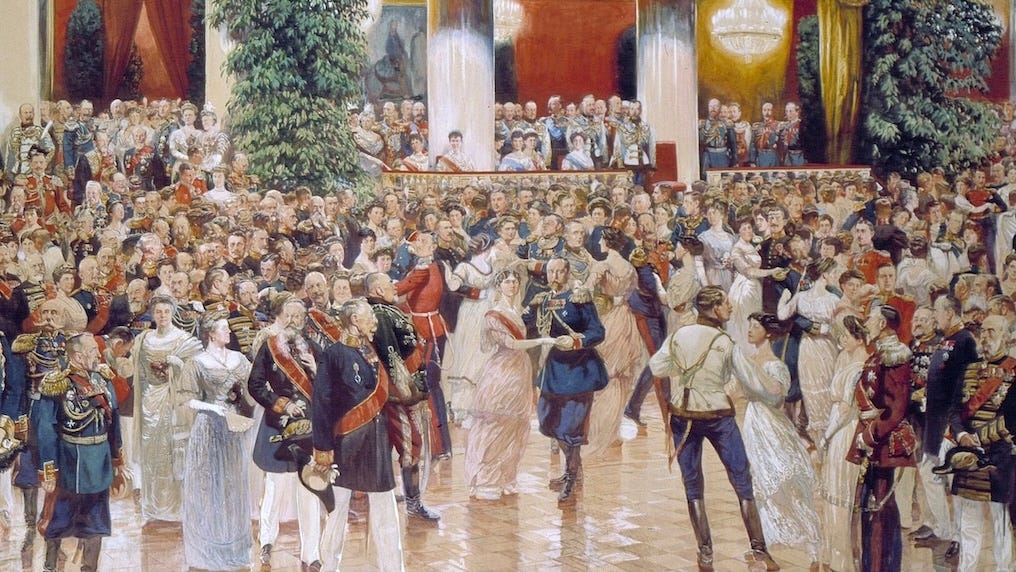
This fear, Tolstoy shows, isn’t really fear in the typical sense. While it does eventually become that for many as they age, it typically starts as something far more banal: a disconnect between theory and application. Everyone knows they will die — it is the only certainty in life — yet no one acts like it.
The Death of Ivan Ilyich shows what this disconnect looks like in practice, and what results because of it. In the first chapter, as guests attend Ivan’s wake, they are discomforted when forced to look the dead man in the face. Tolstoy paints the scene as such:
The expression on [the dead Ivan Ilyich’s] face said that what was necessary had been accomplished, and accomplished rightly. Besides this, there was in that expression a reproach and a warning to the living. This warning seemed to Peter Ivanovich out of place, or at least not applicable to him. He felt a certain discomfort and so he hurriedly crossed himself once more and turned and went out of the door — too hurriedly and too regardless of propriety, as he himself was aware.
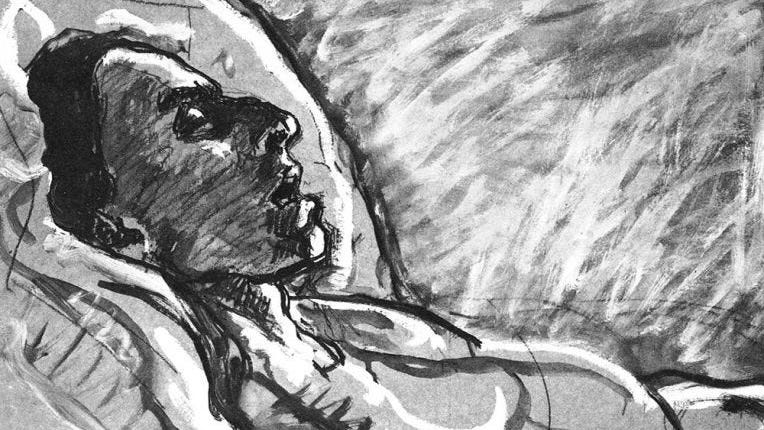
When confronted with the reality of death, the default reaction of many is to evade, ignore, and push the thought out of their minds. They simply can’t bring themselves to accept what mortality means for them. A poignant example of this latter point comes later in the novella, when Ivan Ilyich recalls what he was taught in school:
The syllogism he had learnt from Kiesewetter’s Logic: “Caius is a man, men are mortal, therefore Caius is mortal,” had always seemed to him correct as applied to Caius, but certainly not as applied to himself. That Caius — man in the abstract — was mortal, was perfectly correct, but he was not Caius, not an abstract man, but a creature quite, quite separate from all others.
He had been little Vanya, with a mamma and a papa … and with all the joys, griefs, and delights of childhood, boyhood, and youth. What did Caius know of the smell of that striped leather ball Vanya had been so fond of? … Had Caius kissed his mother’s hand like that? … Had he rioted like that at school when the pastry was bad? Had Caius been in love like that? …
“Caius really was mortal, and it was right for him to die; but for me, little Vanya, Ivan Ilych, with all my thoughts and emotions, it’s altogether a different matter. It cannot be that I ought to die. That would be too terrible.”
Such was his feeling.
According to Tolstoy, this denial of death is arguably the main issue that underlies the vast majority of our modern problems. But what does he say about how to fix it?
The Solution
In order to live life to the fullest, the first thing you have to do is come to terms with your mortality. But this means much more than mere intellectual recognition of death. The real task, Tolstoy suggests, is to have the reality of death soak into your life in such a way that it permeates your entire being — for only then can you truly begin to live.
Prolonged reflection plays a major role in this. Just like reading a classic novel, it’s not enough to skim through it once to find out what happens. Knowing the plot is like knowing in theory that you’ll die, but the real richness of literature lies elsewhere. It is in the themes that permeate a work, in the rhythm, rhyme, cadence, and meter that structure it, and in the painstakingly-wrought prose that conceals the author’s toils behind an air of effortless grace.
You can not fully comprehend a classic after just one reading; you must instead revisit it often, allowing it to sit with you for years and for decades. Likewise, you must do the same with the fact of your mortality.
There’s a reason why the stoics continually emphasize the importance of reflecting on your death. Memento mori (“remember you must die”) isn’t just a fun phrase to tattoo on your wrist, it’s a thought to spend serious time with every single day.
In the good, in the bad, in the highs and in the lows, you must remember that you will die. Only then, the stoics say, will the reality of your death begin to permeate your being and influence your actions. Only then will you begin to live.
But what does Tolstoy think this “beginning to live” actually looks like? How can you know that you’re not simply following the crowd and trudging towards death, but actively making the most of all you’ve been given?
What Tolstoy suggests in The Death of Ivan Ilyich is that to live life to the fullest, you must first let go of what you’ve been led to believe is the “proper” way to live.
This idea has been repeated by philosophers throughout history, in recent times by the likes of Soren Kierkegaard and René Girard, and it holds the key to living authentically…