

Life is full of ups and downs. Periods of motivation and success are followed by seasons where everything seems to go wrong. No matter how hard you try, you can’t break out of the funk — until one day everything starts to change, and you suddenly start winning again.
This ebb and flow of highs and lows can feel incredibly frustrating. Why does life feel like a rollercoaster; why is consistency so difficult? It’s easy to get upset at this state of affairs. But, according to C.S. Lewis, it’s exactly as God intended.
This surprising revelation comes from Lewis’s standout work The Screwtape Letters, in which a senior demon offers his nephew advice on how to lead humans to hell. What their correspondence reveals is that these ups and downs are actually part of God’s design for humanity, and that the low moments — the “troughs” — provide the best opportunities for humans to be led astray.
But that said, they also provide the best opportunity for spiritual growth. Put simply, the troughs are a double-edged sword: they can be the most dangerous for your development, yet also the most beneficial, depending on how you approach them.
Today, we dive into Lewis’s collection of demonic correspondence to learn why highs and lows are actually a good thing, why God lets the dry spells happen, and what you can do to come out of them all the stronger…
Reminder: this is a teaser of our paid subscriber essays.
If you’d like to support our work, please consider a subscription. You’ll get:
New, full-length articles 2x per week
The entire archive of content (200+ articles, essays, and podcasts)
We have just started reading Homer’s Odyssey together in our book club! The next discussion is on Wednesday, June 17, at noon ET — join us!
The Law of Undulation
Let’s begin by looking at the reasons why seasons of up and down exist, and why they’re an inherent part of human nature. This concept first comes up as the senior demon Screwtape attempts to describe to his nephew Wormwood what he terms the “law of Undulation”:
Humans are amphibians — half spirit and half animal … As spirits they belong to the eternal world, but as animals they inhabit time. This means that while their spirit can be directed to an eternal object, their bodies, passions, and imaginations are in continual change, for to be in time means to change.
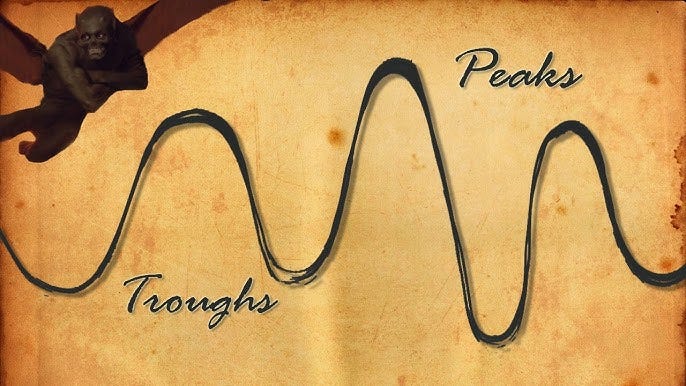
Their nearest approach to constancy, therefore, is undulation — the repeated return to a level from which they repeatedly fall back, a series of troughs and peaks.
In other words, the natural pattern of ups and downs in life is baked into what it means to be human, for humans “inhabit time” and “to be in time means to change”. Linear progress in life isn’t possible; the closest we can get to it is something approximating the ups and downs of fractal waves.
Screwtape makes it clear that this “law of Undulation” applies to all aspects of human life, reminding Wormwood that:
If you had watched your patient carefully you would have seen this undulation in every department of his life — his interest in his work, his affection for his friends, his physical appetites, all go up and down. As long as he lives on earth periods of emotional and bodily richness and liveliness will alternate with periods of numbness and poverty.
Crucially, however, these low moments — the “troughs” — aren’t inherently worse than the peaks. In fact, Screwtape reprimands Wormwood for thinking such a thing:
The dryness and dullness through which your patient is now going are not, as you fondly suppose, your workmanship; they are merely a natural phenomenon which will do us no good unless you make a good use of it.
But that said, there are specific strategies Screwtape outlines for how to tempt humans in these stages, and how to best exploit their low moments…
The Bait and Switch
One of the best ways to attack humans during their troughs, Screwtape says, is to lean into tempting them with sins of the flesh:
In the first place I have always found that the Trough periods of the human undulation provide excellent opportunity for all sensual temptations, particularly those of sex.
But the reason for this might surprise you. The reason Screwtape recommends sexual temptation isn’t because humans are more prone to lust in the troughs. In fact, it’s just the opposite: during the peak moments in life you have much more physical energy, or as Screwtape calls it, “more potential appetite”.
So why does he recommend it? The reason has to do with the fact that good pleasures are more likely to be perverted when they are embraced from a spot of exhaustion and emptiness. The example he provides to Wormwood is that of a man drinking alcohol:
The attack has a much better chance of success when the man’s whole inner world is drab and cold and empty…
You are much more likely to make your man a sound drunkard by pressing drink on him as an anodyne when he is dull and weary than by encouraging him to use it as a means of merriment among his friends when he is happy and expansive.
In other words, during the down moments of life — those in which you lack energy or hope — it is far easier to open the door to bad habits. And once you do so, the demons then compound your error with their next trick, which is to:
…make him acquiesce in the present low temperature of his spirit and gradually become content with it, persuading himself that it is not so low after all.
It’s the devilish art of bait-and-switch: make you err and despair during a momentary trough, and then convince you that state is permanent. You can succeed in leading your patient to hell, Screwtape tells Wormwood, when you “do not let him suspect the law of undulation.”
But if this undulation between peaks and troughs presents so many opportunities to lose sight of what’s good in life, why would God allow them to happen? And how can you resist temptation during the troughs?
It all begins by tackling one of the most difficult questions of all time: why would a good God feel so absent?