


Whether you like it or not, AI is here to stay. It promises to bring innovation alongside disruption, making advances for humanity while impoverishing the lives of countless humans in the process. Some believe AI will herald an explosive era of change. But in fact, it will do much more than that — it will herald in a change of era.
In this sense, the advent of AI is not unlike the Industrial Revolution of two centuries past. That revolution, just as this one, was impossible to resist. The forces and incentives that propelled its advancement were too powerful to be overcome by mere abstentionism. The question was not if you would industrialize, but how you would industrialize.
Yet none of this lessens the fact that for millions of people, the Industrial Revolution completely reshaped their experience of what it means to be human. Many, tragically, were overwhelmed by this chaos. Yet others, through their actions and resilience, were able to overcome.
The question is, how?
That is the question we seek to answer today, as we look at how you can survive in the era of artificial intelligence. Taking cues from the past, we’ll look at how you can continue to live well through a tumultuous change of era, and how — through action, not abstention — you can preserve what it means to be human.
Reminder: this is a teaser of our paid subscriber essays.
If you’d like to support our work, please consider a subscription. You’ll get:
New, full-length articles 2x per week
The entire archive of content (200+ articles, essays, and podcasts)
The Problem
One of the most immediate and obvious repercussions of AI is that it will drastically alter the landscape of the current job market. Certain professions, once thought indispensable, are now up for grabs, and not just the obvious ones. Artists, doctors, surgeons, accountants, and lawyers now face dramatically less job security than they did even just three years ago. What happens if mass layoffs come to these sectors, and to people who invested hundreds of thousands of dollars into their education and career?
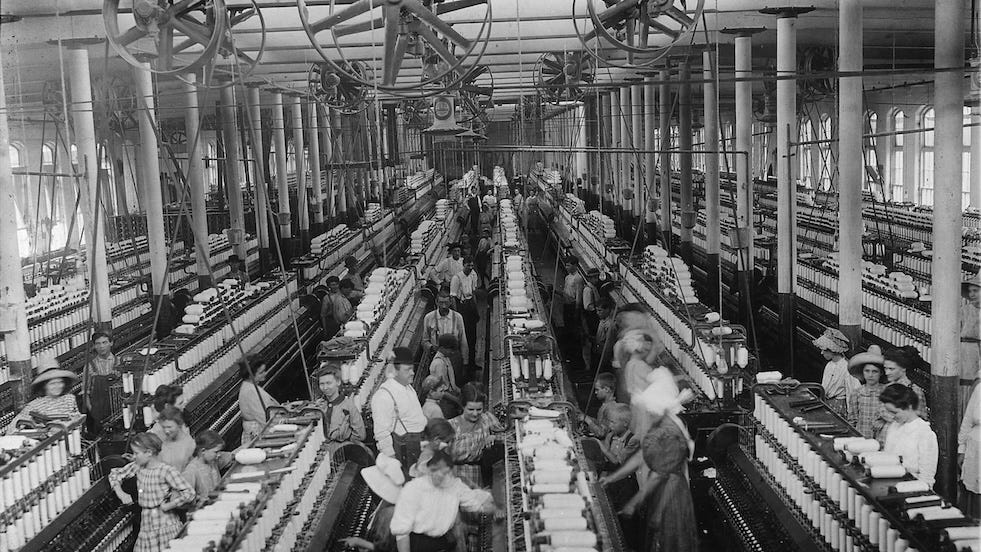
It’s not just the job market that will suffer, however. Our collective capacity for many high-level skills will gradually decline as well. When an AI translator can satisfy with 95% accuracy, for example, who is willing to pay a human one? As pay declines, fewer people will be motivated to enter the field of translation. True experts, men and women who lived for decades in a foreign land learning all its linguistic, historic, and cultural nuance, will become few and far between.
All of this, however, is rather surface-level. New technologies have always disrupted, and will continue to disrupt, the economic status quo. The place where AI really threatens to create chaos is in something far less tangible, yet far more sinister: the way you perceive reality.
Most people fear the biggest danger is that AI-generated pictures and videos will make you think something is real when it isn’t. In reality, however, it’s precisely the opposite. The real danger is that the prevalence of AI will make it so that you can’t believe anything at all. And when you don’t know what’s real, how can you ever make up your mind and act?
This is the true danger of AI. As I’ve written previously, people are hardwired to seek information that helps them better understand the world and determine their course of action in it. And when there is too little or too much information, you resort to trust.
But what happens when trust isn’t enough? What do you do when you don’t even know what is trustworthy and real?
The Solution
The answer begins by turning towards that which AI can never truly replace: the essentially human. To survive in the age of AI, you must put a premium on real things, real interactions, and real people.
This is, of course, much easier said than done. What does it actually look like in practice? Does it simply mean subsidizing those who would otherwise be put out of work by AI? Not quite, as such an approach would be both unsustainable and impractical to implement. Instead, systems must be developed not to replace what was, but to build what will be.
Fortunately, here we have the benefit of being able to look back at history, and specifically to the Industrial Revolution, to see what the people did in a similarly tumultuous change of era. Granted, AI and the Industrial Revolution are not perfect parallels, but they are/were equally unprecedented. In both instances, a change in technology results in the breakdown of pre-existing economic and social systems, leading people to radically question the meaning of life and how they ought to live.
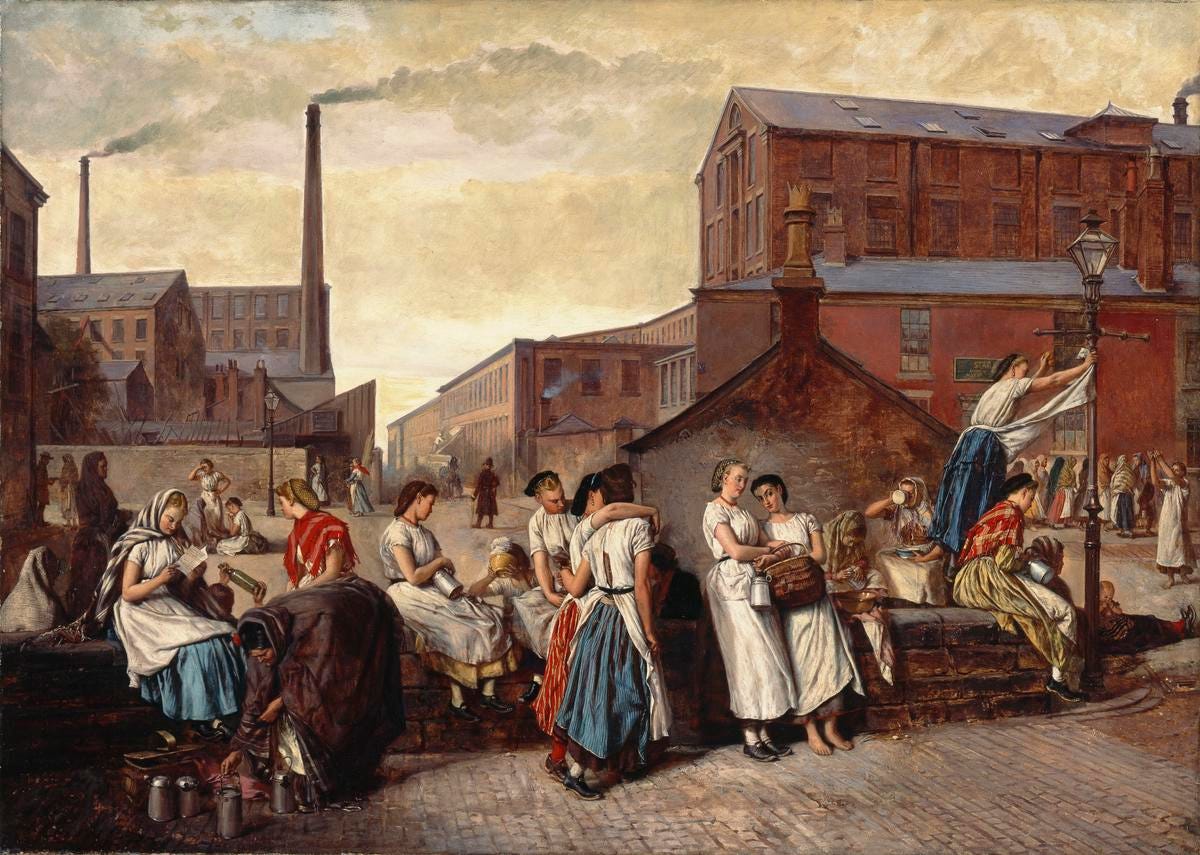
So what do we see about how people responded to such a change? First and foremost, they turned to community, forming guilds, fraternities, mutual aid societies, and other local organizations to help reconstruct a sense of belonging. Whenever they managed to find common footing with others — whether in relation to their trade, or their place of origin — they doubled down on these characteristics and built communities around them, not dissimilarly to the behavior of immigrant groups.
In many respects, those who lived through the Industrial Revolution did indeed find themselves in a “foreign” land, for it was a world that hardly resembled the one they had grown up in.
But while community is what many people turned to in order to overcome their sense of unrootedness, others went several steps further. By leaning into the most essentially “human” aspects of the human experience, they not only managed to survive the change of era, but indeed to thrive in the midst of it. They became major figures of influence in their communities, creating opportunities for others and even shaping policy on both the local and national levels.
So what did these people do to advance their own cause, while simultaneously helping others retain their dignity and humanity in a time of tumult?
And what can they teach you about finding meaning in an uncertain world increasingly dominated by AI?
Well, one answer may have to do with the monetization of beauty…