


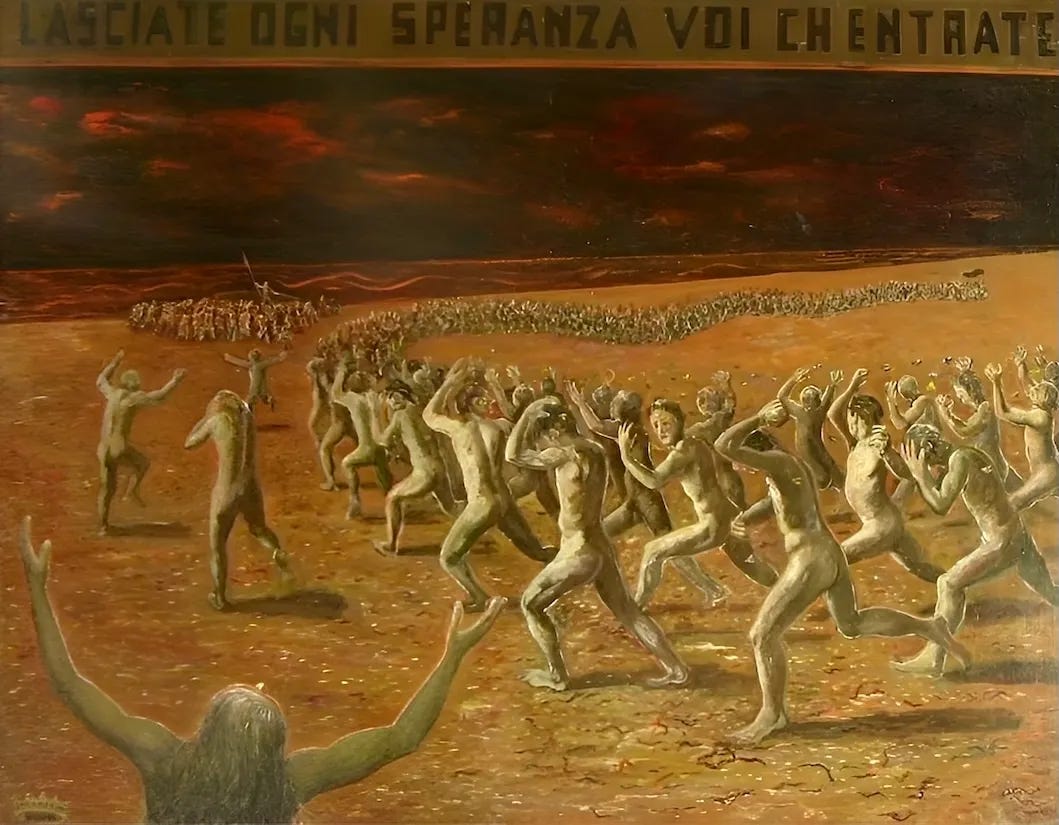
“ABANDON ALL HOPE, YOU WHO ENTER HERE.”
These are the words inscribed above the gate of Hell in Dante’s Inferno. As you pass through the gate to the other side, you expect to see scenes of untold horror, the punishment of souls confined forever to Hell.
Except that’s not what Dante portrays at all. Rather, he shows you something completely unexpected: the souls of the lukewarm, those who in life were rejected by both Hell and Heaven. They were neither “hot nor cold”, and thus are accepted by no one.
At first, this might seem like some consolation — at least they’re not in Hell! But what Dante reveals is that the worst thing you can be in life is lukewarm. He goes on to share a powerful warning against the sin of indifference, showing why you must never be “on the fence”.
What happens in the so-called “vestibule of Hell”, although overlooked by many in favor of other parts of Inferno, provides one of the most important lessons in the entirety of the Divine Comedy.
The only question is, will you heed its warning?
Reminder: this is a teaser of our paid subscriber essays.
If you’d like to support our work, please consider a subscription. You’ll get:
New, full-length articles 2x per week
The entire archive (200+ articles, essays, and podcasts)
We’re about to start reading East of Eden by Steinbeck in the book club. The first discussion is on Wednesday, August 12, at noon ET — join us!
Into the Vestibule of Hell
As soon as Dante passes through Hell’s gate, he is met by a terrifying cacophony of sound. He is now in the “vestibule of Hell”, essentially the holding area before you reach Hell proper. Awakening to the horror around him, he describes the scene as follows:
There sighs and moans and utter wailing swept
resounding through the dark and starless air.
I heard them for the first time, and I wept.
Shuddering din of strange and various tongues,
sorrowful words and accents pitched with rage,
shrill and harsh voices…
-Inferno, Canto III, v. 22-27
His mind “blinded by horror”, Dante asks his guide who these people are, and Virgil tells him that “this state of misery / is clutched by those sad souls whose works in life / merited neither praise nor infamy.” He adds that there aren’t just humans here, but angels too! They are the angels who, when Lucifer rebelled, “were for themselves alone, / not rebels, and not faithful to the Lord.”
Virgil proceeds to describe why these souls are envious of literally everyone else — including the people in Hell. At this moment, Dante suddenly glimpses the punishment lukewarm souls are forced to undergo. Spurred on by the stings of flies and wasps, they run around in pursuit of a white banner. Their blood mingles with tears as it flows off their faces onto the ground beneath them, where “loathsome maggots” gather to consume it…
Worms & Worthless Wretches
But what is the point of this punishment? And what does it reveal about the way these souls lived during their earthly lives?
According to Dante’s idea of contrapasso, each punishment in Hell is directly reciprocal to the disorder of the sin it punishes. It’s for this reason that the souls of the lukewarm are forced to march behind a meaningless banner: since they never stood for any cause in life, they must now do so in death.
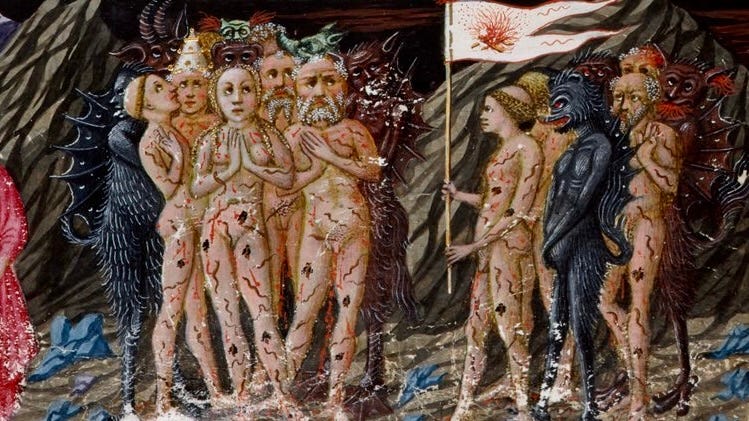
It’s the same reason why they’re spurred on by the stings of wasps and flies. Having lived for nothing in life, they evidently lack internal motivation. This is “remedied” in Hell by external motivation in the form of painful stings.
Finally, the maggots provide a damning indictment of the worthlessness of these souls’ lives. To understand why, you must consider the symbolism of blood in Christianity: Christ’s blood is shed for man’s salvation, and the blood of the martyrs is considered the seed of the Church. To bleed — whether literally or metaphorically — for a worthy cause is a great act of love, and Jesus himself declares that “greater love hath no man than this, that a man lay down his life for his friends.”
But in the case of the lukewarm, their blood merely feeds maggots. “You shall know them by their fruits”, Christ says, but the only “fruit” the lukewarm produce is nourishment for worms. It is the final condemnation Dante offers of these “worthless wretches who had never lived”.
But why is it that Dante feels so strongly about the lukewarm?
As we shall see, his animus is partially rooted in personal experience. But more than that, Dante’s hate is used to offer an urgent warning to the people of his day — and those of our own, too.
Dante makes it abundantly clear that you’re likely far more guilty of being lukewarm than you realize. But how can you tell if you’re sufficiently hot or cold? It all comes down to one simple, life-changing truth….