

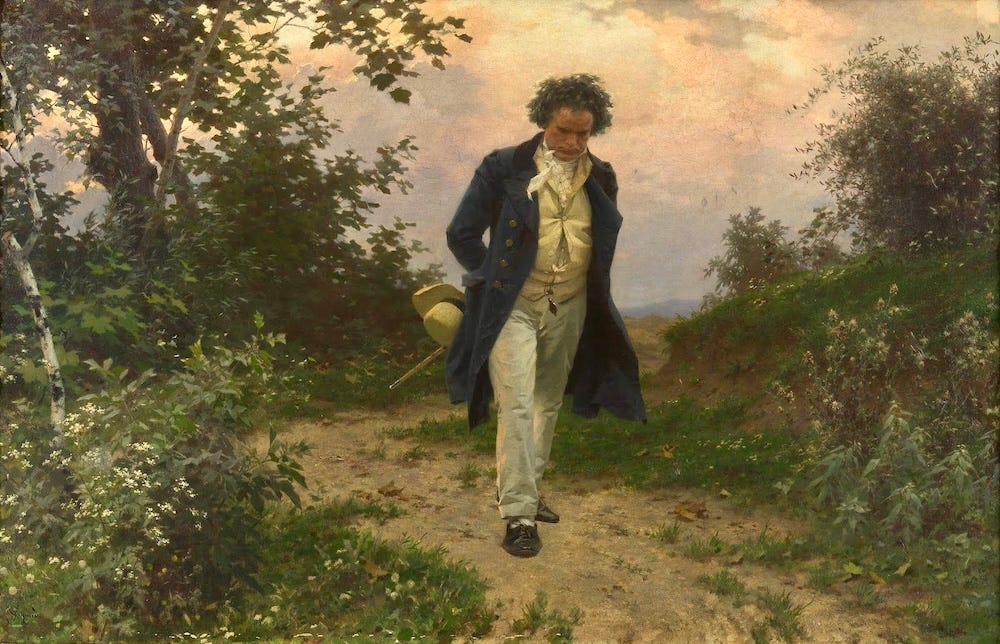
Friedrich Nietzsche once said to “never trust a thought that occurs to you indoors”. A provocative statement, for sure, but is there any truth to it?
According to many authors, the answer is “yes”. Getting outside and walking, it appears, is one of the best ways to spark your creativity and get you thinking about what really matters. Almost unanimously, history’s greatest thinkers credit walks with their biggest insights.
Thinkers from the likes of Seneca to C.S. Lewis have discussed why the humble walk is the key to greatness, and why the answer to your problems might just be a quick jaunt outdoors…
We are 100% reader-supported. This newsletter is free, but if you’re able to support, please consider a paid membership — it helps us enormously. You’ll get:
Full-length articles 2x per week
The entire archive of content (200+ articles, essays, and podcasts)
1) Seneca
We ought to take outdoor walks, to refresh and raise our spirits by deep breathing in the open air.
Even in Roman times, people understood the value of taking a stroll in the fresh air. Especially for a man like Seneca, who was simultaneously a philosopher, statesman, and playwright, being able to “refresh and raise” his spirits with a quick walk was of utmost importance to keeping him energized and mentally sharp.
The Latin phrase solvitur ambulando (“it is solved by walking”) gets at this truth directly. Have a problem? Chances are it can be at least partially remedied by a quick walk.
2) Søren Kierkegaard
Above all, do not lose your desire to walk: every day I walk myself into a state of well-being and walk away from every illness; I have walked myself into my best thoughts and I know of no thought so burdensome that one cannot walk away from it.
Seneca touches on walking’s ability to assuage the negative in your life, but Kierkegaard shows how it brings out the positive as well. This is something you might well have experienced personally: how often is it that you’ve walked yourself into your best thoughts?
One of the best aspects of walking is that it allows you to “do nothing” while still doing something, much like taking a shower or smoking a cigar. It is often in these in-between modes of doing that the best ideas come to you. The fact that walking entails movement, too, makes it all the more powerful.
3) Friedrich Nietzsche
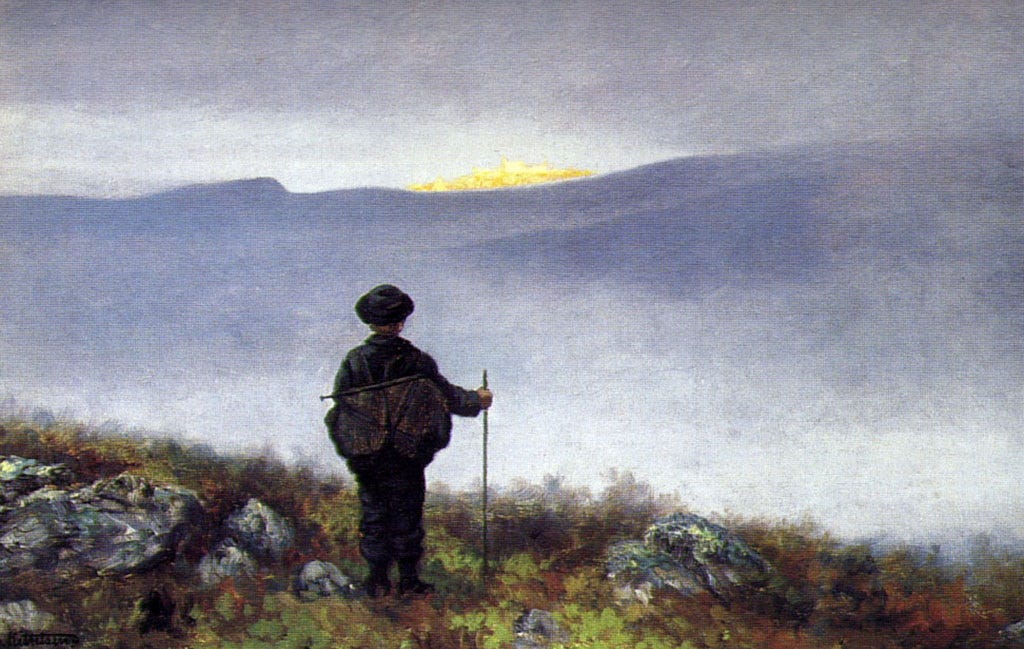
Sit as little as possible; do not believe any idea that was not born in the open air and of free movement — in which the muscles do not also revel… Sitting still… is the real sin against the Holy Ghost.
Here we get a slightly different translation of Nietzsche’s original quote, and placed in more context. For Nietzsche, the mind-muscle connection was a crucial one. He believed activity of the mind and activity of the body were intimately connected, and that it was difficult to have the one without the other.
This is why he deems sitting the “real sin”, because just as much as it is an impediment to movement, it is also an impediment to thought.
4) Ernest Hemingway
I would walk along the quais when I had finished work or when I was trying to think something out. It was easier to think if I was walking and doing something or seeing people doing something that they understood.
This one comes from Hemingway’s book A Moveable Feast, a memoir about his time living as a journalist in Paris.
Whenever Hemingway experienced writer’s block, he would descend to the paved riverbanks of the River Seine and walk until he broke through it. Taking in the sights of Paris certainly didn’t hurt, either. Careful readers will note that the importance Hemingway places on “walking and doing something” as the key to solving his problems recalls Nietzsche’s emphasis on the mind-body connection.
5) C.S. Lewis
Walking and talking are two very great pleasures, but it is a mistake to combine them. Our own noise blots out the sounds and silences of the outdoor world; and talking leads almost inevitably to smoking, and then farewell to nature as far as one of our senses is concerned. The only friend to walk with is one who so exactly shares your taste for each mood of the countryside that a glance, a halt, or at most a nudge, is enough to assure us that the pleasure is shared.
In this passage, Lewis picks up on a fresh aspect of walking: the silence and sounds of nature. For him, a walk through the countryside was infinitely more beneficial than a stroll through the city center.
From birdsongs to leaves rustling in the wind, Lewis believed the quiet rhythms and sounds of nature served to refresh and restore you more than any other. Undoubtedly, it was one of the keys to his own prolific output. Perhaps it will be the key to yours, too.
Don’t forget to join our book club!
We have just voted to read Homer’s Odyssey together, over the next 6-7 weeks. The first discussion is on Wednesday, June 3, at noon ET — join us!
Before we embark, you may want to revisit some of the articles we’ve written previously…


The first discussion is on Wednesday, June 3, at noon ET — join us!
Running does this for me every time. I work out a problem in the first mile that I couldn't solve sitting at a desk for an hour.
There's science behind it — increased blood flow to the prefrontal cortex, the part of the brain responsible for creative thinking and problem solving. The ancient Greeks figured this out without the neuroscience. They knew movement and thought belonged together.
The serendipity of two articles being published about walking on the same day! I better get walking @Adela Slo
https://adelaslo.substack.com/p/why-walking-will-save-your-life?r=3sppn&utm_medium=ios