

The study of history is about far more than rote memorization of names and dates. At its core, it is about discovering the nature of humanity itself. As C.S. Lewis once wrote, the reason we study the past is because:
…we cannot study the future and yet need something to set against the present, [in order] to remind us that the fundamental assumptions have been quite different in different periods, and that much which seems certain to the uneducated is only temporary fashion.
To study history, therefore, is to open your mind to other possibilities, to put your own time and place into context and to imagine how things could be different. But unfortunately, many modern historians actively discourage you from doing this. They prefer to filter history’s voice rather than let it speak for itself, tainting your understanding with their own political biases and modern inclinations.
Fortunately, however, there is a way around this, and it is achieved by going directly to the primary sources themselves. Forget what we think about the Ancient Greeks and Romans — what did they think about themselves?
Today, we explore the top ten ancient authors you must read if you ever want to understand Greek and Roman history on its own terms. These are the sources that didn’t just recount history, but indeed created the field of history as we know it. Read them, and you will have insight into the ancient world unlike any other…
Reminder: this is a teaser of our paid subscriber essays.
If you’d like to support our work, please consider a subscription. You’ll get:
New, full-length articles 2x per week
The entire archive (200+ articles, essays, and podcasts)
The Birth of History
We begin our guide in the mid-5th century B.C. with Herodotus, “the father of history”. Born in Halicarnassus where one of the seven wonders of the ancient world once stood, he traveled widely throughout the Mediterranean and the Near East. His major work, the Histories, documents the wars between the Persians and the Greeks — but it’s about far more than just that.
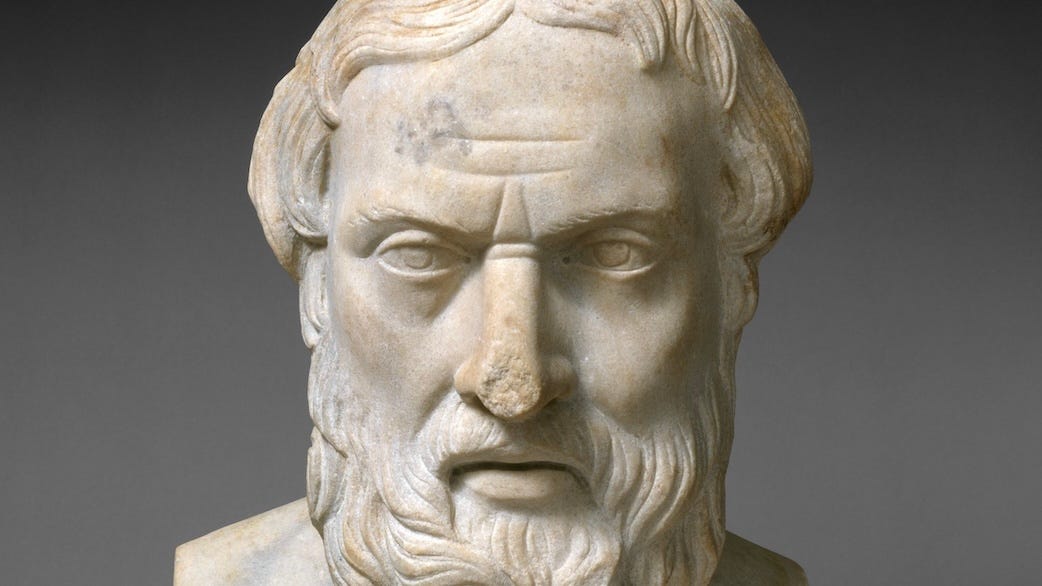
The Ancient Greek word historia (ἱστορία) means “inquiry”, and inquiry is at the heart of Herodotus’ telling of history. He collected different accounts, compared them, and weighed their credibility in order to construct a realistic narrative from the various sources. But most importantly, Herodotus also introduced the idea of causation into the telling of history, taking care to document how human decisions shape events.
His contemporary Thucydides, just 24 years Herodotus’ junior, took this human element a step further by emphasizing the political dynamics behind geopolitics. His History of the Peloponnesian War famously describes the harsh reality of power politics and treats war as a structural, recurring human phenomenon. Where Herodotus inquired into cultures, Thucydides inquired into the nature of power, and these foundational inquiries shape our understanding of history today.
But fortunately, not all of history at this stage is focused on the sweeping arc of human affairs. Xenophon, a soldier and student of Socrates, bridged political theory with lived action by documenting his campaigns in Persia. His Anabasis is a compelling account of the Greek retreat back from Babylon, while his Hellenica continues the history that Thucydides began on the Peloponnesian War.
Taken together, Herodotus, Thucydides, and Xenophon present an unrivaled glimpse into the simultaneously vibrant and violent world of Ancient Greece.
A New World Order
No civilization is immune to the tides of history, and as the star of Ancient Greece began to dim, a new power on the Mediterranean began to rise. That city, Rome, would exert more power and influence on the known world than any civilization ever had. Who better to chronicle this transition in power, then, than a Greek who lived in Rome?
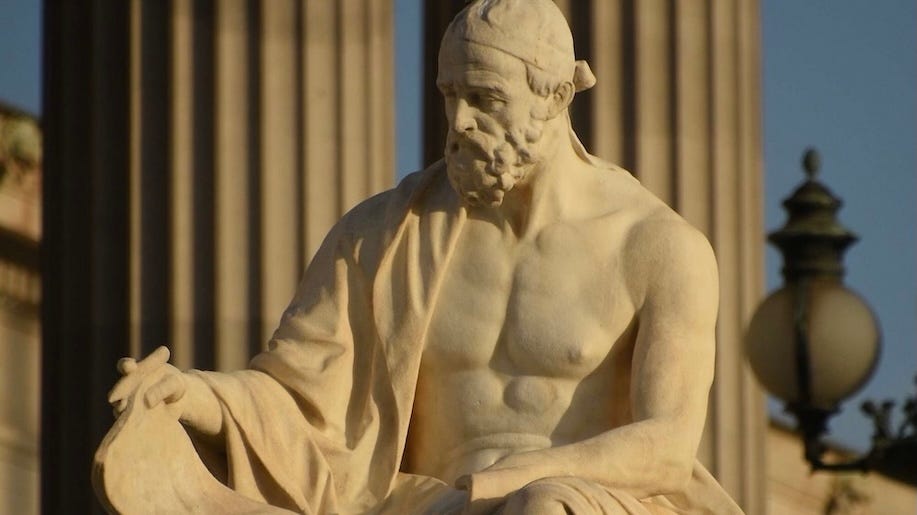
Polybius, a Greek statesman taken to Rome as a political hostage, quickly managed to endear himself to the adoptive son of Scipio Africanus just one generation after the defeat of Hannibal. That man he befriended, Scipio Aemilianus, was the Roman commander during the destruction of Carthage. As such, Polybius had unrivaled access to the men who ensured Rome’s military triumph and rise to power over its greatest Mediterranean rival.
In his account of the Punic Wars, Polybius documented the cultural and political forces that enabled Rome’s ascent. But while he was an outsider who explained Rome’s power, it would take an insider to explain Rome’s character. That man, a Roman historian writing under Caesar Augustus, comprehensively covered the history of Rome from its mythical foundings to its present day.
In his Ab Urbe Condita, the historian Livy documented the reality of civic duty as Rome’s defining strength. His accounts of Romulus and Remus, the early Kings of Rome, and even the transition from Republic to Empire show how Roman pietas shaped the minds and lives of Rome’s citizens in each stage of her development. Duty, discipline, sacrifice, and a determination to never surrender all informed the Romans’ self-understanding, and they help explain how the Romans rose to the heights of power.
But while Polybius and Livy document Rome’s ascent, the next authors explain what happens when a civilization reaches its peak.
They show the cost of corruption, war, and decadence — and, above all, how you can tell when a civilization has embarked on the road to ruin…