

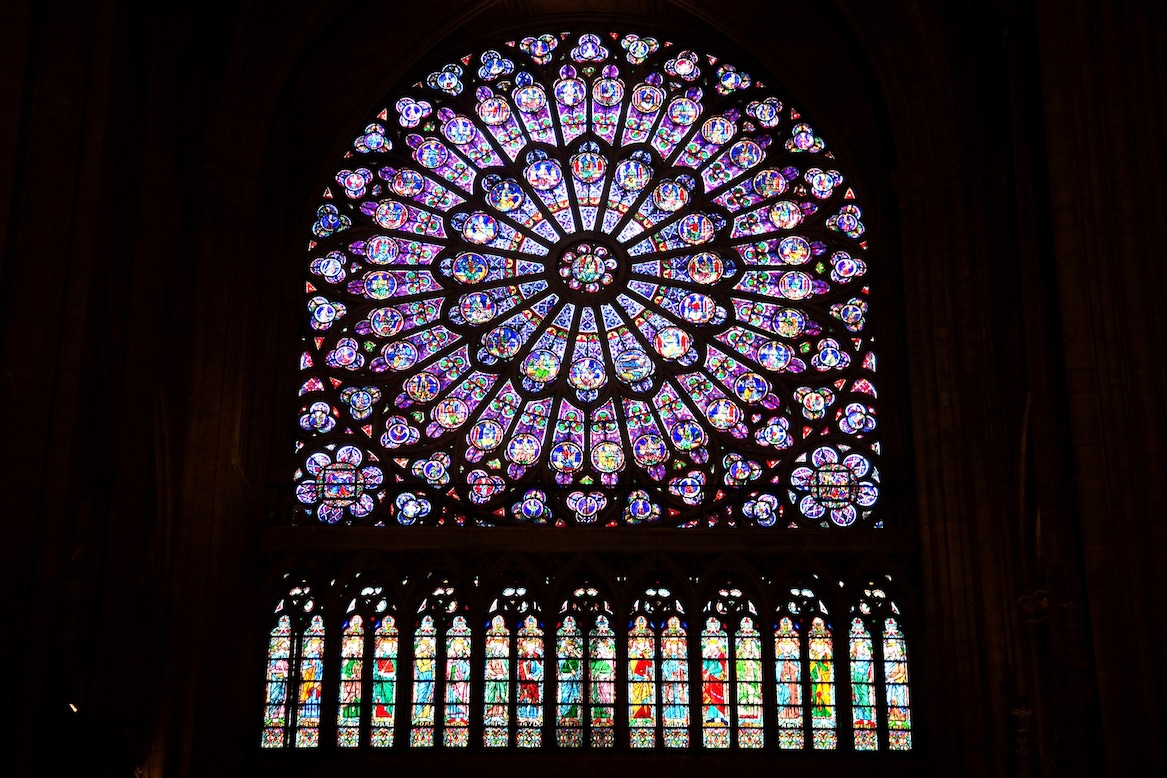
Why do we learn math in school?
Beyond our formal educational years, few of us actually use the math we once learned (to any real complexity, at least). We rarely need to integrate functions or “solve for x.”
But this is not why we learn it.
Math shapes one’s understanding of the nature of our world. It teaches us that the universe is intelligible and knowable — it has an inherent structure that can be understood by the beings living within it.
This is a truly ancient understanding, and it led to the greatest art, architecture, and even literature that we’ve ever known…
We are 100% reader-supported. This newsletter is free, but if you’re able to support, please consider a paid membership — it helps us enormously. You’ll get:
Full-length articles 2x per week
The entire archive (200+ articles, essays, and podcasts)
A Mathematical Worldview
A major contribution of the enigmatic Greek polymath Pythagoras was to intuit that the universe is governed and formulated by math.
As the legend goes, when strolling past a blacksmith’s forge he noticed that two hammers clanging at the same time sound harmonious together if one is twice as heavy as the other. Following this logic, he later realized that the length of a string is inversely proportional to the pitch of the musical note it produces. Thus, music is math, and beauty can be created by arranging things mathematically.
This understanding led Pythagoras to produce a stunning theory called the Music of Spheres (musica universalis), which states that all celestial bodies “hum” a kind of music as they move — and pitch is dependent on the mass and orbit of each body.
If music and math are essentially the same thing, what if the mathematical structure of the entire universe could also be understood as a work of music?
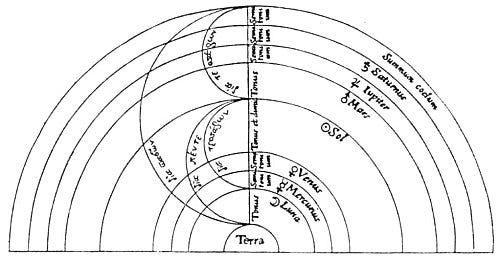
Over a thousand years later, this mode of thought lived on through medieval Europe, when music was taught alongside math as one of the four sciences.
Educators in the Middle Ages believed that each discipline of the “quadrivium” — arithmetic, geometry, music, astronomy — readied the mind (and soul) for the next discipline. And later on, music and math would become preparations for learning philosophy.
Math and music, in this sense, were understood as the tools you need to begin to contemplate truth. If the universe is inherently mathematical, then a mathematical education forms the kind of person who can see reality as meaningful. Math gives structure to your thinking, and invites you to contemplate the mystery of this reality we inhabit.
Musical Architecture
Architects of the Middle Ages drew their inspiration from the harmonic structure of the universe. In his book, The Rose Window, artist Painton Cowen demonstrates that the northern rose window at Chartres Cathedral was created by superimposing three hidden geometries: the Fibonacci sequence, a spiral of equilateral triangles, and an integration of the first two. It is a thing of wild complexity.
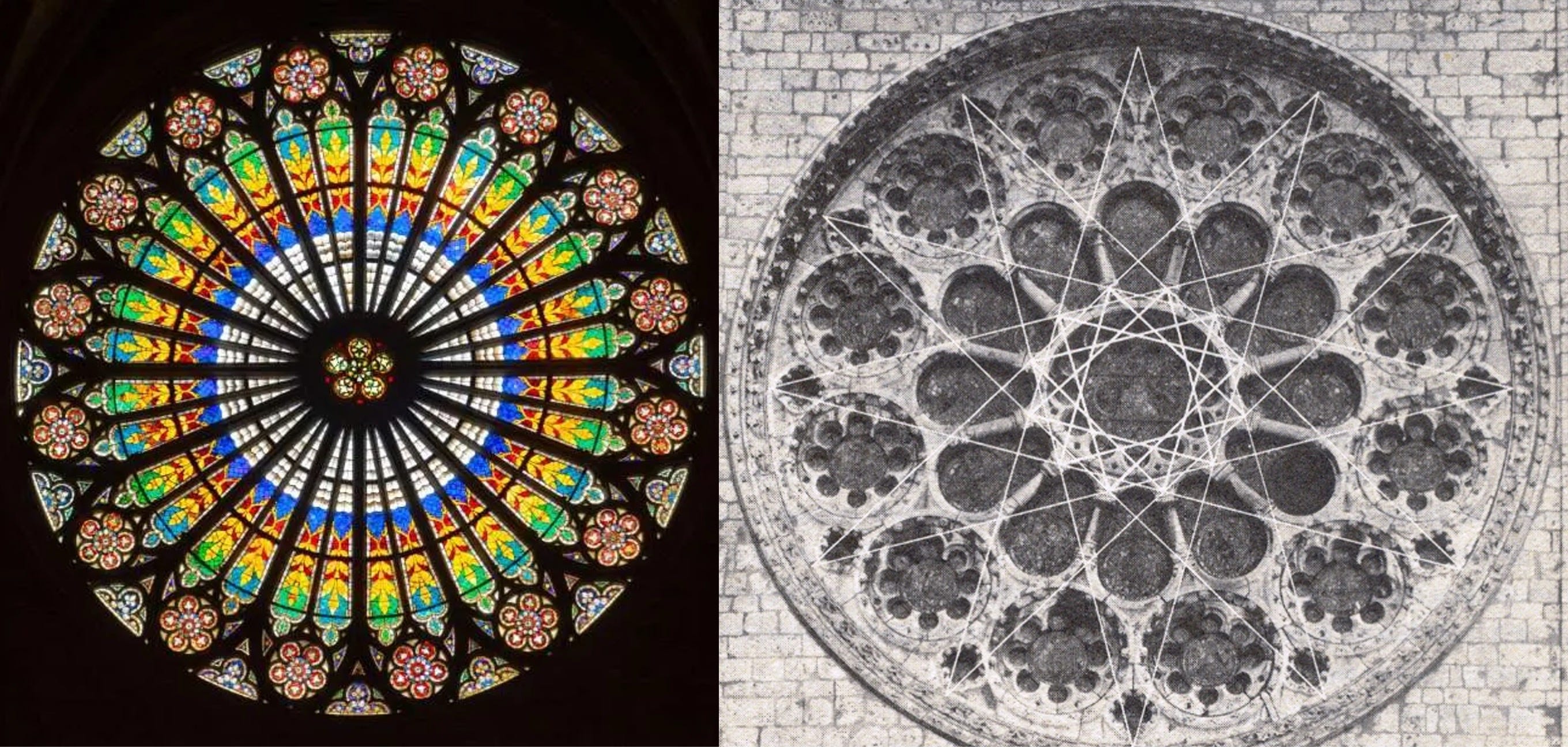
The portal was also divided into twelve segments, because the number 12 was especially meaningful to them: “the number of perfection of the universe and of the Logos.” Medieval Christians, then, layered their own sacred numerology on top of their understanding of an inherently mathematical world.
An apt criticism of architecture today would likely point out that the abstract, imposing forms of modernity are the very opposite of this idea. Rather than seeking to extract the harmonious patterns of nature, our architects produce something more like raw, individual artistry — the expression of purely inner feelings, which have not been appropriately filtered through the patterns of universal order.
The medieval architect relied on the objective, external order of the universe. The modern architect relies only on his internal feeling, and the result is that today’s built environments fail to impress us with wonder.
A much later polymath than Pythagoras, Johann Wolfgang von Goethe, astutely observed the following in the 18th century:
“Music is liquid architecture; Architecture is frozen music.”
Anyone who has taken in a wondrous rose window knows instinctively that this is true. Wherever math and symmetry are taken seriously in the visual arts, the result is something of otherworldly beauty, and it fills us with the same sense of calm that classical music does.
The Western Imagination
Where else do we see the evidence of this mathematical, musical worldview?
Well, it has seeped deeper into the Western imagination than we might first realize, and some of the greatest works of literature were also created in this understanding.
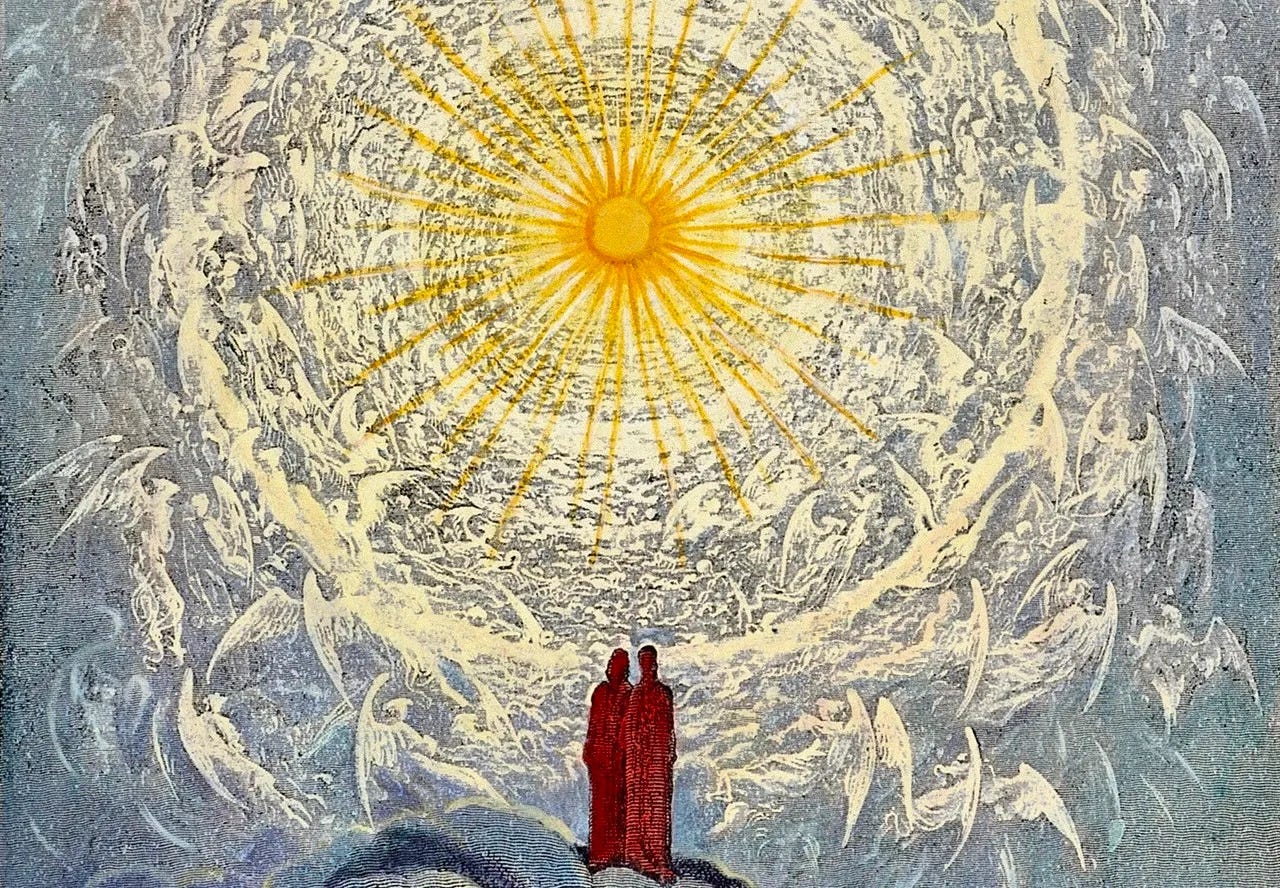
You can see the Music of Spheres in the cornerstone poem of the West, Dante’s Divine Comedy. Dante’s ascension through the heavenly spheres of Paradiso is not short of musical imagery, and we find the concentric spheres of Dante’s Heaven to be perfect and orderly. A harmonious arrangement of the blessed souls reflects this:
Differing voices make sweet music.
Just so our differing ranks in this our life
create sweet harmony among these wheels.–Paradiso, Canto 6, 124–26
By comparison, Dante’s Hell is a fractured, decaying place without strict order (we find it has literal structural damage). Hell is a ruined architecture, not a perfected one, and this reflects the chaotic disorder that is sin.
Pythagoras’s idea of the universe as a great musical composition also stretches into the great stories of modern times. When J.R.R. Tolkien’s Samwise Gamgee enters into the earthly paradise of Lothlórien, it is so beautiful that he says he feels as though he is inside a song. Tolkien’s universe is indeed a song, sung into being by the Music of the Ainur, as we read in his lore of Middle-earth.
It is no small thing that two such great sagas of the Western imagination (and many others) reflect this thinking. What if creating deeply convincing literary beauty also requires a certain re-tuning to the musical, mathematical order of things?
Hear the Music
William Shakespeare recognized that our challenge as beings of this universe is to try to hear its music and live in tune with it:
But in his motion like an angel sings,
Still quiring to the young-eyed cherubins;
Such harmony is in immortal souls;
But whilst this muddy vesture of decay
Doth grossly close it in, we cannot hear it.
Come, ho! And wake Diana with a hymn:
With sweetest touches pierce your mistress’ ear
And draw her home with music.The Merchant of Venice, William Shakespeare
“But whilst this muddy vesture of decay Doth grossly close it in, we cannot hear it.” Indeed, the universal music that Pythagoras wrote about is not audible to human ears. As Johannes Kepler said, it is “heard by the soul” instead.
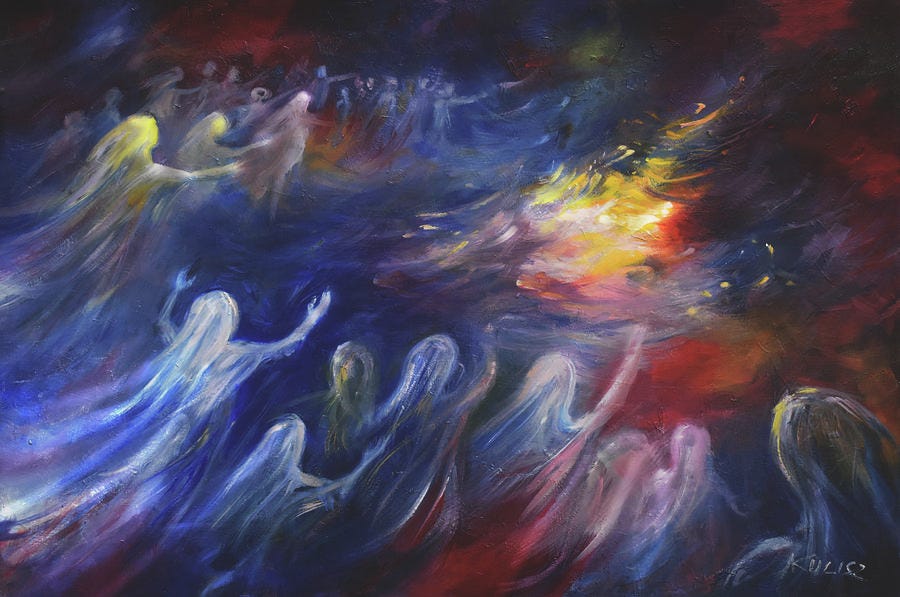
Shakespeare’s answer to the challenge of hearing it, then, is to “wake Diana with a hymn.” If we cannot hear the universal composition audibly, we must create our own earthly music that echoes the cosmic order.
Remember, math says that you are beholden to an external standard of infinite beauty and order. That means that you are not all that you could be — you can be better.
A mathematical understanding of the universe inspires an important kind of humility. This humility compels us to look to nature to provide the highest beauty, and this is what leads to our greatest artistic creations.
But this doesn’t mean that creating beauty, in music for example, is only about reflecting the objective order of the universe. The genius of Beethoven was to construct mathematically sound and harmonious compositions, yet to inject into them the unquantifiable elements of human emotion and creativity within him.
Perhaps our task is to bring both of these perspectives into balance: the objective, mathematical order of the universe, and the subjective, inner experience that can never be measured.
..and the subjective, inner experience that can never be measured.” That’s how we beat AI
Excellent inspiration for this homeschool mom to share with the children today. Let the math lessons commence!