


This past weekend, a group of French sculptors began installing a 50-foot statue of Prometheus at the Texas headquarters of Elon Musk’s SpaceX.
While the statue itself is an incredible thing to behold, no less astonishing is the practically overnight success of the group behind the project: Atelier Missor. In just a matter of months, it seems, they went from relative obscurity to erecting a statue for the wealthiest man in the world.
But what, you might ask, does any of this have to do with learning a language?
The answer has nothing to do with learning English to access American markets. No, it’s about something else entirely, and begins with the fact that Atelier Missor’s “overnight success” was anything but.
Today, we look at the benefits of learning a language in an age where technology makes translation easy, and learning (seemingly) irrelevant. Because, as we shall see, knowing a language is about far more than just knowing the meaning of words…
Don’t forget to join our book club!
We’re about to start East of Eden by John Steinbeck! The first discussion is TODAY, August 12, at noon ET — join us! The links to join are here.

We are 100% reader-supported. This newsletter is free, but if you’re able to support, please consider a paid membership. You’ll get:
Full-length articles 2x per week
The entire archive (200+ articles, essays, and podcasts)
From Vagabond to Visionary
One year ago, Atelier Missor was practically unheard of in America. But there was one place they were already immensely popular: French YouTube.
For the previous six years, Missor — the leader of Atelier Missor — had been posting videos to his YouTube channel documenting his foray into sculpture. He shared stories about his errant youth, and how beauty had called him back from the verge of meaninglessness and despair. A video entitled Je commence la sculpture (“I’m starting sculpting”) dated Jan 26, 2020 is one of his earliest videos, and is still available to watch on the channel.
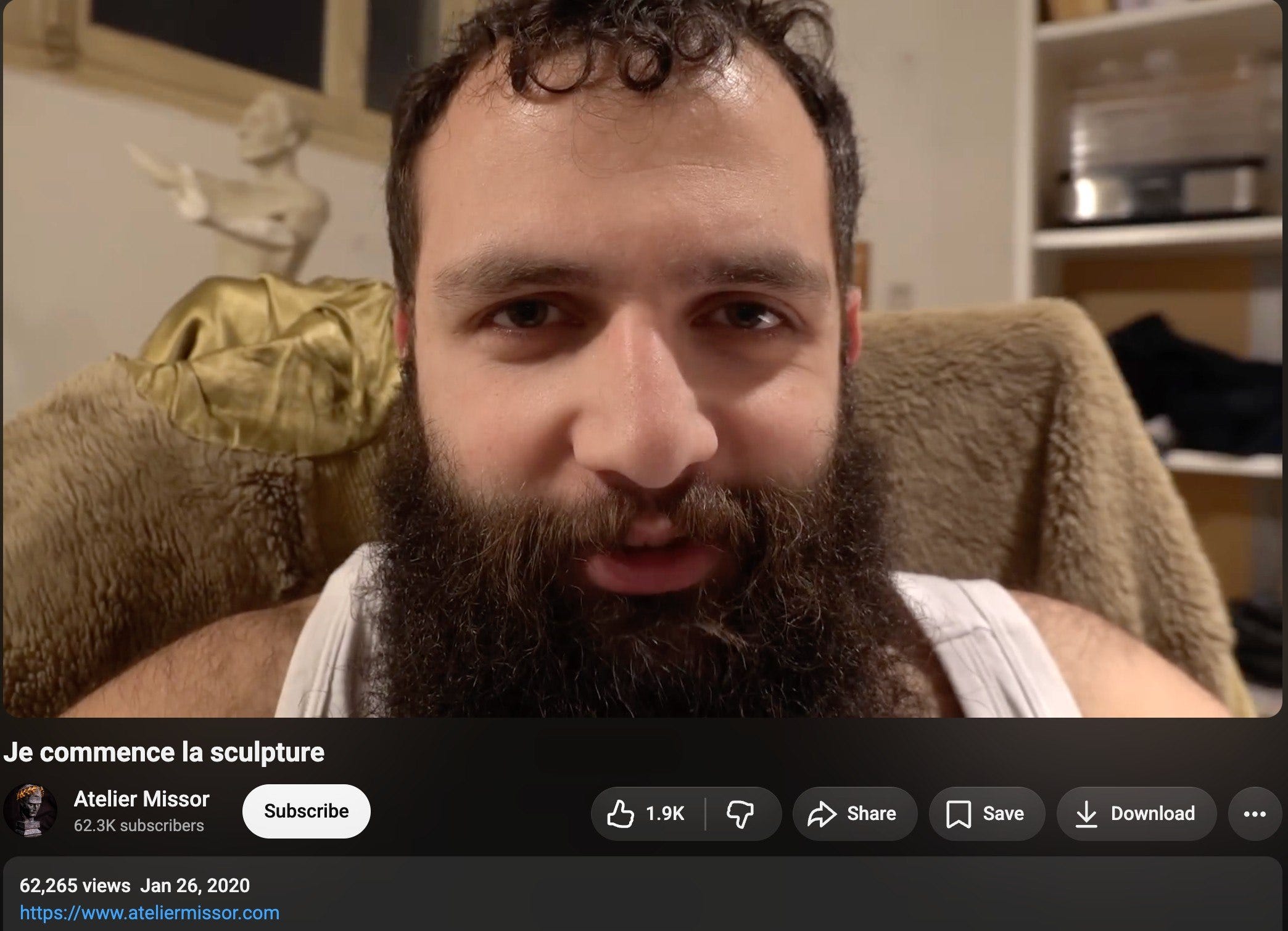
About this same time, Culturist co-founder Evan Amato was living in France. He came across Missor’s work and got connected with him to share marketing advice as the atelier began producing and selling busts at scale. Missor’s domestic base in France was growing faster than ever, and he was regularly adding new members to the team in order to keep up with demand.
Eventually, Missor pivoted away from producing busts to set his sights on something far grander. Although no one could have imagined an installation at SpaceX just yet, the seeds of ambition had certainly been planted…
Cultural Insider Trading
The point of the story is this: while Missor and his team appeared to come out of nowhere as an overnight success, they had in reality been honing their craft for nearly a decade. And crucially, anyone who was plugged into French culture could have identified their talent years before anyone in the American market did.
To illustrate the importance of this, consider the world of investing: early access to knowledge is crucial to playing the stock market, so much so that insider trading — the buying or selling of securities while possessing confidential facts that would change the stock price if known — is illegal because of the unfair advantage it confers.
But in the world of language, a different kind of “insider trading” exists: that of being able to penetrate different cultures to access their ideas and human capital. There are certainly clear examples of where this could pay off in business, or even in the world of art: it’s why, for example, we were able to partner with the painter Carl-Nikolas before his career took off. But more than that, this insider access to culture is one of the greatest “growth hacks” for your own personal development.
There are several reasons why people with feet in different worlds — whether linguistic, cultural, professional, or otherwise — often report high levels of wellbeing. One is that they are able to view both their own and other cultures from an outside perspective, and pick and choose what they prefer from each one. By intentionally synthesizing different modes of being, you can lead a life that best aligns with your values and priorities.
But you can never do this to the fullest if you don’t take time to learn a language…
The Illusion of Understanding
In the age of AI, language learning might seem a thing of the past. Six years ago, YouTube didn’t automatically translate Missor’s YouTube videos into English, but it does now. Why bother to learn a foreign language when you can translate any tweet, text, or video at the click of a button?
The problem with this line of argument is that it reduces culture and language down to a simple matter of words. But as anyone who has learned a language can attest, culture is about far more than language. Yet at the same time, it can never be fully grasped without knowing the language.
A phrase widely attributed to Nelson Mandela captures part of the ineffable magic of speaking a foreign tongue: “If you talk to a man in a language he understands, that goes to his head. If you talk to him in his language, that goes to his heart.” The reason language goes to the heart is that it conveys so much more than simply the meaning of words: it conveys shared context, cultural references, ways of being, etc.
So while AI can translate everything for you, it can never build meaningful, cross-cultural relationships. It can never tell you where hidden, up-and-coming talent is found in a faraway land, nor tell you which curiosities of one culture will be a smash hit once imported into another. All of this, at the end of the day, will remain for flesh-and-blood humans to figure out for themselves.
This, ultimately, is why you should learn another language. Precisely because AI renders translation easier than ever, it creates the illusion of understanding people and cultures who are fundamentally different from your own. There is great opportunity, therefore, for those who take time to truly learn, and truly understand.
Whether your motivation is to hop on business opportunities and cultural trends before others catch on, or simply to be exposed to other ways of thinking and living, the future belongs to those who don’t simply read about foreign worlds, but who enter and embrace them.
This is a perfect explanation of why depending on AI to translate everything for you is a terrible idea. I have cross checked Google's translations many times and its almost always so wrong that it ends up making things worse. A sterile translation from AI will never understand language and nuances the way humans do.
I was just thinking about this this very morning !