


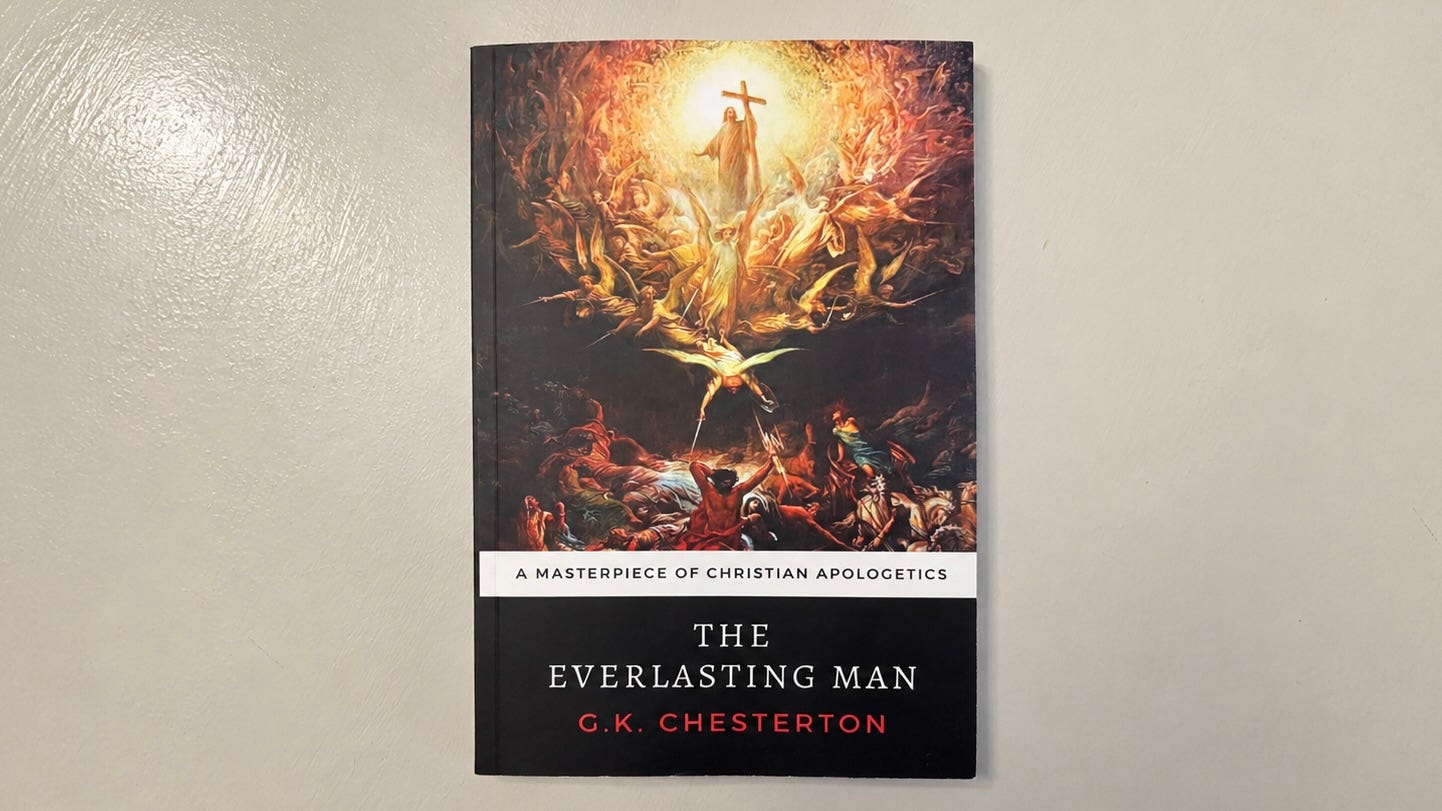
G.K. Chesterton’s The Everlasting Man is one of the most underrated books of the 20th century. It is a work of Christian apologetics, celebrated as a masterpiece precisely because it does very little in the realm of formal apologetics.
Chesterton’s argument for Christianity is not powerful because of its positive proofs, but because of what it exposes about modernity. Put simply, Chesterton helps you understand the “founding myth” of modern man — once you see it, you begin to realize that many of the so-called “self-evident truths” of contemporary society are not nearly as self-evident as they appear. For what it’s worth, C.S. Lewis once credited The Everlasting Man more than any other book with helping inspire his conversion to Christianity.
So, what is this founding myth of modernity? And why does it matter?
In short, it is the idea that mankind is steadily progressing from primitive superstition to rational enlightenment. It is by casting away this myth, says Chesterton, that you can rediscover a deeper understanding of what it means to be human.
Today, then, we’ll explore the key ideas of The Everlasting Man and Chesterton’s call to rediscover a sense of wonder at the extraordinary nature of human existence…
Come and read Chesterton with our book club!
The Everlasting Man is our December read-along. Our first LIVE discussion is on December 2 — see the reading schedule here.
Read it as a member of our book club. You’ll get:
Biweekly live discussions and weekly reading guides
New, full-length essays every week
Access to our incredible community of readers
The entire archive (200+ articles, essays, and guides)
What is a Founding Myth?
Put simply, a “founding myth” is the metanarrative that a civilization tells itself in order to establish its identity.
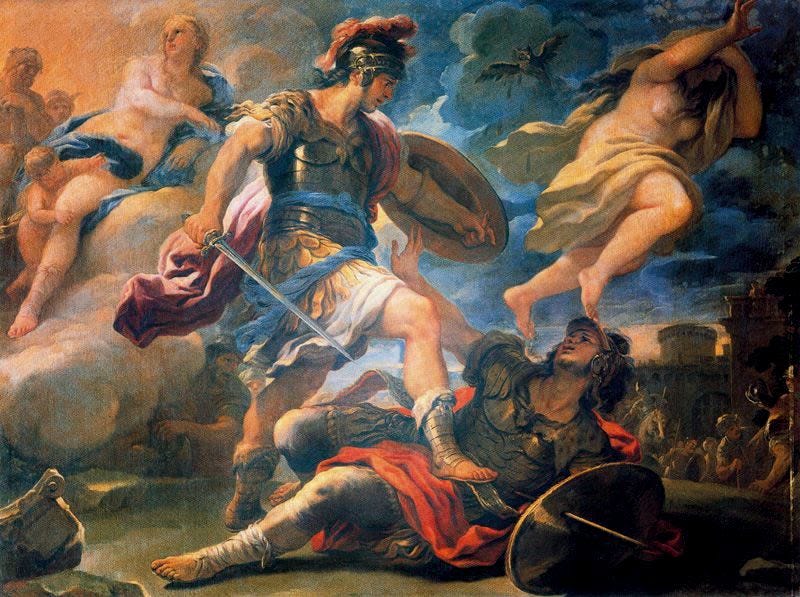
The Roman Empire, for example, embraced Virgil’s Aeneid as its foundational story. It tells the mythic tale of pious Aeneas, who obeys the decrees of the gods and lays the foundations for what would become Rome. In doing so, it taught Romans to see themselves as a people defined by duty, piety, and civic responsibility. It gave them a shared narrative and moral vision — an answer to what it meant to be Roman.
The same can be said of Homer for the Greeks, and of Christianity for later civilizations. Indeed, Tolkien famously called Christianity the “true myth” because it possesses all the structures of a great myth while being rooted in real history.
So, we may grant that civilizations of the past embraced founding myths. But the question remains: Does modernity have one?
At first glance, it sounds strange to accuse modern civilization — largely agnostic and secular — of embracing mythology. After all, few (if any) great founding myths emerged in the Western literary tradition after the time of Christ. Yet while modernity may lack formal mythologies, modern man still tells himself a story about his origins. Chesterton lays out that story succinctly in The Everlasting Man, and you can judge whether this “story” sounds familiar. To paraphrase Chesterton, modernity’s myth is thus:
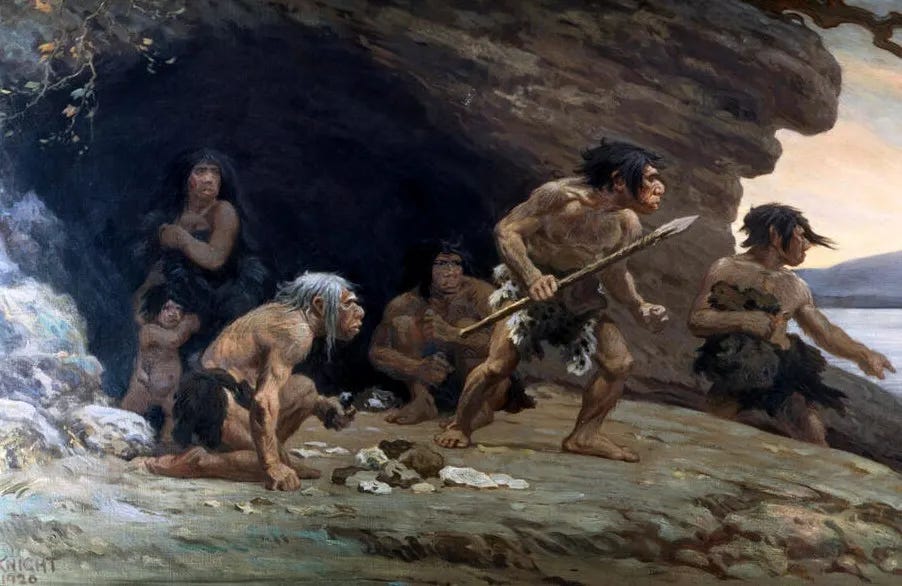
Mankind is a product of evolution who has descended from apes, and is gradually awakening into a higher state of pure rationality. Once we were cavemen — mistaking lightning for God and scratching primitive images onto stone — but over time, we’ve shed this ignorance, gained mastery over nature, and outgrown the archaic superstition of days past.
Religion, in this view, was merely a transitional phase in humanity’s ascent. In the end, mankind is expected to become fully rational, using his reason alone to master nature — thereby ushering in a utopian future free from suffering, superstition, and constraint.
Now, while this story lacks the grandeur of ancient myths, it is a founding myth nonetheless. Let’s explain why…
Modernity’s Myth
One might accuse Chesterton of being anti-science, expecting him to launch an attack upon evolution itself, but this is not his argument. Chesterton is largely indifferent to whether evolution is true or false.
His concern is not with evolution as a scientific theory, but the unscientific philosophical conclusions that are smuggled in alongside it. Notice that the “founding myth” described above is not a scientific account at all. Rather, it uses the authority of science to construct a particular narrative about mankind. This “myth” has all the features of a philosophical metanarrative, including:
A cosmogony: matter → life → mind
A fall upward: ignorance → enlightenment
A salvation arc: science → mastery → utopia
An eschaton: fully rational, liberated humanity
So, what we have is a story: one explaining man’s origins, his ultimate destiny, and how he is to make sense of his nature in light of this narrative.
At this point, a natural objection arises: mankind is a storyteller by nature. Just because we make interpretive choices about our origins and life’s purpose doesn’t mean that this “founding myth” of modernity is actually incorrect.
The answer to this objection is to simply turn it back on its accuser: the same can be said of the older founding myths. Nothing about modern science or history renders the wisdom or truth claims about human nature as expressed through religion and mythology fundamentally invalid.
To state it bluntly, science and history tell us facts about the natural world, but offer little to no guidance about metaphysics, morality, or how man is to live well. Consider, for example, a depressed office worker. A neuroscientist can show him a map of how his brain chemistry has faltered, but he cannot explain why the cushy office job has sapped his will to live, nor what can bring solace to his aching soul.
Circling back to Chesterton’s argument, the story we tell ourselves about cavemen and prehistory is not a narrative derived from science but a philosophical argument, asserted without evidence, while hiding behind scientific authority. Chesterton is not primarily concerned with whether this narrative is true or false; he wants us to recognize it for what it is — a myth. His aim is to defend the good name of science (drawing sound conclusions about nature from observable phenomena) while also rescuing philosophy and theology from corrosive skepticism. Chesterton writes:
Nobody can imagine how nothing could turn into something. Nobody can get an inch nearer to it by explaining how something could turn into something else. It is really far more logical to start by saying ‘In the beginning God created heaven and earth’ even if you only mean ‘In the beginning some unthinkable power began some unthinkable process.’ For God is by its nature a name of mystery, and nobody ever supposed that man could imagine how a world was created any more than he could create one.
But evolution really is mistaken for explanation. It has the fatal quality of leaving on many minds the impression that they do understand it—and everything else.
The Wisdom of a Child
So, what are we to conclude? What is Chesterton’s purpose in exposing the founding myth of modernity?
The danger is that this story reduces man to merely another animal, differing from the beasts only by degree. It encourages us to regard the things that make us human — our capacity for art, religion, reason, moral reflection — as incidental products of a gradual biological process, rather than clues to the mysterious and extraordinary nature of man. Indeed, Chesterton observes that the earliest human beings we can identify are already recognizably human: they made art and they wrestled with the great mysteries of life and death.
By recasting these things as primitive stages on the road to modern rationality, the founding myth explains away precisely what it ought to make us wonder at. Once these things are explained away as evolutionary impulses, we lose sight of the deeper questions they raise: What is man here for? What makes a human life worth living?
The result is a decaying intellectual tradition preoccupied with explaining the mechanics of existence but incapable of grappling with its true meaning. The answer to this, says Chesterton, is to return to the wonder of a child:
But when fundamentals are doubted, as at present, we must try to recover the candour and wonder of the child; the unspoilt realism and objectivity of innocence. Or if we cannot do that, we must try at least to shake off the cloud of mere custom and see the thing as new, if only by seeing it as unnatural.
This childlike wonder echoes the Socratic claim that wonder is the beginning of wisdom. The central problem of modernity — an age of agnostic skepticism — is that it has lost its sense of wonder. What united the high pagans of antiquity and the Christians of medieval Europe was precisely this posture: the former sought the logos, the latter sought God.
Both were united by a belief that reality was intelligible. It was permeated with Truth, Beauty, and Goodness, and proper love of these transcendentals made one’s life worth living. There is a redemptive Beauty in him who abides in Truth and Goodness despite his sufferings in this vale of tears.
The cure for small-minded sophistry, then, is great-spirited wonder, grounded in belief and love of the Good. Man learns to live precisely when he sets his vision upon things more beautiful than mere pleasure or survival.
That man has descended from apes is a scientific claim. But the reality that man cannot live off bread alone has been proven in spades — for mere survival is not the great problem in today’s Western Civilization. Rather, our great challenge is to recover meaning and a love of Truth in a modern world marred by skepticism.
Maybe modern man has lost his way, as Chesterton supposes. And though we may be skeptical about religion, God, or a greater meaning to life, he would humbly implore us to be skeptical of our skepticism. Indeed, it is not rational that man live by rationality alone…
Thank you for reading!
And please do read The Everlasting Man with our group in December if you can. It is a life-changing book. You can find our reading guide for Week 1 of 4 here.
To join our book club and take part in the discussions, you just need a premium subscription to our publication — you’ll start receiving all the invite links and reading guides automatically:
If you have any questions on how the book club works, feel free to respond to this email, or check out the FAQs page here:
How to Join Our Book Club

We recently launched our book club and have been amazed by the response. In our age of distraction and outrage, there is so much enthusiasm for simply going back to basics and reading the great books again.
P.S. If you think a friend or family member might also enjoy being part of our book club, you can now send gift subscriptions!
Share our search for Truth, Goodness, and Beauty with them, too:
The founding myth approach is a brilliant way in, and you've absolutely nailed my favorite line, the one about shaking off mere custom and seeing it as new (if only by seeing it as unnatural).
It also made me think of the caves that were discovered after he wrote (Lascaux in 1940, Chauvet in 1994), which in fact make his point about early art even stronger than he could have possibly imagined.
Thank you for recommending this book. I didn't know it at all. I read Chesterton's "Father Brown" tales.