


Few topics are as controversial as AI. For some, it is the harbinger of a new utopia; for others, of the apocalypse. Debate rages over whether artificial intelligence will save or destroy humanity — so where does the truth lie?
“Somewhere in the middle” is an attractive answer, but one that misses the point entirely. This is because the truth about AI isn’t simply the average of its pros and cons. Rather, it is a double-edged sword. In other words, the critics and proponents of AI are both largely right.
But what does this mean in practical terms? On the one hand, it means that the dangers of AI, and specifically those dealing with its impact on your own mental and relational capacities, cannot be overlooked. On the other, it means that AI does genuinely present a revolutionary new opportunity to improve your life and make the world a better place. But everything hinges on how you use it.
Today, we take a bird’s-eye view at the pros and cons of AI to help you better understand which aspects of it threaten to destroy your humanity, and which aspects might enhance it. The next decades, if not centuries, of human life will be defined by how you choose to engage (or not) with AI right now in the present.
Whatever you do, you can’t afford to get this wrong…
Don’t forget to join our book club…
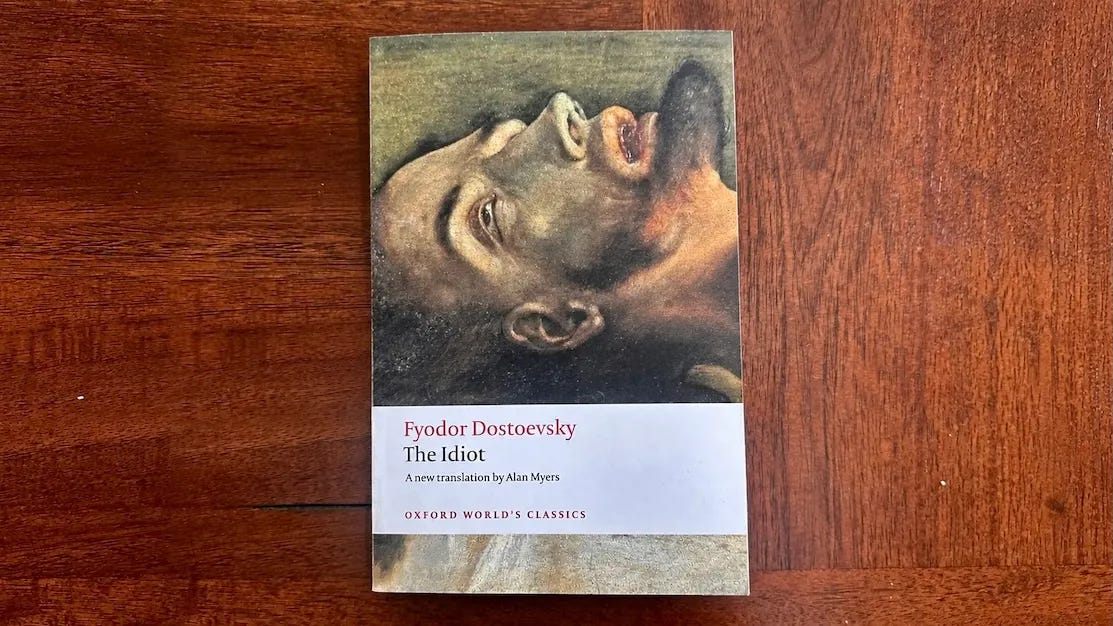
We’re reading Dostoevsky’s The Idiot together over the next 6 weeks!
The next discussion is on October 7. Watch back the first session here.
We are 100% independent, funded only by our incredible community. Become a paid member and get:
New, full-length essays like this one every week
Access to our biweekly book club and reading guides
Access to our incredible community of readers
The entire archive (200+ articles, essays, and podcasts)
The Atrophy of Thought
Let’s begin by addressing the negative aspects of AI, many of which will be familiar to our readers. For this, we’ll focus mainly on the ways AI use affects you personally, as we previously discussed broader societal impact like job loss and decreased trust in our article comparing AI and the Industrial Revolution.
The most immediate personal impact of AI is an atrophy of thinking. This is abundantly clear in the scientific literature, as even at this early stage, studies repeatedly show that increased use of generative AI correlates with a decline in critical thinking skills.1 Just as your muscles atrophy when they go unused, so too do your cognitive abilities.
A large reason for this is that, just as muscle growth occurs via the tearing and regrowth of muscle fibers (weightlifting tears the fibers, rest allows them to regrow), learning happens only when your brain faces genuine difficulty. Simply reading an analysis of Plato doesn’t mean you retain the knowledge; rather, you must actually wrestle with his ideas in order to fully understand them. This phenomenon has been labeled by neuroscientists as “desirable difficulty,” and is a prerequisite not just for learning, but for the development and maintenance of your critical thinking skills.
But what’s more, AI use also correlates with increased homogenization of output. To put it another way, it results in a leveling out of the unique qualities that make you you. A 2025 study, for example, revealed that “while LLMs can produce creative content that might be as good as or even better than human-created content, their widespread use risks reducing creative diversity across groups of people.”
But what does this actually mean? In practical terms, it is not dissimilar to findings on the nature of human beauty. When researchers combine pictures of different faces into a single composite image, for example, people generally find the resulting “average” face more attractive than the individual faces from which it was made. However, that composite never competes with faces people deem “exceptionally attractive”, because the most attractive faces have features that depart significantly from the mean.
With AI, this phenomenon is much the same: it allows you to produce work that is better than the population average, but which is too homogenous to ever stand out as something truly exceptional. It takes into account none of your unique background, interests, or forms of expression. Throw Tolkien and Hemingway into a blender, and the result is not a superior third author, but a destruction of what makes each man’s unique style his own. Generative AI does the same to your own human touch, which leads us to our next point…
The End of “Friction”
In a previous article, we explored how and why, for many people, AI is replacing God. To be fair, most people are completely unaware of the ways in which they render to their unassuming chatbot friend the status of divinity. Yet their deference to AI’s output reveals a form of reverence previously reserved exclusively for the Godhead.
If AI is already beginning to replace the relationship between God and man, therefore, how much more will it replace the relationship between fellow men? While it is true that the comprehensive access to knowledge that AI offers makes it a powerful tool, human relationships are not built by efficiency. They are instead built through adversity, confronting a mutual enemy and carrying a shared burden.
This dynamic manifests in any relationship that asks “how do we solve this problem?”, and can look like high-school students studying for a test, SpaceX engineers designing a rocket, or parents helping their child figure out how to deal with a bully. In any case, progress is almost never linear: heated debates rage as to the best course of action, and feelings are often hurt along the way. But as these hurdles are overcome, relationships are formed and strengthened.
In this regard, one of the greatest dangers of AI is that, in presenting you with an outlet to voice and resolve your problems in private, it deprives you of the friction necessary for human relationships to thrive. What’s more, it trains you to perceive that friction as a problem (as opposed to a normal element of humanity) whenever you encounter it in the real world. In this sense, it is definitionally dehumanizing, in that it increasingly causes you “to address or portray (someone) in a way that obscures or demeans that person’s humanity”.2
For these reasons and more, increasing numbers of people today define themselves as AI-abstentionists. They are intent on living in ways that never threaten to compromise human dignity in themselves and in others, and their contribution to the discourse on AI is invaluable.

At the same time, however, abstentionism is not the only route. Nor, perhaps, is it the desirable one. Because for many, the opportunities presented by AI actually offer the potential to create a world that is more human, not less. These extend far beyond the realm of personal efficiency and present opportunities to restructure even the most foundational economic and communal aspects of society.
If you care about making the world a better place for both you and your neighbor, these opportunities are too substantial to ignore. However, they all hinge on your ability to use AI as your servant, without it inadvertently becoming your master.
So how do you tread that fine line?
It all starts with learning to use AI to break free of institutional constraints, and use it as a tool towards winning your independence…